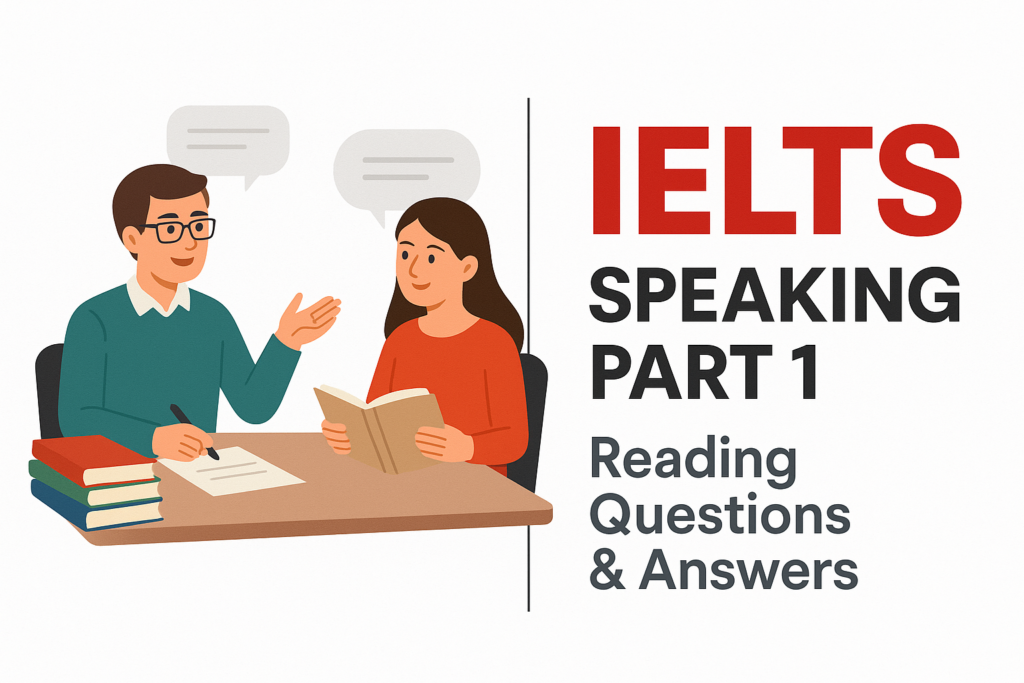
IELTS Speaking Part 1 Reading questions and answers are worth practising because reading is a familiar topic, but it can still expose weak answer habits. You may be asked what you read, whether you prefer books or online articles, how often you read, or whether your reading habits changed after school. Before you memorise a list of model answers, take the IELTS Express Pre-Test to check your current speaking band range and see whether answer length, fluency, or vocabulary is holding you back.
Part 1 is not a knowledge test. The examiner is not checking whether you are a serious reader or whether you know famous authors. The real test is whether you can answer ordinary personal questions clearly, naturally, and with enough detail. This guide gives you common reading questions, sample answers, vocabulary, mistake warnings, and a short practice routine.
IELTS Speaking Part 1 Reading Questions And Answers: What To Expect
Reading usually appears as an everyday Part 1 topic. The examiner may ask about books, magazines, news, online articles, study reading, childhood reading, libraries, or whether people in your country enjoy reading. The questions are simple, but your answers still need control.
A good Part 1 answer is normally two to four sentences. Start with a direct answer, add one reason, then give a small example if it fits. You do not need a speech. You need enough language to show fluency, grammar, vocabulary, and pronunciation.
- Answer the exact question first.
- Add one clear reason.
- Use one example from your real life.
- Keep the answer conversational, not academic.
- Stop before it becomes a memorised mini-presentation.
Why Reading Is A Useful Speaking Topic
Reading works well in the IELTS Speaking test because it connects to school, work, study, leisure, technology, and daily routines. It also lets the examiner test past and present habits. You might need to compare what you read now with what you read as a child, or explain why your habits changed.
The danger is giving answers that are too general. If every answer says “I like reading because it is interesting”, the language sounds thin. More exact answers mention what you read, when you read it, why it helps, and whether you prefer paper or digital formats.
If you want to practise under realistic timing, access unlimited IELTS mock tests and record your Part 1 answers without pausing to plan every sentence.
Common IELTS Speaking Part 1 Reading Questions
These are common question types for the reading topic. The examiner may change the wording, so practise flexible ideas rather than memorising one fixed script.
- Do you like reading?
- What kind of things do you usually read?
- Do you prefer reading books or online articles?
- Did you enjoy reading when you were a child?
- How often do you read?
- Do you read more for study, work, or pleasure?
- Do people in your country like reading?
- Do you think reading habits have changed?
- Would you like to read more in the future?
- Do you prefer printed books or e-books?
When practising, choose five questions and answer each one in 20 to 30 seconds. If an answer is only one sentence, add a reason. If it becomes too long, remove one detail.
Sample Answers About Reading Habits
Question: Do you like reading?
Yes, I do, although I read more short articles than full books these days. I usually read about work, health, or personal finance because those topics feel useful in daily life.
Question: How often do you read?
I read something almost every day, but not always for a long time. On weekdays, I usually read news or study material online, and on weekends I sometimes read a book if I have enough time.
Question: What kind of things do you usually read?
I mostly read online articles, work-related information, and sometimes novels. I like reading practical material because I can learn something quickly and use it straight away.
These answers are not complicated. They sound natural because they answer directly, give a reason, and include a small detail. That is often enough for Part 1.
Sample Answers About Books And Online Reading
Question: Do you prefer reading books or online articles?
I prefer online articles for everyday reading because they are quick and easy to access. However, if I want to understand a topic deeply, I still prefer a book because it is usually more organised.
Question: Do you prefer printed books or e-books?
I prefer printed books when I am reading for pleasure because it feels easier on my eyes. For study or travel, e-books are more convenient because I can carry many books on one device.
Question: Do you read more now than in the past?
I read more often now, but the type of reading has changed. When I was younger, I read school textbooks and stories. Now I read more online content connected with work and daily decisions.
For a broader answer-building system, read the IELTS Speaking Part 1 tips and strategies guide and compare your reading answers with the suggested Part 1 structure.
Sample Answers About Childhood Reading
Question: Did you enjoy reading when you were a child?
Yes, I enjoyed storybooks when I was young, especially books with pictures and simple adventures. I probably read more for fun then because I had fewer responsibilities.
Question: What did you read at school?
At school, I read textbooks, short stories, and some novels for class. Some books were interesting, but others felt difficult because I had to analyse them for exams.
Question: Should children read more books?
Yes, I think children should read regularly, but it should not feel like punishment. If they can choose topics they enjoy, reading becomes a habit instead of just homework.
Childhood questions are useful because they let you use past tense naturally. Keep the grammar simple and accurate. You do not need to describe your whole childhood.
Useful Vocabulary For Reading Answers
You do not need rare literary vocabulary for this topic. You need clear words that fit ordinary speaking answers. Use vocabulary that helps you be specific.
- Fiction: stories that are imagined, such as novels or short stories.
- Non-fiction: factual writing, such as biographies, history, or self-development books.
- Article: a short piece of writing, usually online, in a magazine, or in a newspaper.
- E-book: a book read on a phone, tablet, or e-reader.
- Audiobook: a recorded book that you listen to.
- Browse: to look through reading material casually.
- Skim: to read quickly for the main idea.
- In-depth: detailed and serious.
Use these words only when they fit. For example, you could say, “I usually skim news articles in the morning,” or “I prefer in-depth books when I want to understand a subject properly.” Natural use matters more than difficult vocabulary.
How To Extend Reading Answers Naturally
A simple method is answer, reason, example. If the examiner asks whether you like reading, answer yes or no, explain why, then mention one type of reading. This gives your answer shape without making it sound rehearsed.
You can also use contrast. For example, “I used to read more novels, but now I read more online articles because I have less free time.” Contrast shows grammar range and makes a simple answer more interesting.
Another useful pattern is preference plus condition. You might say, “I prefer printed books if I am reading at home, but I use e-books when I travel.” This sounds natural because real preferences often depend on the situation.
Common Mistakes With Reading Answers
The first mistake is pretending to read a lot when you do not. IELTS does not require you to be a book lover. If you rarely read books, say so honestly, then explain what you do read, such as news, websites, work messages, or study material.
The second mistake is using the same adjective again and again. Interesting is useful, but it becomes weak if every answer depends on it. Try more exact words such as practical, relaxing, informative, convenient, detailed, difficult, enjoyable, or time-consuming.
The third mistake is over-explaining. Part 1 answers should not sound like essays. If your answer has a direct answer, one reason, and one example, it is probably enough.
If Speaking is still hard to control, see our IELTS preparation plans and choose support that includes spoken feedback, not just sample answers.
A Seven-Day Practice Plan For Reading Questions
On day one, record answers to ten reading questions and check whether you answer directly. On day two, add one clear reason to every answer. On day three, practise past-tense answers about childhood reading.
On day four, practise comparison answers about books, e-books, online articles, and audiobooks. On day five, use reading vocabulary in short answers without forcing it. On day six, mix reading with other Part 1 topics so you can change topic smoothly. On day seven, record a full Part 1 practice set and write down three repeated problems.
This routine is short, but it trains the right habit. IELTS Speaking Part 1 rewards flexible control, not memorised paragraphs.
Final Checklist Before Practising Reading Questions
Before test day, make sure you can answer questions about what you read, how often you read, childhood reading, digital reading, printed books, and whether people read much in your country. Practise giving honest answers with enough detail.
You can also review the IELTS Speaking Part 1 sample answers page to compare answer length and natural wording across different topics.
The best reading answers are clear rather than impressive. Say what is true, give a reason, and add a concrete example. If you can do that smoothly, reading becomes one of the safer Part 1 topics.
Ready to find out your IELTS band score?
Take the IELTS Express Pre-Test for just $4.99 and get your personalised band prediction with a 14-day improvement plan.
FAQ: IELTS Speaking Part 1 Reading Questions And Answers
What reading questions are common in IELTS Speaking Part 1?
Common questions ask whether you like reading, what you usually read, whether you prefer books or online articles, if you enjoyed reading as a child, and whether people in your country read much.
How long should my reading answers be?
Most answers should be two to four sentences. Give a direct answer, add one reason, and include a short example if it fits naturally.
Can I say I do not like reading books?
Yes. Be honest, then explain what you do read, such as news, online articles, work material, messages, or study notes. The examiner is testing your English, not your reading taste.
Should I memorise IELTS Speaking Part 1 reading answers?
No. Prepare ideas and useful vocabulary, but avoid memorising full answers. The examiner may change the wording, so flexible answers are safer.
What vocabulary is useful for reading answers?
Useful words include fiction, non-fiction, article, e-book, audiobook, browse, skim, in-depth, practical, informative, relaxing, and time-consuming.