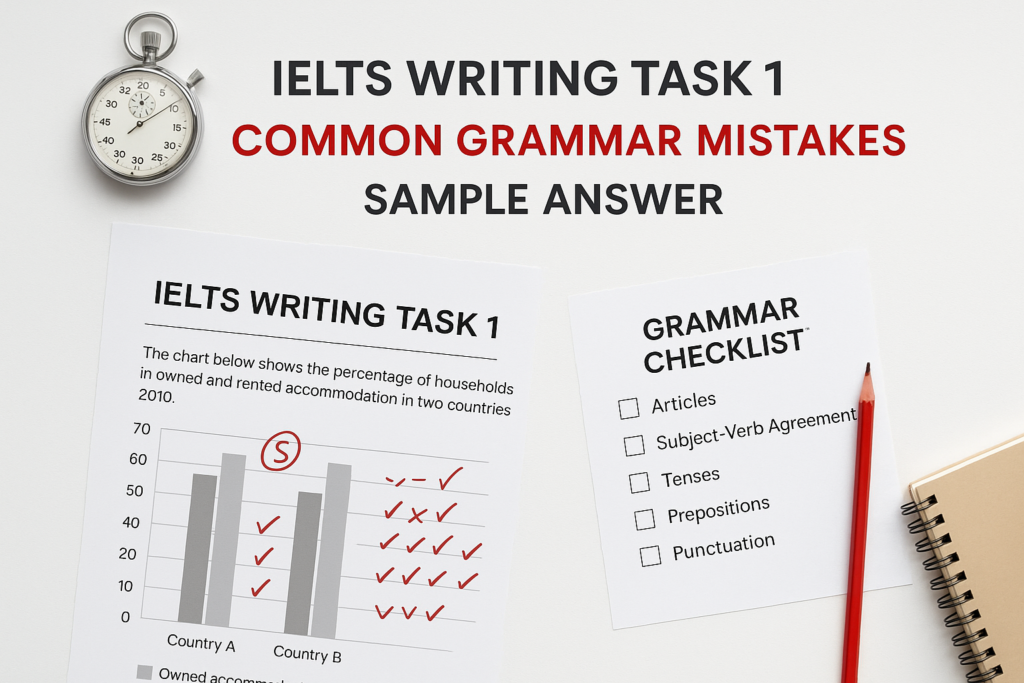
If you are searching for an IELTS Writing Task 1 Common Grammar Mistakes sample answer, you probably know that Task 1 is not only about choosing the right data. Grammar control decides whether your report sounds clear, accurate, and easy to follow. Before you practise another full report, take the IELTS Express Pre-Test to check your current band range and see whether Task 1 grammar is one of your biggest score risks.
In Academic Writing Task 1, small grammar errors can damage meaning quickly. A wrong tense can make a past trend sound current. A missing plural can make the data sound awkward. A weak comparison can confuse the reader. The good news is that most Task 1 grammar problems are predictable, so you can fix them with a focused editing routine.
IELTS Writing Task 1 Common Grammar Mistakes Sample Answer: The Main Issue
Many candidates write Task 1 reports by copying memorised sentence frames. That can help with structure, but it often hides grammar problems. The examiner is not looking for fancy sentences. They want a clear report that describes the visual accurately, compares key features, and controls grammar across the introduction, overview, and body paragraphs.
The most common grammar mistakes in Task 1 involve tense, subject-verb agreement, articles, plurals, comparison language, prepositions, sentence boundaries, and noun phrases. These are not small cosmetic issues. They affect the reader’s ability to understand what changed, which group was higher, and how the figures relate to each other.
- Use past tense for completed past periods.
- Keep singular and plural nouns consistent.
- Check every comparison for a clear object.
- Avoid joining two full sentences with only a comma.
- Edit data sentences for accuracy before adding complex grammar.
A Band-Safer Sample Task 1 Answer
Imagine a line graph showing the percentage of households with internet access in three countries between 2000 and 2020. Country A rises from 40% to 90%, Country B increases from 25% to 75%, and Country C climbs from 10% to 55%. A strong report might begin like this:
The line graph compares the proportion of households with internet access in three countries from 2000 to 2020. Overall, internet access increased in all three countries, with Country A remaining the highest throughout the period and Country C showing the lowest figures despite steady growth.
This sample introduction and overview are not complicated, but they are grammatically controlled. The verb “compares” matches the graph. The noun phrase “the proportion of households” is precise. The overview uses past meaning with “increased” and “remained”, because the period is finished. It also avoids exact figures, which keeps the overview broad.
Mistake 1: Using The Wrong Tense
Tense errors are one of the fastest ways to weaken a Task 1 report. If the chart describes 2000 to 2020, you normally need past tense. If the chart includes a future projection, you may need future forms. If the chart has no time period, present simple is usually safer.
A weak sentence is: Internet access increases in Country A from 40% to 90% between 2000 and 2020. Because the period is completed, the safer sentence is: Internet access increased in Country A from 40% to 90% between 2000 and 2020.
Another problem is mixing tenses inside one paragraph without reason. If you write “rose” in one sentence and “rises” in the next, the report feels unstable. Choose the tense based on the task period and keep it consistent. If you need repeated timed practice, access unlimited IELTS mock tests and review your grammar under exam pressure.
Mistake 2: Subject-Verb Agreement
Subject-verb agreement errors often appear when candidates use long noun phrases. A sentence may start with “the percentage of households”, but the writer treats it as plural because “households” is nearby. The real subject is usually “percentage”, so the verb must match that idea.
Weak: The percentage of households were higher in Country A. Better: The percentage of households was higher in Country A. You could also avoid the problem by writing: Households in Country A had a higher rate of internet access.
In Task 1, clarity is more important than forcing a difficult structure. If a sentence becomes hard to control, rewrite it. A simple accurate sentence is better than a complex sentence with broken agreement.
Mistake 3: Articles And Plurals
Articles and plurals are small, but they make IELTS reports sound either controlled or rough. Candidates often write “the internet access”, “a households”, or “three country”. These mistakes are easy to miss when you are focused on data.
In most Task 1 reports, you can write “internet access” without an article when speaking generally. You write “households” when there is more than one household. You write “three countries”, not “three country”. These details may seem basic, but repeated errors reduce grammatical accuracy.
A useful editing step is to circle every countable noun in your report. Ask whether it needs a plural ending, an article, or both. This takes less than one minute and catches many avoidable mistakes.
Mistake 4: Weak Comparison Grammar
Task 1 depends on comparison. You need to compare groups, figures, trends, and changes. Many candidates know words like “higher”, “lower”, “more”, and “less”, but they forget to complete the comparison clearly.
Weak: Country A was higher than Country B internet access. Better: Country A had a higher rate of internet access than Country B. Another good option is: The rate of internet access in Country A was higher than that in Country B.
Be careful with “compared to” as well. It should connect two clear items. Instead of writing, “Country A increased compared to Country B”, write exactly what you mean: Country A increased more sharply than Country B. For more data-writing examples, the IELTS Writing Task 1 sample answers page can help you see how comparisons work in full reports.
Mistake 5: Prepositions With Data
Prepositions cause frequent Task 1 errors because data language uses fixed patterns. Figures rise from one number to another. They increase by a certain amount. They stand at a certain level. They remain stable at a figure.
Weak: The figure increased from 40% until 90%. Better: The figure increased from 40% to 90%. Weak: It rose with 20 percentage points. Better: It rose by 20 percentage points.
Do not try to vary prepositions for style. Task 1 is not a vocabulary competition. The correct preposition is the best preposition. Repetition is acceptable when it keeps the data accurate.
Mistake 6: Comma Splices And Long Sentences
A comma splice happens when two complete sentences are joined only with a comma. It is common in Task 1 because candidates try to include several data points quickly. The result can feel rushed and grammatically weak.
Weak: Country A rose steadily, Country B increased more slowly. Better: Country A rose steadily, while Country B increased more slowly. You could also write two sentences: Country A rose steadily. Country B increased more slowly.
Long sentences are not automatically better. If a sentence has three data points, two comparisons, and a contrast, it may become hard to control. Split it. The examiner rewards clear organisation and grammatical accuracy, not sentence length for its own sake.
Mistake 7: Unclear Referencing
Referencing words such as “it”, “they”, “this”, and “these” are useful, but they must point to something clear. In Task 1, unclear referencing can make the reader unsure whether you mean a country, a figure, a trend, or a category.
Weak: Country A and Country B increased over the period, and it was the highest in 2020. What does “it” mean? Better: Country A and Country B increased over the period, and Country A was the highest in 2020.
Repeating a noun is sometimes better than using a pronoun. IELTS writing should be smooth, but it must first be clear. If a pronoun could refer to more than one thing, use the noun again.
Corrected Sample Paragraph
Here is a weak body paragraph: Country A increase from 40% to 90%, it was highest than the other countries. Country B was rise from 25% until 75% and Country C had the lowest, but they increased.
A corrected version is: Country A increased from 40% to 90%, making it the highest figure throughout the period. Country B also rose substantially, from 25% to 75%. Country C had the lowest rate of internet access, although it still increased steadily from 10% to 55%.
The corrected version fixes tense, comparison grammar, prepositions, sentence boundaries, and referencing. It also separates the data into three controlled sentences. The language is not overly advanced, but it is accurate and easy to follow.
How To Edit Your Task 1 Grammar In Two Minutes
After writing your report, do not reread it vaguely. Use a checklist. First, check the time period and confirm the tense. Second, check every plural noun. Third, check each comparison word and ask whether the comparison is complete. Fourth, check prepositions around numbers. Fifth, look for long sentences that need splitting.
This editing routine works because it targets the errors that appear most often. You are not trying to perfect every sentence. You are removing the mistakes most likely to confuse the reader or reduce grammatical accuracy.
If grammar mistakes keep appearing even after practice, compare IELTS preparation plans and choose support that includes writing correction. Feedback is especially useful for Task 1 because candidates often repeat the same sentence patterns without noticing the error.
A Practice Method For Grammar Control
Choose one Task 1 chart and write only the introduction and overview. Then rewrite them three times. In the first version, use very simple grammar. In the second, add one comparison. In the third, add a clearer overview statement. This trains accuracy before complexity.
Next, write one body paragraph using six figures only. Limit yourself to four sentences. This forces you to choose data carefully and prevents overloaded sentences. When you finish, underline every verb and every preposition connected to a number.
Finally, compare your paragraph with a reliable model. Do not copy the model blindly. Notice how it handles tense, comparison, and sentence length. The IELTS Writing Task 1 common mistakes guide is useful for checking whether your errors are part of a wider pattern.
Final Checklist Before You Submit
Before you finish Task 1, ask five questions. Did I use the correct tense for the time period? Did I make singular and plural nouns accurate? Did I complete each comparison? Did I use the right prepositions with numbers? Did I split any sentence that became too long?
These checks will not turn a weak report into a perfect one, but they can prevent unnecessary grammar loss. In IELTS, avoiding repeated basic errors is often more valuable than adding one impressive sentence.
The best Task 1 grammar is controlled, not decorative. Your goal is to make the data clear. When the grammar supports that purpose, your report sounds more confident and your score has a better chance of moving upward.
Ready to find out your IELTS band score?
Take the IELTS Express Pre-Test for just $4.99 and get your personalised band prediction with a 14-day improvement plan.
FAQ: IELTS Writing Task 1 Common Grammar Mistakes Sample Answer
What grammar mistakes are most common in IELTS Writing Task 1?
The most common mistakes involve tense, subject-verb agreement, articles, plurals, comparison grammar, prepositions with data, and long sentences that are hard to control.
Should Task 1 use past tense or present tense?
Use past tense when the chart describes a completed past period. Use present simple when there is no time period or when describing what the visual shows generally.
How can I improve Task 1 grammar quickly?
Practise short data paragraphs, then edit for tense, plurals, comparisons, prepositions, and sentence boundaries. Targeted editing is faster than rereading without a checklist.
Are complex sentences necessary for a high Task 1 score?
You need some range, but complex sentences must be accurate. Clear, controlled sentences are better than long sentences with agreement or punctuation errors.
Can a sample answer help me fix grammar mistakes?
Yes, if you compare the sample with your own writing and notice the grammar choices. Look at tense, comparison patterns, prepositions, and how the sample avoids overloaded sentences.