If you need an IELTS Writing Task 1 Trend Description sample answer, the key is not to describe every movement on the graph. The key is to explain the main trend clearly, choose useful data, and write an overview that proves you understand the visual. Before you keep writing practice answers without feedback, take the IELTS Express Pre-Test to check your current band range and get a focused 14-day improvement plan.
Trend description is common in Academic IELTS Writing Task 1. You may see a line graph, bar chart, table, or mixed chart where figures rise, fall, fluctuate, remain stable, or change at different speeds. A strong answer reports what happened without adding opinions, causes, or background knowledge that the graph does not show.
What An IELTS Writing Task 1 Trend Description Sample Answer Should Do
A trend description answer should summarise the main movements in the visual and support those movements with selected figures. The examiner wants to see that you can identify the big picture, group information logically, and use accurate language for change.
The answer does not need clever ideas. IELTS Task 1 is a reporting task. Your job is to paraphrase the question, give a clear overview, and then describe the most important details. If you can do that calmly and accurately, your answer already has the shape of a higher band response.
- Paraphrase the chart in one short introduction.
- Write an overview that captures the main trend or contrast.
- Group the data into logical body paragraphs.
- Select key starting points, ending points, peaks, lows, and turning points.
- Use trend language accurately, especially with prepositions and time phrases.
IELTS Writing Task 1 Trend Description Sample Answer
Here is a sample task. Imagine a line graph showing the percentage of households in one country with internet access from 2000 to 2020. The figures were 18% in 2000, 35% in 2005, 57% in 2010, 74% in 2015, and 89% in 2020.
Sample answer
The line graph shows the proportion of households in one country that had internet access between 2000 and 2020.
Overall, household internet access rose substantially throughout the period. The increase was fastest between 2000 and 2010, after which the figure continued to climb but at a slightly slower pace.
In 2000, fewer than one fifth of households had internet access, at 18%. This figure almost doubled to 35% by 2005, before rising more sharply to 57% in 2010. This means that by the middle of the period, internet access had become available in more than half of all households.
The upward trend continued in the second half of the period, although the rate of growth became less dramatic. The proportion increased from 57% in 2010 to 74% in 2015, and then reached 89% in 2020. By the end of the period, internet access was common in the vast majority of households.
Why This Sample Answer Works
This sample answer works because it reports the main story first. The overview tells the examiner that internet access increased strongly across the whole period and that the growth was faster in the first half than in the second half. That is more useful than listing five numbers without interpretation.
The body paragraphs then support the overview with selected figures. The first body paragraph covers 2000 to 2010, when the increase was strongest. The second covers 2010 to 2020, when the figure kept rising but more gradually. The structure follows the trend, so the answer is easy to read.
If you want to practise this under test timing, access unlimited IELTS mock tests and check whether your overview stays clear when the clock is running.
How To Write The Introduction
The introduction should simply restate what the graph shows. You do not need background information or an opinion. Mention the type of visual, the subject, the measurement, and the time period if those details are given.
For example, if the task says the line graph shows household internet access from 2000 to 2020, the introduction can say, “The line graph shows the proportion of households in one country that had internet access between 2000 and 2020.” This is short, accurate, and enough.
A common mistake is trying to make the introduction sound impressive. Phrases such as “the provided illustration demonstrates a dramatic phenomenon” usually sound unnatural. Plain reporting language is better because the examiner can see the meaning immediately.
How To Write A Strong Overview
The overview is the most important paragraph in a trend description answer. It should explain the biggest movement without too many details. For most line graphs, ask yourself three questions: what went up, what went down, and what changed the most?
In the sample answer, the main trend is simple: the figure rose throughout the period. The second important point is that the increase was faster from 2000 to 2010 than from 2010 to 2020. Those two ideas make a strong overview because they summarise the whole graph.
A weak overview says, “Overall, there were many changes.” That does not tell the examiner anything useful. A stronger overview says, “Overall, household internet access rose substantially throughout the period, with the fastest growth occurring in the first ten years.” That is clear and specific.
How To Choose The Right Data
You do not need to include every figure from a trend graph, especially if there are many years or categories. Choose the data that supports the main trend. Usually this means the first figure, final figure, highest point, lowest point, biggest rise, biggest fall, and any clear turning point.
In a small graph with only five figures, it is fine to include all the numbers. In a complex graph with many years, you should be selective. The examiner is not checking whether you can copy the chart. They are checking whether you can summarise it.
For more Task 1 models, the IELTS Writing Task 1 sample answers guide can help you compare how data selection changes across line graphs, bar charts, and tables.
Paragraph Structure For Trend Description
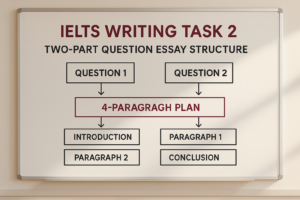
Most trend description answers work well with four paragraphs: introduction, overview, body paragraph one, and body paragraph two. This structure is simple, but it gives your answer control. It also helps you avoid mixing overview points with smaller details.
You can organise body paragraphs by time period, trend direction, or category. In the sample answer, the body paragraphs are divided into the first half and second half of the period. That makes sense because the speed of growth changed after 2010.
If a graph has two or more lines, you might organise the body by categories instead. For example, one paragraph could describe figures that increased, while the other describes figures that declined or stayed stable. The best grouping is the one that makes the main comparison easiest to follow.
Vocabulary For Describing Trends
Trend vocabulary should be accurate before it is ambitious. Useful verbs include rose, increased, grew, climbed, fell, declined, dropped, fluctuated, remained stable, levelled off, peaked, and reached. Useful nouns include a rise, an increase, a fall, a decline, a fluctuation, a peak, and a low point.
- Use “rose to” for the final number: it rose to 89%.
- Use “rose by” for the amount of change: it rose by 71 percentage points.
- Use “from…to” for a full movement: it rose from 18% to 89%.
- Use “between…and” for the time period: between 2000 and 2020.
- Use “whereas” or “while” when comparing two different trends.
Be careful with dramatic language. A figure that rises from 18% to 89% over twenty years may be described as a substantial increase. A small movement from 72% to 74% should not be called a dramatic surge.
Grammar Patterns That Improve Trend Answers
Trend answers often need past simple, present perfect, comparatives, and clauses of contrast. If the graph shows a completed past period, use past simple: the figure rose, fell, or remained stable. If the chart includes the present and continues to now, present perfect may be possible, but only when the time frame supports it.
Comparative grammar is also useful. You might write that growth was faster in one period than another, or that one category remained higher than another throughout the period. These comparisons show analysis, not just description.
Keep sentences controlled. One sentence can report one movement and one figure. Very long sentences with three dates, four numbers, and several linking phrases often create grammar errors. Clear and accurate beats crowded and awkward.
Common Mistakes In Trend Description Answers
The first mistake is missing the overview. Without an overview, a Task 1 answer can become a list of figures. This can limit the score because the main features are not clearly presented.
The second mistake is describing every year in order. If the graph has many data points, this becomes mechanical and hard to read. You should group information and highlight the important changes.
The third mistake is adding reasons that are not shown. If internet access increased, do not say it was because smartphones became cheaper unless the task gives that information. IELTS Task 1 asks you to report the data, not explain society.
If Task 1 is still limiting your writing score, compare IELTS preparation plans and choose support that includes feedback on overview, grouping, grammar, and data accuracy.
A 20-Minute Practice Method
Use the first two minutes to study the visual. Find the start, finish, highest point, lowest point, biggest movement, and any change in speed. Do not write immediately. The overview depends on what you notice before drafting.
Use the next three minutes to plan the introduction, overview, and body paragraph grouping. Then spend about twelve minutes writing. Keep the final three minutes for checking tense, figures, spelling, articles, and prepositions such as to, by, from, and between.
This routine protects your answer from panic. Candidates often lose marks because they start writing before they understand the graph. A short plan usually saves time because the body paragraphs become easier to write.
Final Checklist Before You Submit
Before you finish, check that the answer has a clear overview. Then check that the body paragraphs support that overview with selected data. Make sure you have not repeated the same trend vocabulary too often or used dramatic words for small changes.
Read the answer once for accuracy. Are the numbers correct? Did you write percentage points when needed? Did you use past tense for past data? Did you describe only what the graph shows? These checks are small, but they protect your score.
A strong IELTS Writing Task 1 trend description answer is not complicated. It is organised, selective, and accurate. Find the main trend, state it clearly, support it with useful figures, and keep your language natural.
Ready to find out your IELTS band score?
Take the IELTS Express Pre-Test for just $4.99 and get your personalised band prediction with a 14-day improvement plan.
FAQ: IELTS Writing Task 1 Trend Description Sample Answer
How many paragraphs should a Task 1 trend description answer have?
Most answers should have four paragraphs: introduction, overview, body paragraph one, and body paragraph two. This keeps the report clear and makes the main trend easy to find.
Do I need to include every number from the graph?
No. Include the figures that support the main trend. Use starting points, ending points, peaks, lows, and major changes rather than copying every data point.
What should the overview include?
The overview should describe the biggest movement or contrast in the visual. For a trend graph, mention whether figures rose, fell, fluctuated, stayed stable, or changed at different speeds.
Can I explain why a trend happened?
Only if the visual gives that reason. In IELTS Writing Task 1, you should report the data shown. Do not add outside knowledge or personal opinions.
How can I improve trend description quickly?
Practise writing overviews first, then practise grouping data into two body paragraphs. These skills usually improve Task 1 answers faster than memorising long vocabulary lists.