If you need an IELTS Writing Task 1 Comparison Chart sample answer, the main skill is not writing more data. The main skill is choosing the clearest comparisons and showing the examiner that you understand the chart. Before you spend another week practising alone, take the IELTS Express Pre-Test to check your current band range and get a focused 14-day improvement plan.
Comparison charts can look simple, but they often expose weak Task 1 habits. Some candidates list every number. Others describe one category at a time and forget the overview. A stronger answer groups the data, reports the biggest differences, and uses accurate comparison language without guessing reasons that are not shown.
What An IELTS Writing Task 1 Comparison Chart Sample Answer Should Do
A comparison chart answer should summarise the main features of a visual and compare the most important data. In Academic IELTS Writing Task 1, this may involve a bar chart, line graph, table, pie chart, or mixed visual. The answer should be clear, selective, and based only on the information given.
The examiner is looking for more than correct numbers. A good response has a short introduction, a clear overview, and body paragraphs that group details logically. The overview is especially important because it shows the main message of the chart before the smaller figures appear.
- Paraphrase the task in one sentence.
- Write an overview that reports the biggest patterns.
- Select key figures instead of listing everything.
- Compare categories directly where possible.
- Use accurate language for percentages, amounts, and changes.
IELTS Writing Task 1 Comparison Chart Sample Answer
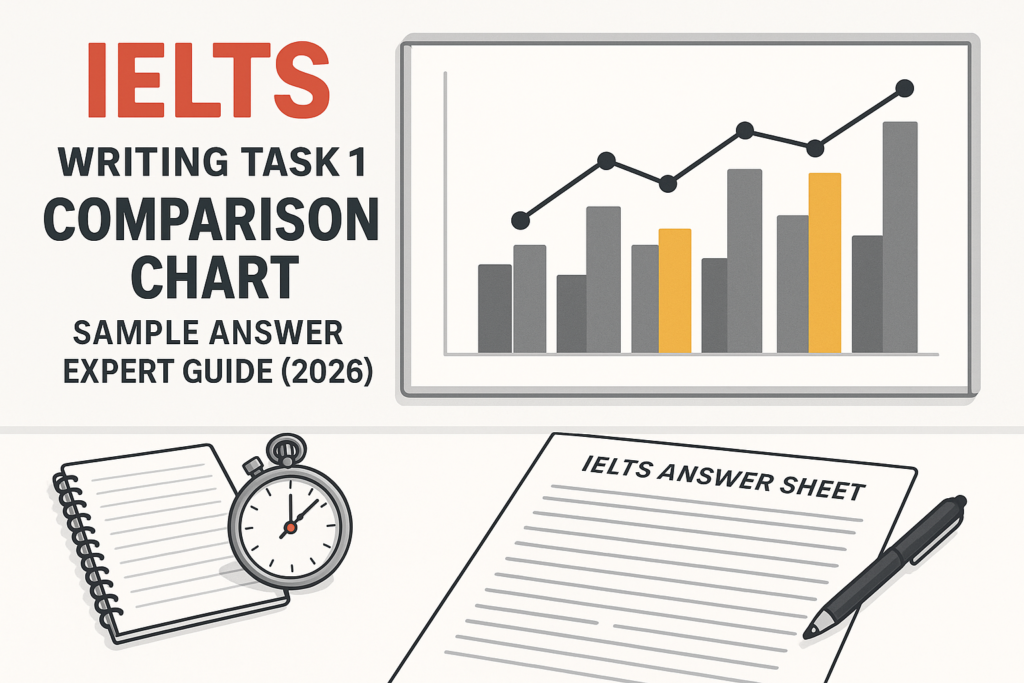
Below is a sample comparison chart task. Imagine a bar chart showing the percentage of people in three age groups who used online banking in 2010 and 2020. The age groups are 18 to 30, 31 to 50, and over 50. In 2010, the figures were 58%, 45%, and 21%. In 2020, they were 91%, 84%, and 66%.
Sample answer
The bar chart compares the proportion of people in three age groups who used online banking in 2010 and 2020.
Overall, online banking use increased in every age group over the ten-year period. The youngest group had the highest usage in both years, but the largest rise was among people aged over 50.
In 2010, 58% of people aged 18 to 30 used online banking, compared with 45% of those aged 31 to 50. The figure for people over 50 was much lower, at only 21%, which means the youngest group was almost three times as likely to use online banking as the oldest group.
By 2020, online banking had become common across all three groups. Usage among 18 to 30-year-olds rose to 91%, while the figure for the 31 to 50 group increased to 84%. The most noticeable change was in the over-50 group, where the percentage climbed from 21% to 66%. Although older users still had the lowest figure in 2020, the gap between the age groups had become much smaller.
Why This Sample Answer Works
The sample answer works because it does not describe the chart mechanically. It gives the reader the main story first: all groups increased, younger adults remained highest, and older adults had the largest rise. That is a strong overview because it covers both years and all three age groups.
The body paragraphs then support the overview with selected figures. The first body paragraph explains the 2010 position. The second explains 2020 and highlights the change over time. This structure is easy to follow because each paragraph has a clear job.
If you want to test this skill under timed conditions, access unlimited IELTS mock tests and check whether your overview stays clear when the clock is running.
How To Write The Introduction
The introduction should paraphrase the task, not copy it word for word. Keep it short. You only need to say what the chart compares, what units are used, and what time period or categories are included.
For example, if the task says the chart shows online banking use by age group in 2010 and 2020, the introduction can say, “The bar chart compares the proportion of people in three age groups who used online banking in 2010 and 2020.” This is simple and accurate.
Do not add opinions or explanations. IELTS Task 1 is a reporting task. You should not say that online banking increased because smartphones became popular unless the chart gives that reason.
How To Write A Strong Overview
The overview is the most important part of a comparison chart answer. It should describe the biggest patterns without too many numbers. In most cases, two sentences are enough.
Look for the highest category, the lowest category, the biggest change, and any clear similarity. In the sample task, the youngest group was highest in both years, every group increased, and the oldest group changed the most. Those are the ideas that belong in the overview.
A weak overview says, “Overall, there were many changes.” That is too vague. A stronger overview says, “Overall, online banking use increased in every age group, with the youngest group remaining highest and the oldest group recording the largest rise.” That tells the examiner what you actually noticed.
How To Choose The Right Data
You do not need every number in the chart. You need enough figures to support the main comparisons. If a chart has many categories, choose the highest, lowest, largest change, smallest change, and any unusual pattern.
In the sample answer, the key figures are 58%, 45%, and 21% for 2010, then 91%, 84%, and 66% for 2020. Because there are only six figures, it is safe to include them all. In a larger chart, you would need to be more selective.
For broader Task 1 practice, the IELTS Writing Task 1 sample answers guide can help you compare chart types and notice how the data selection changes.
Paragraph Structure For Comparison Charts
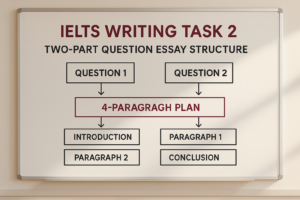
Most comparison chart answers work well with four paragraphs: introduction, overview, body paragraph one, and body paragraph two. This structure is predictable, but it is not boring. It helps the examiner find the information quickly.
You can organise body paragraphs by time, category, or trend. In the sample answer, the paragraphs are organised by year because the chart compares two time points. If the chart compared countries in one year only, it might be better to group high-performing countries in one paragraph and lower-performing countries in another.
The best structure is the one that makes the comparison easiest to read. Do not force a template if the chart clearly suggests a better grouping.
Vocabulary For Comparison Chart Answers
Comparison chart vocabulary should be accurate and natural. You do not need rare words. You need reliable phrases that help you compare data clearly.
- Use “compared with” or “whereas” to contrast two categories.
- Use “rose to” and “increased to” for final figures.
- Use “rose by” and “increased by” for the amount of change.
- Use “the highest figure” and “the lowest figure” for ranking.
- Use “respectively” only when the order is obvious.
A common mistake is mixing “to” and “by”. If usage increased from 21% to 66%, it increased to 66%. It increased by 45 percentage points. Those are not the same sentence pattern.
Grammar Patterns That Improve Your Answer
Comparison charts often need comparative grammar. Useful patterns include “higher than”, “lower than”, “almost twice as high as”, “the same as”, and “a much smaller proportion than”. Use these patterns when they are true and supported by the data.
You also need tense control. If the chart shows past data, use past tense. If it shows future projections, use language such as “is expected to” or “is projected to”. If there is no future data, do not invent predictions.
Short, accurate sentences are better than long sentences that lose control. A clear sentence with one comparison usually scores better than a complicated sentence with three figures and a grammar error.
Common Mistakes In Comparison Chart Answers
The first mistake is writing without an overview. Without an overview, the answer may feel like a list of numbers. This can limit Task Achievement because the main features are not clear.
The second mistake is describing data in the same order as the chart, even when the order is not meaningful. If the chart lists categories alphabetically, that does not mean your answer should follow the same order. Group by meaning, not by position.
The third mistake is using too many memorised phrases. Expressions such as “witnessed a dramatic growth” often sound unnatural and may be inaccurate. Use plain reporting language. The examiner rewards clarity.
If Writing Task 1 is still holding your score down, compare IELTS preparation plans and choose support that includes feedback on overview, grouping, grammar, and data accuracy.
A 20-Minute Practice Method
Use the first two minutes to study the chart and underline the biggest patterns. Do not start writing immediately. If you miss the main story at the start, the answer will usually become messy.
Use the next three minutes to plan the overview and paragraph grouping. Then spend about twelve minutes writing the answer. Leave the final three minutes to check figures, tense, articles, plurals, and comparison language.
This method feels slow at first, but it saves time because you make fewer structural mistakes. Planning is not a luxury in Task 1. It is how you protect the score.
Final Checklist Before You Submit
Before you finish, check that the answer has four clear paragraphs. Make sure the overview reports the main pattern, not a minor detail. Then check that each body paragraph includes selected data and at least one direct comparison.
Read the answer once for accuracy. Are the percentages correct? Did you write “by” when you meant “to”? Did you compare the right age groups or categories? Small errors can happen, but repeated data mistakes weaken the answer.
A strong IELTS Writing Task 1 comparison chart answer is controlled, selective, and easy to read. Find the main story first, choose the figures that support it, and write the report in a structure the examiner can follow.
Ready to find out your IELTS band score?
Take the IELTS Express Pre-Test for just $4.99 and get your personalised band prediction with a 14-day improvement plan.
FAQ: IELTS Writing Task 1 Comparison Chart Sample Answer
How many paragraphs should an IELTS Task 1 comparison chart answer have?
Most answers should have four paragraphs: introduction, overview, body paragraph one, and body paragraph two. This structure keeps the report clear and easy to assess.
Do I need to include every number from the chart?
No. Include the figures that support the main features. In a small chart you may include most numbers, but in a larger chart you should select the strongest comparisons.
What should the overview include?
The overview should describe the biggest patterns, such as the highest and lowest categories, the largest change, or the clearest similarity. Avoid detailed numbers in the overview unless they are necessary.
Can I explain why the figures changed?
Only if the chart gives a reason. IELTS Writing Task 1 asks you to report the data, not invent causes. Stay close to what the visual shows.
How can I improve comparison chart answers quickly?
Practise writing overviews first, then practise grouping body paragraphs. These two skills usually improve Task 1 answers faster than memorising more vocabulary.