If you are looking for an IELTS mock test with score report, you probably want more than a set of practice questions. You want to know where your current band score sits, which section is dragging the result down, and what to fix before the real exam. Before you book a full mock test, you can also take the IELTS Express Pre-Test to get a quick band prediction and a practical starting point for your study plan.
A useful mock test should feel close to the real IELTS test, but the score report is what turns practice into improvement. Without a report, you may only know that you made mistakes. With a proper report, you can see whether the problem is timing, question type, grammar, vocabulary, fluency, task response, or section strategy. That is the difference between doing another test and learning from the test you have already done.
What Is An IELTS Mock Test With Score Report?
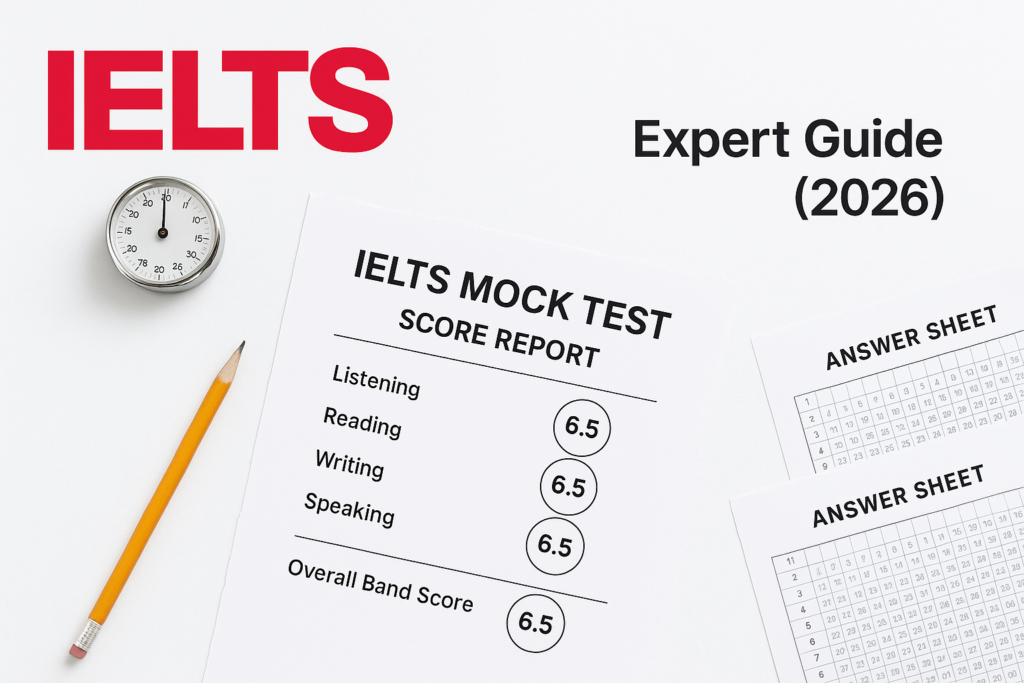
An IELTS mock test with a score report is a full or section-based practice test that gives you estimated band scores and feedback after completion. The test may cover Listening, Reading, Writing, and Speaking, or it may focus on one skill. The report should show your result clearly enough to guide your next study decisions.
A basic report may only show a raw score and estimated band. A stronger report explains the reason behind the score. For Listening and Reading, that may include question types, accuracy patterns, spelling errors, and timing issues. For Writing and Speaking, it should connect feedback to IELTS criteria so you know what to improve next.
- Listening and Reading reports should show accuracy, question type problems, and likely band range.
- Writing reports should comment on task response, organisation, vocabulary, and grammar.
- Speaking reports should comment on fluency, pronunciation, vocabulary, and grammar.
- The best reports include a short improvement plan, not only a score.
Why The Score Report Matters More Than The Practice Test
Many students complete mock tests repeatedly and still do not improve. The reason is simple: a test measures performance, but it does not automatically teach you what to change. If you finish a Reading test and only check the answer key, you may know you scored 27 out of 40. You may not know whether you lost marks because you read too slowly, misunderstood True/False/Not Given questions, missed synonyms, or ran out of time.
The score report should turn the result into a diagnosis. A student with Listening 7.5, Reading 6.0, Writing 6.5, and Speaking 7.0 does not need equal practice in all four sections. They need to protect Listening and Speaking while building a sharper Reading method and a more reliable Writing structure. A good report makes that obvious.
If you want repeated practice with realistic timing, use unlimited IELTS mock tests and compare your score reports over time. One report shows your current level. Several reports show whether your preparation is actually working.
What A Good IELTS Score Report Should Include
A useful report should be specific enough to help you make decisions. It should not simply say “practise more” or “improve grammar”. Those comments are too broad. You need feedback that identifies the skill, the pattern, and the next action.
For Listening, the report should show whether you lost marks from spelling, plural forms, missed keywords, map questions, multiple choice, or losing concentration after one missed answer. For Reading, it should show whether your errors came from matching headings, sentence completion, True/False/Not Given, vocabulary matching, or poor time control.
For Writing, the report should explain whether your score is being limited by task response, paragraph development, grammar accuracy, sentence control, or vocabulary. For Speaking, it should identify whether answers are too short, too memorised, unclear, repetitive, or not extended enough.
How Accurate Is A Mock Test Band Score?
A mock test band score is an estimate, not an official IELTS result. Listening and Reading estimates can be fairly close when the test materials are realistic and the scoring conversion is sensible. Writing and Speaking estimates depend heavily on the quality of the examiner or feedback system. A vague or automated score without clear criteria should be treated carefully.
The best way to use a mock score is to look for a reliable band range. If your mock tests repeatedly show Reading around 6.0 to 6.5, do not assume you are safely at 7.0 because one test felt easier. If Writing feedback repeatedly shows weak development, take that seriously even if you like your essay. Mock tests are most useful when they reveal repeated patterns.
For a broader view of how bands are calculated, review the IELTS score calculator guide. It helps you understand why a few marks in Listening or Reading can change the band, while Writing and Speaking depend on examiner criteria.
Full Mock Test Or Section Mock Test?
A full mock test is useful when you need to understand your overall readiness. It shows how the four sections interact and whether fatigue affects your performance. This matters because the real test is not just four separate skills. It is also a pressure event with timing, concentration, and recovery between sections.
A section mock test is better when you already know your weak area. If Writing is the only section below target, a full mock test every few days may waste time. You may get more improvement from targeted Writing mocks with detailed feedback. If Speaking is unstable, several shorter Speaking mock tests may be more useful than repeating full tests.
- Use a full mock test to measure overall readiness.
- Use section mocks to fix one weak skill.
- Use timed practice when your problem is speed or pressure.
- Use feedback-based practice when your problem is quality or accuracy.
How To Read Your IELTS Mock Test Score Report
Start with the lowest section, not the overall score. Many students feel encouraged by a strong overall estimate, but IELTS goals often depend on section minimums. A university, visa, professional registration, or migration pathway may require no band below a certain score. If one section is low, that section deserves priority.
Next, check whether the report shows skill patterns. In Reading, do you lose marks near the end because of timing? In Listening, do you lose marks in Section 4 because the information comes quickly? In Writing, does the feedback mention weak examples or unclear position? In Speaking, does it mention short answers or limited range?
Finally, convert the report into three actions. For example: practise True/False/Not Given for three days, rewrite two Task 2 body paragraphs, and record five Speaking Part 2 answers. A score report should lead to a calendar, not just a feeling.
Common Mistakes Students Make With Mock Tests
The first mistake is taking too many mock tests without reviewing them. This feels productive because it takes time and effort, but it can become a loop. If you repeat the same strategy, you often repeat the same score. Review is where the improvement happens.
The second mistake is using unrealistic practice materials. Some online tests are much easier or harder than IELTS. That can create false confidence or unnecessary panic. Use practice materials that match IELTS timing, question style, and difficulty as closely as possible.
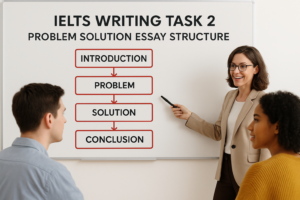
The third mistake is ignoring Writing and Speaking feedback. These sections need expert judgement because the answer is not simply right or wrong. If your report says your Task 2 ideas are underdeveloped, do not respond by memorising more vocabulary. Fix the development problem first.
A 14-Day Plan After Your Mock Test
After your mock test, spend the first day reviewing the report carefully. Highlight the lowest section and the most repeated issue. On days two to four, practise only that issue. If Reading timing is the problem, complete timed passages and review where you slowed down. If Writing task response is the problem, plan and rewrite introductions and body paragraphs.
On days five to seven, add a second weakness while keeping light practice for your stronger sections. On days eight to ten, complete section mocks under timed conditions. On days eleven to thirteen, do a full mock test or two section mocks, depending on your target. On day fourteen, compare the new report with the old one and decide whether the plan worked.
If your deadline is close and you need guided help, compare IELTS preparation plans and choose support based on the section that is limiting your score.
How Often Should You Take An IELTS Mock Test?
If your test is more than a month away, one full mock test every one or two weeks is usually enough. Between full mocks, use targeted section practice. If your test is within two weeks, you may need more frequent mocks, but only if you still have time to review them properly.
Taking a mock test every day is rarely useful unless you are already near your target and only need stamina practice. Most students improve faster by alternating test, review, targeted practice, and retest. The sequence matters. Testing without review is like checking the temperature without treating the fever.
Final Checklist Before You Trust A Mock Test Result
Before you rely on a mock test score report, check that the test used IELTS-style timing, question types, and scoring. Check that Writing and Speaking feedback is linked to the real criteria, not just general comments. Check that the report gives you a practical next step for each weak area.
Most importantly, look for patterns across more than one result. One mock test can be affected by tiredness, topic familiarity, nerves, or an unusually hard passage. Repeated patterns are more reliable. If three reports show the same weakness, believe the pattern and build your study plan around it.
Ready to find out your IELTS band score?
Take the IELTS Express Pre-Test for just $4.99 and get your personalised band prediction with a 14-day improvement plan.
FAQ: IELTS Mock Test With Score Report
Is an IELTS mock test with score report accurate?
It can be a useful estimate if the test materials are realistic and the feedback is based on IELTS-style scoring. Treat it as a band range and use repeated reports to confirm patterns.
Should I take a full mock test before booking IELTS?
Yes, a full mock test can show whether you are close to your target score across all four sections. It is especially useful if you need a minimum band in every skill.
What should I do after receiving a mock test score report?
Start with your lowest section, identify the repeated error pattern, and choose three specific actions for the next week. Do not just take another test without reviewing the first one.
How many IELTS mock tests should I take?
Most students do best with one full mock every one or two weeks, plus targeted section practice between tests. If your exam is close, you can increase frequency as long as you still review properly.
Can a mock test predict my official IELTS score?
It can help predict your likely range, but it cannot guarantee the official result. Test-day nerves, topic difficulty, timing, and examiner judgement can all affect your final score.