If you are checking the IELTS requirement for Nursing Registration Australia, the most important point is that nursing registration is not only about your overall score. The Nursing and Midwifery Board of Australia, often called the NMBA, looks at English language evidence carefully because nurses must communicate safely with patients, families, doctors, and other health workers. Before you spend money on another full test, take the IELTS Express Pre-Test to estimate your current band level and see which section may need work.
For many internationally qualified nurses, IELTS becomes one of the final hurdles before registration. That can make the test feel more stressful than usual. The good news is that the requirement is clear once you understand the score pattern, accepted test type, validity period, and how section minimums work.
What Is The IELTS Requirement For Nursing Registration Australia?
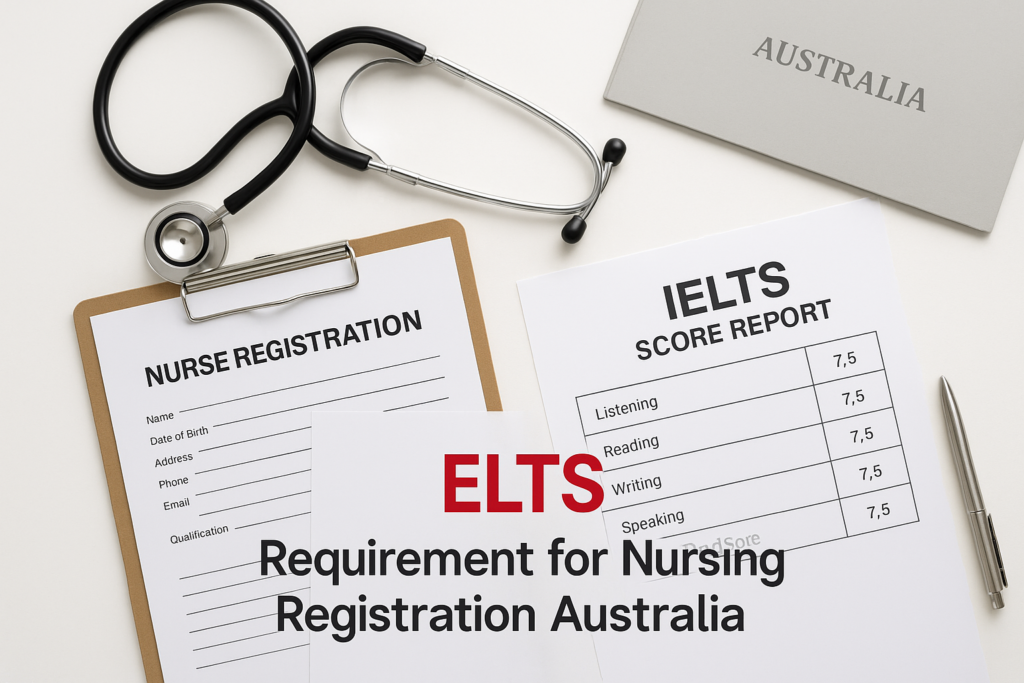
For nursing and midwifery registration in Australia, applicants generally need to show English language proficiency through one of the accepted pathways. If you use IELTS, the usual requirement is an overall band score of 7.0 with no band less than 7.0 in Listening, Reading, Writing, and Speaking. This means a 7.5 overall score will not solve the problem if Writing is 6.5 or Speaking is 6.5.
Most nurses apply through the Australian Health Practitioner Regulation Agency, known as AHPRA, under NMBA standards. Requirements can change, so you should always check the current NMBA English language skills standard before submitting documents. Treat this guide as practical preparation advice, not legal or registration advice.
- Target score: usually IELTS 7.0 overall.
- Section minimum: usually 7.0 in each of Listening, Reading, Writing, and Speaking.
- Test type: IELTS Academic is normally the relevant version for professional registration.
- Evidence must usually be current and verifiable.
Why Section Minimums Matter More Than The Overall Band
The biggest trap for nursing applicants is focusing only on the overall band. IELTS calculates an overall score from the four section scores, but registration bodies usually care about each section separately. A nurse with Listening 8.0, Reading 8.0, Speaking 7.0, and Writing 6.5 may have a strong overall result, but the Writing score can still block the registration pathway.
This is frustrating, but it makes sense from a healthcare perspective. Nurses need to understand instructions, read clinical information, explain care clearly, and write notes accurately. A weakness in one skill can create real risk in a workplace. That is why your preparation plan should protect the lowest section, not only chase a higher average.
If your test date is close, practise under realistic conditions with unlimited IELTS mock tests. Timed practice shows whether your weakest section stays stable when pressure is high.
IELTS Academic Or General Training For Nurses?
For nursing registration, IELTS Academic is normally the safer and more relevant choice. IELTS General Training is often used for migration or workplace purposes, but professional registration in health fields commonly requires Academic because it is closer to university and professional reading and writing demands.
Do not assume that a General Training result will be accepted because it has the same band score. Before booking, check the exact requirement for your registration pathway. If the application asks for Academic IELTS, book Academic IELTS. A wrong test version can waste both time and money.
How IELTS Fits Into The AHPRA And NMBA Registration Process
English language evidence is one part of the registration process. You may also need identity documents, qualification evidence, professional history, criminal history checks, and proof that your nursing education and practice meet Australian standards. IELTS does not replace those requirements. It simply proves that your English level meets the standard expected for safe practice.
Timing matters. Some applicants prepare for IELTS after gathering all other documents. Others start earlier because they know Writing or Speaking may take several attempts. If your goal is registration within a set deadline, start English preparation early enough to allow for retesting. A single failed section can delay the whole application.
For a wider view of nursing-related preparation, review a nursing-focused IELTS pathway guide. It connects the test with the bigger nursing pathway.
Common Score Problems For Nursing Applicants
Writing is often the hardest section for nurses because it requires controlled grammar, clear paragraphing, and task response under time pressure. Many nurses know the topic well but write too generally, overuse memorised phrases, or make sentence errors when trying to sound formal.
Speaking can also be a problem if answers are too short or too memorised. A nurse may have strong workplace English but still lose marks because IELTS Speaking tests fluency, range, pronunciation, and the ability to extend answers naturally. Reading and Listening problems usually come from timing, question type confusion, or losing concentration in the middle of the test.
- Writing: weak paragraph development, grammar errors, unclear position, or incomplete task response.
- Speaking: short answers, memorised language, limited examples, or nervous delivery.
- Reading: slow scanning, missed keywords, and difficulty with True/False/Not Given questions.
- Listening: losing track after one missed answer, spelling errors, and plural mistakes.
A Practical IELTS Study Plan For Nursing Registration
Start by diagnosing your lowest section. Do not spend equal time on all four skills if one section is clearly blocking you. A nurse with Reading 8.0 and Writing 6.0 needs a different plan from a nurse with balanced 6.5 scores across the test.
For Writing, practise Task 1 and Task 2 separately. IELTS Academic Writing Task 1 requires you to describe visual information such as graphs, charts, maps, or processes. Task 2 requires an essay. For registration, you need reliable performance in both tasks, not one strong answer and one weak answer.
For Speaking, record short answers and listen for hesitations, repeated words, grammar slips, and unclear pronunciation. You do not need a fake accent. You need clear, steady speech that answers the question directly. For Listening and Reading, build question-type practice and review every mistake. The review is where improvement happens.
If you need guided support rather than random practice, compare IELTS preparation plans and choose the level of help that matches your deadline and target score.
How Long Should Nurses Prepare For IELTS?
The answer depends on your starting level. If you are already around Band 7 in most sections, two to four weeks of focused practice may be enough to stabilise your result. If Writing or Speaking is around Band 6, allow more time. Moving from 6.0 to 7.0 is not just learning a few phrases. It usually needs better structure, grammar control, topic development, and test timing.
A useful approach is to work in fourteen-day blocks. At the start of each block, test all four skills. During the block, focus heavily on the weakest section while keeping light practice for the other three. At the end, test again and decide whether your plan is working. If the same errors keep appearing, change the method rather than repeating the same practice.
Should You Retake IELTS Or Try Another English Test?
Some nurses choose another accepted English test if IELTS is not matching their strengths. This can be sensible, but do not switch tests only because one result was disappointing. Every test has its own format, scoring rules, and pressure points. Switching too late can create new problems.
If your IELTS scores are close, such as 7.0 in three sections and 6.5 in one section, it may be better to focus on the weak section and retake. If you repeatedly miss the requirement by a larger margin, compare accepted tests carefully and choose the format that fits your skills. Always confirm that the test and score combination is accepted for your exact registration pathway before booking.
Final Checklist Before You Book IELTS
Before booking your test, confirm the required test type, target score, validity period, and whether combined results are accepted for your situation. Check your name and identity document details carefully. Make sure the test date leaves enough time for results, possible retesting, and registration deadlines.
Then build your study around the score you actually need. Nursing registration usually leaves little room for a weak section, so protect your lowest band first. A smart plan is simple: diagnose, practise the weakest skill, review mistakes, do full timed tests, and only book when your practice results are consistently close to the requirement.
Ready to find out your IELTS band score?
Take the IELTS Express Pre-Test for just $4.99 and get your personalised band prediction with a 14-day improvement plan.
FAQ: IELTS Requirement For Nursing Registration Australia
What IELTS score do nurses need for registration in Australia?
Nursing applicants using IELTS generally need 7.0 overall with no band below 7.0 in Listening, Reading, Writing, and Speaking. Always check the current NMBA English language standard before applying.
Do nurses need IELTS Academic or General Training?
IELTS Academic is normally the relevant test for nursing registration because it matches professional and academic language demands. Do not book General Training unless your registration instructions clearly allow it.
Can I register as a nurse if one IELTS band is 6.5?
If your pathway requires no band below 7.0, a 6.5 in one section can block the English requirement even if your overall score is high. You may need to retake or provide another accepted form of English evidence.
How long is an IELTS result valid for nursing registration?
English test validity rules depend on the registration standard in force when you apply. Many applicants work around a two-year evidence window, but you should confirm the current NMBA rule before relying on an older result.
Which IELTS section is hardest for nurses?
Writing is often the hardest because it requires clear structure, grammar accuracy, and task response under time pressure. Speaking can also be challenging if answers are too short or memorised.