If you are preparing an IELTS Writing Task 2 Social Media band 7 answer, the key is to avoid writing a general rant about phones. Social media questions usually ask about communication, young people, privacy, news, mental health, business, education, or relationships. Before you practise full essays, take the IELTS Express Pre-Test to check your current writing band and see which parts of your essay need the most work.
Social media is a useful IELTS topic because every candidate has personal experience with it, but that can also be a trap. Personal stories are not enough for Task 2. A Band 7 essay needs a clear position, logical body paragraphs, specific examples, accurate grammar, and vocabulary that fits the question. You do not need extreme opinions. You need controlled ideas that answer the task directly.
What A Social Media Essay Needs To Do
An IELTS Task 2 essay about social media should first identify the exact question type. If the task asks whether social media has a positive or negative effect, you need a clear judgement. If it asks for advantages and disadvantages, you must discuss both sides. If it asks whether governments should regulate social media, your essay must focus on rules, responsibility, and possible limits, not simply whether people like Instagram or TikTok.
Many candidates lose marks because they write too broadly. They mention teenagers, fake news, online shopping, privacy, celebrities, and addiction in one paragraph. That makes the essay feel busy but underdeveloped. A stronger answer chooses two main ideas and explains them properly.
- Read the question type before choosing ideas.
- Choose two main points that can be developed clearly.
- Use examples that a general reader can understand.
- Keep your opinion consistent from introduction to conclusion.
IELTS Writing Task 2 Social Media Band 7 Answer Structure
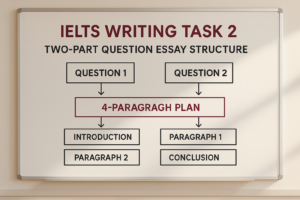
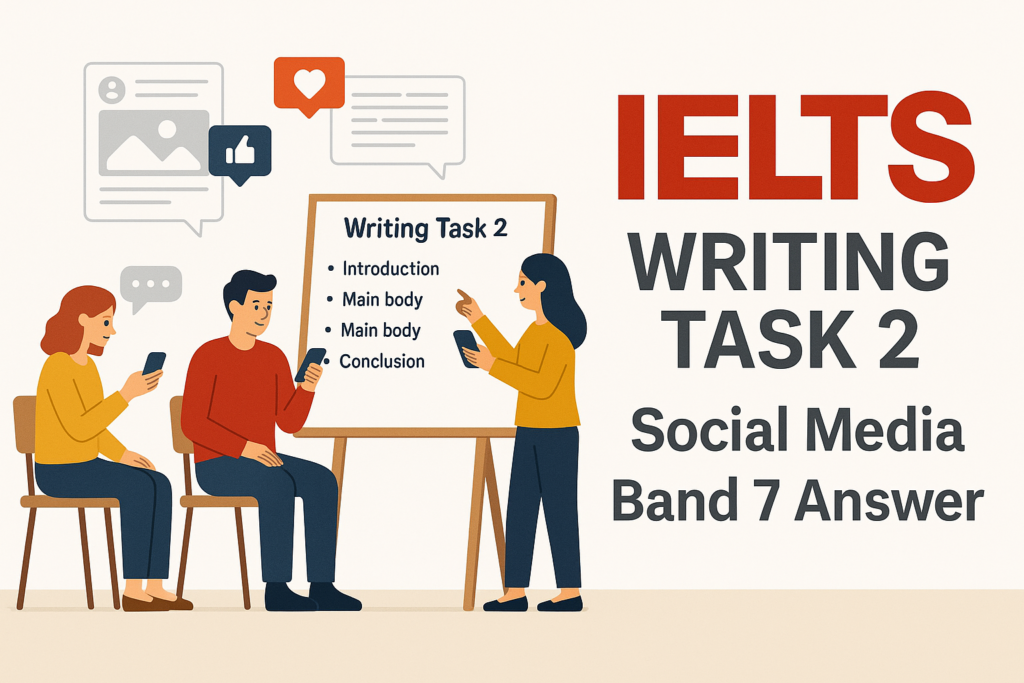
A reliable Band 7 structure has four paragraphs: introduction, body paragraph one, body paragraph two, and conclusion. This structure is simple, but it gives you enough room to develop each idea. For social media topics, body paragraph one can discuss a major benefit, such as easier communication or access to information. Body paragraph two can discuss a serious drawback, such as misinformation, reduced attention, or privacy risk.
If the question asks for your opinion, make that opinion visible in the introduction. Then use each body paragraph to support or qualify it. For example, you might argue that social media is useful for communication and public awareness, but harmful when people use it without limits or when platforms spread unreliable information.
If you want to test this structure under exam timing, use unlimited IELTS mock tests and write several technology and communication essays in one week. Timed practice shows whether your paragraphing is stable when the topic changes.
Sample Question For A Social Media Essay
Here is a realistic IELTS Writing Task 2 question:
Social media has changed the way people communicate and receive information. Some people believe this is a positive development, while others think it has created serious problems. Discuss both views and give your own opinion.
This is a discuss both views and opinion question. You need to explain why some people see social media as beneficial, explain why others are concerned, and then give your own view. A safe Band 7 position is that social media has clear benefits, but its value depends on how responsibly people and platforms use it.
Band 7 Sample Answer: Social Media
Social media is now a major part of communication, news, business, and daily life. Some people argue that it has made society more connected and better informed, while others believe it has increased misinformation, distraction, and social pressure. In my view, social media is a useful development overall, but only when users treat it as a tool rather than allowing it to replace careful judgement and real relationships.
On the one hand, social media has improved communication by making it faster and more convenient. People can stay in contact with relatives overseas, join professional networks, follow community updates, and share important information during emergencies. Small businesses can also reach customers without paying for expensive advertising. For example, a local cafe can announce a new product, reply to customer questions, and build loyalty through regular posts. In this sense, social media gives ordinary people and small organisations a voice that they might not have had in the past.
On the other hand, social media can create serious problems when information spreads without proper checking. False news, exaggerated claims, and emotional content can move quickly because people often share posts before reading them carefully. This can damage public trust and influence opinions on health, politics, or social issues. Another concern is that constant scrolling can reduce concentration and increase comparison, especially among young people. If users measure their lives against carefully edited images, they may feel anxious or dissatisfied.
I believe the strongest answer is not to reject social media completely, but to use it more responsibly. Schools should teach students how to check sources, protect privacy, and recognise advertising or manipulation. Platforms should also remove clearly harmful content and make it easier for users to understand why certain posts are shown to them. At the same time, individuals need personal limits, such as choosing reliable sources and reducing screen time when it affects study, sleep, or relationships.
In conclusion, social media has improved communication and created new opportunities for individuals and businesses. However, it can also spread misinformation and encourage unhealthy habits if people use it carelessly. Therefore, I think social media is positive overall, but its benefits depend on digital literacy, platform responsibility, and sensible personal use.
Why This Sample Answer Reaches Band 7
This sample answer reaches a Band 7 style because it answers every part of the question. The introduction paraphrases the topic and gives a clear opinion. The first body paragraph explains the positive view with communication, community updates, and small business examples. The second body paragraph explains the negative view with misinformation and social pressure. The final body paragraph gives the writer’s own judgement and practical conditions.
The vocabulary is also controlled. Phrases such as digital literacy, public trust, reliable sources, platform responsibility, personal limits, social pressure, and misinformation are useful for this topic. They are not rare words, but they are accurate and flexible. Band 7 writing usually sounds clear and precise, not overloaded with memorised expressions.
Useful Vocabulary For Social Media Essays
Social media essays need vocabulary for communication, information, behaviour, and responsibility. You do not need to use technical language unless it is relevant and accurate. Simple academic phrases used well are safer.
- misinformation: false or inaccurate information that people may believe or share.
- digital literacy: the ability to use online tools wisely and judge information carefully.
- online privacy: protection of personal information shared on the internet.
- social pressure: pressure to look, behave, or live in a certain way because of other people.
- platform responsibility: the duty of social media companies to manage harmful or misleading content.
- screen time: the amount of time people spend using phones, computers, or other devices.
Use these phrases inside full sentences. For example, you could write, “Digital literacy is important because users need to recognise misinformation before they share it with others.” That sentence is clear, relevant, and easy for the examiner to follow.
Common Mistakes In Social Media Essays
The first mistake is using emotional language. Sentences such as “social media is destroying society” or “everyone is addicted” sound exaggerated unless the question gives that direction. IELTS essays need a measured tone. You can discuss harm, but you should explain the cause, effect, and possible solution.
The second mistake is giving examples that are too personal. It is fine to think about your own experience, but the essay should discuss society more broadly. Instead of writing only about your friends using social media, write about students, families, businesses, communities, or news audiences.
The third mistake is weak paragraph development. A sentence such as “social media is good for communication” is not enough. Explain who communicates, how it helps, and what result follows. If your ideas often stay too general, compare your writing with the IELTS Writing Task 2 band score guide and check whether each paragraph has a clear main idea and support.
Planning A Band 7 Answer In Five Minutes
Use the first five minutes to control the essay. Write the question type, your opinion, and two main ideas. For the sample question above, your plan could be: social media improves communication and opportunity; social media spreads misinformation and pressure; my opinion is that it is useful if people and platforms use it responsibly.
This plan is enough. You do not need a long list of points. Too many ideas can make the essay harder to organise. A Band 7 essay usually develops a small number of relevant ideas well.
- Minute one: identify the question type.
- Minute two: choose your position.
- Minute three: choose body paragraph one.
- Minute four: choose body paragraph two.
- Minute five: decide your example and conclusion line.
How To Adapt This Answer To Other Social Media Questions
You can adapt the same core ideas to several question types. For an advantages and disadvantages question, discuss fast communication and business opportunities as advantages, then misinformation and reduced concentration as disadvantages. For an agree or disagree question, choose whether social media has improved society and defend that position. For a problem and solution question, discuss false information, privacy risks, or excessive screen time, then suggest digital literacy, platform rules, and personal limits.
Be careful with memorisation. You can reuse ideas, but you must change the answer to fit the task. If a question focuses on children, write about education, parental guidance, social comparison, and attention. If it focuses on news, write about source checking, speed, public trust, and regulation. For more topic-based examples, read the IELTS Writing Task 2 sample answers page and compare how each essay develops its argument.
Final Tips Before You Write Your Own Answer
Before writing your own social media essay, decide whether the question is mainly about communication, information, young people, privacy, business, or government control. That decision will guide your examples. Then write a clear introduction and make sure every body paragraph connects back to your opinion.
Do not chase difficult vocabulary. A clear sentence with accurate grammar is better than a complicated sentence that loses meaning. If you need a broader preparation plan, see our IELTS preparation plans and choose a study option that matches your test date and target band.
Ready to find out your IELTS band score?
Take the IELTS Express Pre-Test for just $4.99 and get your personalised band prediction with a 14-day improvement plan.
FAQ: IELTS Writing Task 2 Social Media Band 7 Answer
Is social media a common IELTS Writing Task 2 topic?
Yes. Social media can appear under technology, communication, young people, news, education, business, or society. Prepare flexible ideas rather than one memorised essay.
What opinion is safest for a social media essay?
A balanced opinion is often safest. You can argue that social media is useful for communication and information, but risky when users spread misinformation or spend too much time online.
Can I mention teenagers in a social media essay?
Yes, if the question connects to young people, education, mental health, or screen time. Explain the point clearly and avoid exaggerated claims about all teenagers.
Do I need advanced vocabulary for Band 7?
No. You need accurate vocabulary used naturally. Terms such as misinformation, digital literacy, online privacy, social pressure, and platform responsibility are useful if they fit the sentence.
How many examples should I include?
One clear example in each body paragraph is usually enough. Examples should support the main idea instead of replacing explanation.