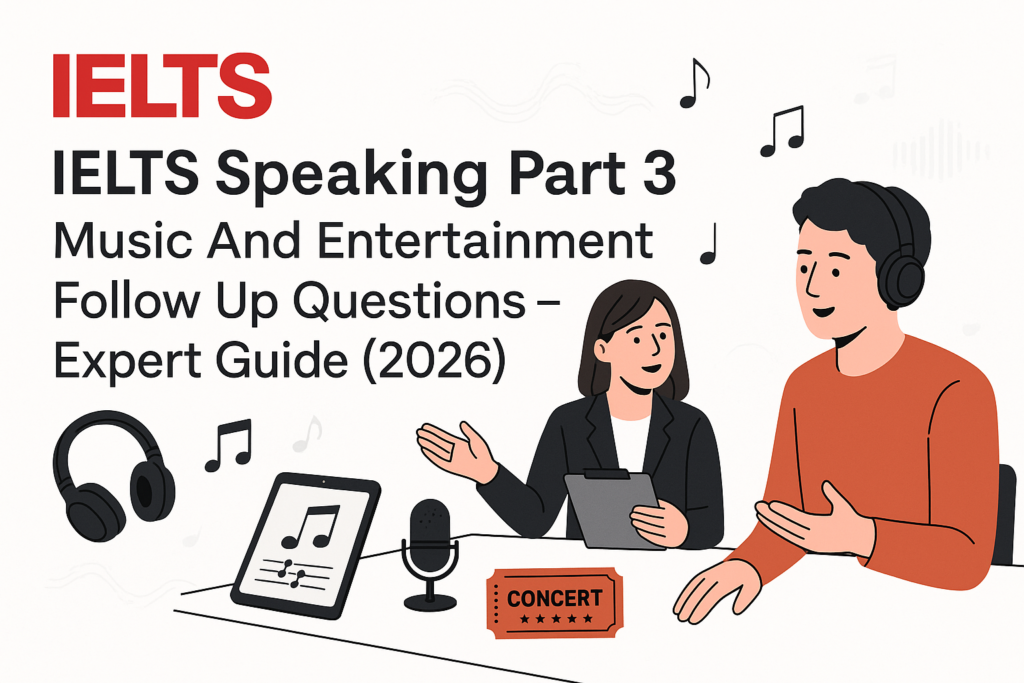
If you are preparing for IELTS Speaking Part 3 Music And Entertainment follow up questions, expect the examiner to move beyond your favourite singer or film. Part 3 usually asks you to discuss music habits, concerts, streaming platforms, traditional music, children’s entertainment, screen time, celebrity culture, public funding for the arts, and how entertainment is changing. Before you practise a list of memorised answers, take the IELTS Express Pre-Test to check your current band level and see which speaking skills need the most attention.
Music and entertainment is an easy topic to start, but it can become surprisingly abstract in Part 3. Many candidates can say what music they like, but they struggle when the examiner asks whether governments should support musicians, whether children spend too much time watching videos, or whether traditional entertainment will survive. A stronger answer explains causes, compares generations, gives realistic examples, and finishes with a clear judgement. You do not need to be an expert in the arts. You need flexible ideas and natural language.
What Music And Entertainment Questions In Part 3 Are Testing
Part 3 tests your ability to discuss general ideas rather than only personal taste. If Part 2 asks you to describe a song, a concert, or a film you enjoyed, Part 3 may ask why people listen to music, how entertainment affects children, whether celebrities influence young people, or whether live performances are still important.
A useful answer normally has four parts: a direct answer, a reason, an example, and a result. If the examiner asks whether people prefer online entertainment now, you could say many people do because it is cheap, convenient, and available on demand. Then explain that streaming services allow people to watch shows, listen to music, and follow creators at any time. Finish by adding that this convenience can reduce attendance at cinemas or live shows, although special events still attract audiences.
- Answer the exact question first.
- Move from personal preference to a wider social point.
- Use examples from families, schools, workplaces, concerts, cinemas, or online platforms.
- Finish with a result, comparison, or judgement.
For the wider speaking test format, read the IELTS Speaking Test complete guide alongside this topic practice.
How To Build A Band 7 Music And Entertainment Answer
A Band 7 style answer is usually clear, balanced, and developed. It does not sound like a memorised speech. It answers the question directly, explains one or two useful ideas, and gives a realistic example. The safest pattern is answer, explain, example, extend.
For example, if the question is “Do you think live music is still important?”, you might say yes, because live music creates a social and emotional experience that recorded music cannot fully replace. Then add that people may stream songs every day, but concerts allow them to share the atmosphere with other fans and see musicians perform in real time. Extend the answer by saying that live events also support local venues, technicians, and small businesses.
If you want to test this answer shape under exam pressure, use unlimited IELTS mock tests and record several Part 3 music and entertainment answers in one session. You will quickly hear whether your ideas stay organised when the examiner changes the angle.
Common IELTS Speaking Part 3 Music And Entertainment Follow Up Questions
Use these questions to practise flexible thinking. Do not memorise full scripts. Prepare useful ideas for each theme so you can adapt naturally on test day.
- Why do people enjoy listening to music?
- Do young and older people enjoy different types of entertainment?
- Is live music better than recorded music?
- Should children learn to play a musical instrument?
- Has online entertainment changed people’s social lives?
- Are celebrities a good influence on young people?
- Should governments support artists and musicians?
- Do people spend too much time on entertainment today?
- Will traditional music remain popular in the future?
- How has technology changed the entertainment industry?
Sample Answer: Why Do People Enjoy Listening To Music?
People enjoy music because it affects their mood very quickly. Some people listen to energetic songs when they exercise or commute, while others use calm music to relax after work. Music is also connected to memory, so a song can remind someone of a place, a person, or a stage of life. Another reason is that music can create a sense of identity. Teenagers, for example, may feel connected to a certain style of music because it reflects their personality or social group. So music is not only entertainment; it can also be emotional and social.
This answer works because it gives more than one reason without becoming a list. It connects mood, memory, identity, and social groups, which gives the examiner enough language to assess.
Sample Answer: Is Live Entertainment Still Important?
Yes, I think live entertainment is still important, even though online entertainment is more convenient. A live concert, theatre show, comedy event, or sports match gives people a shared experience. The audience reacts together, and that atmosphere is difficult to recreate on a phone or laptop. Live events also support creative workers, local venues, hospitality businesses, and tourism. Of course, not everyone can afford frequent tickets, but for special occasions, live entertainment still has a strong place in modern life.
Notice the balance. The answer admits that online entertainment is convenient, but it still explains why live events matter. That is stronger than simply saying one option is better.
Sample Answer: Should Children Learn Music?
In many cases, yes, children should have the chance to learn music because it can develop concentration, confidence, coordination, and creativity. Learning an instrument also teaches patience because progress is usually slow at the beginning. However, I do not think every child should be forced to become a serious musician. Some children may enjoy singing, dancing, or simple rhythm activities more than formal lessons. The main goal should be exposure and enjoyment first, because pressure can make children lose interest.
This answer is examiner-safe because it avoids an extreme view. It supports music education but recognises that children have different interests and abilities.
Vocabulary For Music And Entertainment Discussion
Useful vocabulary for this topic should help you discuss enjoyment, culture, technology, business, children, and social habits. Avoid rare technical music terms unless you can use them naturally. Clear phrases used accurately are better than impressive words used awkwardly.
- live performance: music, theatre, comedy, or another show performed in front of an audience.
- streaming platform: an online service that lets people watch videos or listen to music on demand.
- traditional music: music connected to a country’s history, culture, language, or community.
- screen time: time spent using phones, tablets, computers, or televisions.
- creative industry: businesses and workers connected to music, film, games, design, media, or performance.
- celebrity culture: public attention around famous people and their lifestyles.
- shared experience: an event or activity that people enjoy together.
Use these phrases inside complete answers. Instead of only saying “streaming platform”, say: “Streaming platforms have made entertainment more convenient because people can choose music or videos whenever they want.” That sentence is simple, but it shows control.
How To Extend Short Music And Entertainment Answers
If your answer is too short, add one useful layer. You can explain a cause, give a result, compare old and new entertainment, mention children and adults, or connect the topic to technology, money, culture, education, family life, or mental health. Music and entertainment questions are easy to extend because they involve both personal habits and wider social change.
For example, if you say people watch more online videos now, explain why. Phones are portable, internet access is cheaper than before, and short videos fit into small breaks during the day. If you say traditional music is important, explain what it protects: language, history, community identity, ceremonies, and family memories. If you say celebrities influence young people, explain both sides: they can inspire confidence or creativity, but they can also create unrealistic expectations.
- Compare live shows, streaming, television, cinema, and social media.
- Compare entertainment for children, teenagers, adults, and older people.
- Mention cost, convenience, culture, technology, family routines, or public spaces.
- Explain how entertainment affects mood, learning, relationships, identity, and local businesses.
If your answers are organised but still sound basic, the IELTS Speaking Part 3 tips and strategies guide can help you build stronger discussion habits.
Common Mistakes With Music And Entertainment Follow Up Questions
The first mistake is only talking about your own taste. Personal examples are useful, but Part 3 needs wider discussion. If the examiner asks whether traditional music is important, do not only say that you prefer pop music. Use your preference briefly, then explain the wider cultural issue.
The second mistake is giving extreme opinions about technology. Saying online entertainment is destroying society is too simple. Online entertainment can distract people, but it can also make education, culture, music, films, and creative work more accessible. A balanced answer gives you more room to show language.
The third mistake is listing examples without explaining them. Saying “music is relaxing, fun, and popular” is not enough. Explain why it relaxes people, how it creates enjoyment, and why it is popular across age groups. Development matters more than the number of points.
- Do not turn every answer into a list of favourite songs or films.
- Do not ignore traditional music, live events, or children’s entertainment.
- Do not make extreme claims about celebrities or screen time.
- Do not memorise long answers that fail to match the exact question.
Music And Entertainment Answer Frames You Can Reuse
Reusable frames help you start clearly without sounding robotic. For technology questions, try: “Technology has not removed entertainment; it has changed how people access it.” Then discuss streaming, phones, social media, or online concerts. For cultural questions, try: “Traditional music may not dominate everyday listening, but it still has cultural value.” Then explain identity, history, ceremonies, or education.
For children’s questions, try: “Entertainment can be positive if it is balanced with study, sleep, physical activity, and real conversation.” This frame works for screen time, games, cartoons, music lessons, and online videos. For celebrity questions, try: “Celebrities can influence young people in both helpful and unhelpful ways, depending on the behaviour being promoted.” Then give one positive and one negative example.
These frames are not scripts. They are starting points. Practise them with different questions until you can change the examples naturally.
Practice Plan For This Topic
Start with six questions and answer each one for 45 to 60 seconds. Record yourself. Then listen for three things: whether you answered directly, whether you gave a clear example, and whether your final sentence finished the idea. If your answer stops too early, repeat it with one extra cause or result.
On the second round, change the angle. Move from “Do people enjoy music?” to “Why do teenagers enjoy music?” Then try “Why do older people prefer different entertainment?” This trains flexibility, which is exactly what Part 3 requires. You can also compare your responses with the IELTS Speaking Part 3 sample answers to see how developed answers are shaped.
If your test is close and you need a structured plan, see our IELTS preparation plans so you can choose the right level of speaking support instead of guessing what to practise next.
How To Sound Natural When Discussing Entertainment
Natural answers usually sound specific, not dramatic. Instead of saying, “Entertainment is very important for everyone,” say, “Entertainment helps people relax, connect with others, and take a break from study or work.” That sentence gives the examiner clearer content.
Use moderate language when the issue is complex. Phrases like “for many people”, “in some families”, “it depends on the purpose”, and “one possible reason” can help you avoid overgeneralising. This matters because entertainment habits are shaped by age, income, culture, technology access, free time, language, and personality.
Also remember that entertainment is broader than music and movies. You can discuss concerts, theatre, games, podcasts, short videos, dance, sport, festivals, children’s cartoons, public performances, and traditional arts. This gives your answer more variety and helps you avoid repeating the same idea.
Ready to find out your IELTS band score?
Take the IELTS Express Pre-Test for just $4.99 and get your personalised band prediction with a 14-day improvement plan.
FAQ: IELTS Speaking Part 3 Music And Entertainment Follow Up Questions
How long should my Part 3 music and entertainment answers be?
Most strong answers are around 35 to 60 seconds. Answer directly, explain one clear idea, give a realistic example, and add a result or comparison. Very short answers usually do not show enough language.
Do I need advanced music vocabulary for IELTS Speaking?
No. You need accurate, natural language more than specialist music terms. Phrases like live performance, streaming platform, screen time, traditional music, and celebrity culture are useful if you can use them clearly.
Can I talk about films, games, or social media in this topic?
Yes. Music and entertainment questions often include wider entertainment habits, so films, games, online videos, concerts, podcasts, sport, and social media can all be relevant if they answer the question.
Should I give both sides when discussing celebrities?
Often, yes. Celebrities can inspire young people through talent, discipline, or charity work, but they can also promote unrealistic lifestyles. A balanced answer usually sounds more mature.
What if I do not know much about traditional music?
You can still answer safely by discussing culture, family events, national identity, festivals, language, and school education. IELTS tests communication, not specialist knowledge of music history.