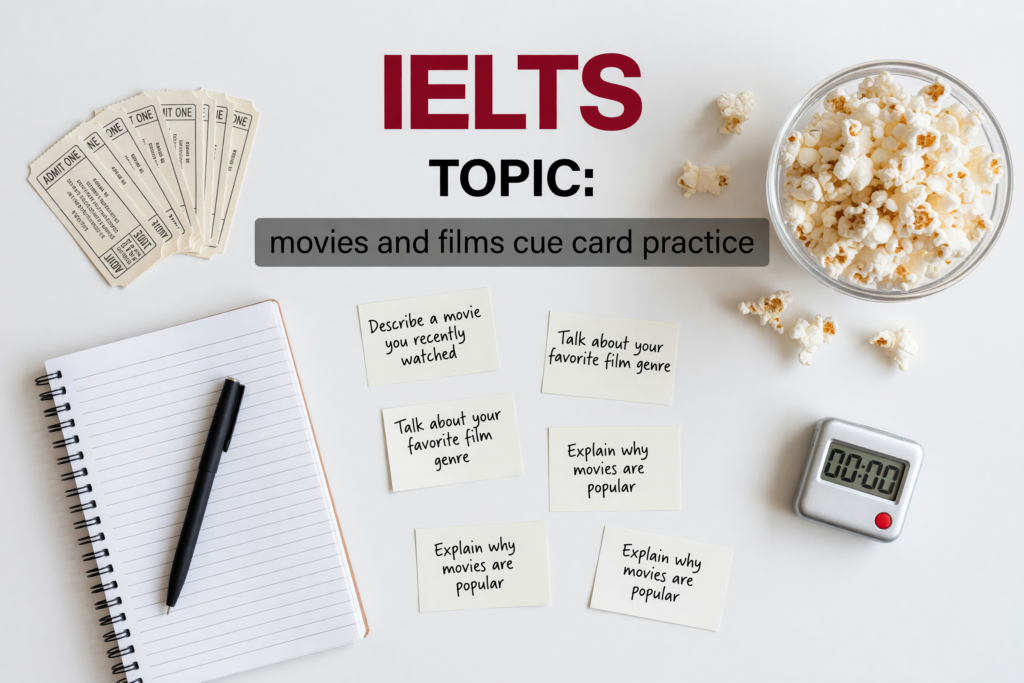
If you are practising IELTS Speaking Part 2 Movies And Films cue card sample, this is the kind of topic that looks easy until you try to keep talking for two full minutes. Most candidates can name a film they enjoyed. The problem starts when they need to explain it with enough detail, clear structure, and natural language to sound fluent instead of repetitive.
Before you keep guessing whether your speaking is already close to your target band, take the IELTS Express Pre-Test. It is a quick way to see whether your current Part 2 answers already sound organised enough for Band 7, or whether they still need more control and range.
In this guide, you will see a realistic cue card prompt, a full Band 7+ style sample answer, a breakdown of why the answer works, useful vocabulary, common mistakes, and likely Part 3 follow-up questions. The aim is not to memorise a script. The aim is to understand how a strong answer is built so you can adapt the structure to your own experience and speak more naturally on test day.
What the examiner wants from a movies and films cue card
A movies and films topic usually asks you to describe a film you watched, a film that affected you, a film you would recommend, or a memorable cinema experience. The exact wording can change, but the examiner is testing the same core skills: fluency and coherence, lexical resource, grammar range and accuracy, and pronunciation.
The weak version of this answer is easy to recognise. The candidate says the film was interesting, the actors were good, and the story was exciting, but nothing becomes specific. A stronger answer chooses one film clearly, explains when and where the speaker watched it, gives a short description of the story, and finishes with a personal reaction that sounds genuine rather than rehearsed.
- Choose one film instead of mentioning several at once
- Give a clear viewing context, such as at home, in the cinema, or with friends
- Add one or two specific details about the plot, message, or performance
- Finish with a real reason the film stayed in your mind
A typical IELTS Speaking Part 2 prompt for this topic
If you search for a sample answer, it helps to know what a realistic cue card can look like. One common version is:
Describe a movie or film that you enjoyed watching.
You should say:
- what the movie was
- when and where you watched it
- what it was about
- and explain why you enjoyed it so much.
That prompt is simple, but it does not automatically produce a good answer. If you respond with four short sentences, one for each bullet point, your answer will feel thin. A better approach is to use the bullet points as a base, then add context, one or two scenes or impressions, and a final reflection that makes the answer sound complete.
Full sample answer: Band 7+ response
Here is a sample answer for a candidate aiming at Band 7 or above:
“A film I really enjoyed watching was 3 Idiots, which is a popular Indian movie that I first saw a few years ago with two of my close friends. We watched it at home one weekend when we were all feeling quite tired from study, and honestly we expected it to be just a light comedy. However, it turned out to be much more memorable than that.
The film is mainly about three university students and the pressure they face in a very competitive education system. What I liked was that it balanced humour with more serious ideas. Some scenes were genuinely funny, but at the same time the story also showed how stress, family expectations, and fear of failure can affect young people.
I think the reason it stayed with me is that it felt entertaining and meaningful at the same time. It was not the kind of movie that you forget as soon as it ends. I also liked the performances because the actors made the characters feel believable, especially in the emotional parts of the story.
Another reason I enjoyed it was that I watched it with friends, so the whole experience felt more relaxed and memorable. We laughed at the same scenes and then talked about the message afterwards. Overall, I would say it is one of those films that is easy to enjoy on the surface, but it also leaves you with something to think about later.”
This answer works because it sounds personal, specific, and well developed. It does not waste time retelling the entire plot. Instead, it gives enough detail to answer the question clearly while keeping the focus on the speaker’s own response.
Why this sample can score well
The biggest strength of the sample is control. The answer starts with the title of the film, then explains the viewing situation, then describes the story and the speaker’s reaction. That order is easy to follow. The examiner does not need to work hard to understand the answer, which supports fluency and coherence.
The vocabulary is also natural rather than forced. Phrases such as “light comedy”, “more memorable than that”, “balanced humour with more serious ideas”, and “left me with something to think about” fit spoken English well. They sound much better than throwing in advanced words that do not match the candidate’s real speaking style.
The answer also uses enough grammar range to sound flexible. There is past tense for the viewing experience, present tense for describing the film more generally, and comparison between entertainment and meaning. If you want a broader model for how Part 2 and Part 3 answers fit together, our IELTS Speaking Part 2/3 Framework is a useful reference point.
How to build your own answer without memorising
Using a sample answer is useful, but copying it line by line is risky. Examiners hear memorised material all the time. The speech becomes too smooth in some places, too stiff in others, and it often breaks down when the cue card changes slightly. The safer method is to memorise a structure rather than a script.
For a movies and films topic, a four-part structure works well:
- Name the film and say when or where you watched it
- Give a short summary of what it was about
- Explain what stood out, such as the message, acting, visuals, or soundtrack
- Finish with a personal reason you enjoyed it or remember it
That structure gives you enough material to speak for close to two minutes without drifting. It also keeps you from turning the answer into a long plot summary. In IELTS Speaking, the focus is your English, not your film review. If you need more timed practice after reading cue card samples, compare your pacing against unlimited IELTS mock tests so you can see whether your answer still sounds coherent after the first minute.
Useful vocabulary for talking about movies and films
Many candidates think they need highly technical cinema vocabulary for this kind of topic. That is not necessary. You only need language that helps you describe story, feeling, performance, message, and reaction in a clear way.
- plot for the main story of the film
- lead character for the main person in the story
- strong performance for convincing acting
- thought-provoking for something that makes you reflect
- light-hearted for something fun and easy to enjoy
- kept me engaged for a film that held your attention
The important thing is to use these phrases naturally. For example, instead of saying, “The movie was thought-provoking,” and stopping there, explain what idea made you think more deeply. Maybe it changed your view of education, friendship, family pressure, or success. That extra detail makes the vocabulary sound real rather than memorised.
Common mistakes candidates make on this cue card
The most common mistake is trying to tell the entire story of the film from beginning to end. That usually creates two problems. First, the answer becomes rushed and messy. Second, the speaker forgets to explain why the film mattered personally. A cue card response is not a full review and it is not a summary for someone who has never seen the film.
Another common mistake is choosing a film the candidate cannot describe properly. Some people pick a very famous movie because they think it sounds impressive, then struggle to explain the plot or why they liked it. It is much smarter to choose a film you can talk about comfortably, even if it is simple.
A third issue is overusing basic opinion words. If every sentence includes “good”, “interesting”, or “amazing”, the answer quickly becomes repetitive. It is better to prepare a few more precise phrases in advance so your answer sounds varied without becoming artificial.
- Retelling the whole plot instead of selecting key points
- Giving no personal reaction at the end
- Choosing a film you cannot explain clearly
- Repeating basic adjectives too often
What kind of Part 3 questions may follow
After a film-related Part 2 topic, the examiner often moves into a broader discussion about entertainment, media influence, cinema culture, or how films affect society. That means Part 3 usually becomes less personal and more analytical.
Common follow-up questions include:
- Why do some films become popular internationally?
- Do films influence the way people think or behave?
- Is going to the cinema still important now that streaming is common?
- What kinds of films do young people usually prefer?
You do not need a perfect answer to these questions. You need a clear point, a short explanation, and sometimes an example. For instance, if you are asked whether films influence behaviour, you could say they influence opinions and fashion to some extent because audiences often connect strongly with characters and stories, but the effect depends on the person and the film itself. That is enough to sound balanced and thoughtful.
How to practise this topic effectively
The best way to practise a movies and films cue card is to repeat the same topic with controlled variation. First, talk about a film you watched at home. Then try a film you saw in the cinema. Then choose a documentary, an animated film, or a comedy. The goal is to become flexible, not to rehearse one fixed answer.
It also helps to record yourself. When you listen back, check whether your answer has a clear beginning, middle, and end. Notice where you hesitate, where you repeat the same words, and whether you spend too long on plot summary. That kind of review usually shows your weak points much faster than doing random cue cards without analysis.
A simple formula to keep speaking for two minutes
If you panic in Part 2, a simple formula helps more than a clever idea. For this topic, you can use:
- Start: name the film and the viewing situation
- Middle: explain the basic story and one thing that stood out
- Development: describe how it made you feel or think
- Finish: explain why you would remember or recommend it
This formula works because it keeps the answer moving. It also gives you room to sound personal without becoming disorganised. The candidate who speaks calmly and clearly about one film will usually score better than the candidate who tries to sound advanced but loses direction after forty seconds.
Ready to find out your IELTS band score?
Take the IELTS Express Pre-Test for just $4.99 and get your personalised band prediction with a 14-day improvement plan.
FAQ: IELTS Speaking Part 2 Movies And Films cue card sample
Can I talk about a film in my own language?
Yes. The film does not need to be in English. What matters is whether you can describe it clearly and naturally in English during the test.
Is it better to choose a famous film or a simple one?
Choose the film you can explain most comfortably. A simple film with clear detail is usually safer than a famous film you cannot describe well.
Do I need to explain the full story of the movie?
No. A short summary is enough. Most of your answer should focus on what stood out and why you enjoyed or remembered the film.
What if I cannot remember the name of a real movie in the exam?
You can still describe a film clearly even if you momentarily forget the exact title. However, it is easier if you practise with a few real examples before test day.
How long should my answer be in Speaking Part 2?
You should aim to keep speaking until the examiner stops you, which is usually close to two minutes. A clear structure makes that much easier.