If you are comparing IELTS computer vs paper based pros cons, you are already asking the right question. Most candidates focus only on which format feels more modern or more familiar. That misses the real issue. The better format is the one that protects your score under pressure. Your typing speed, concentration style, reading habits, handwriting, and test-day nerves all affect whether computer-based IELTS or paper-based IELTS will work better for you.
Before you book the wrong format and hope for the best, take the IELTS Express Pre-Test for just $4.99 and get a personalised band prediction with a 14-day improvement plan. That gives you a more useful baseline than guessing whether your current habits already suit the test you are about to pay for.
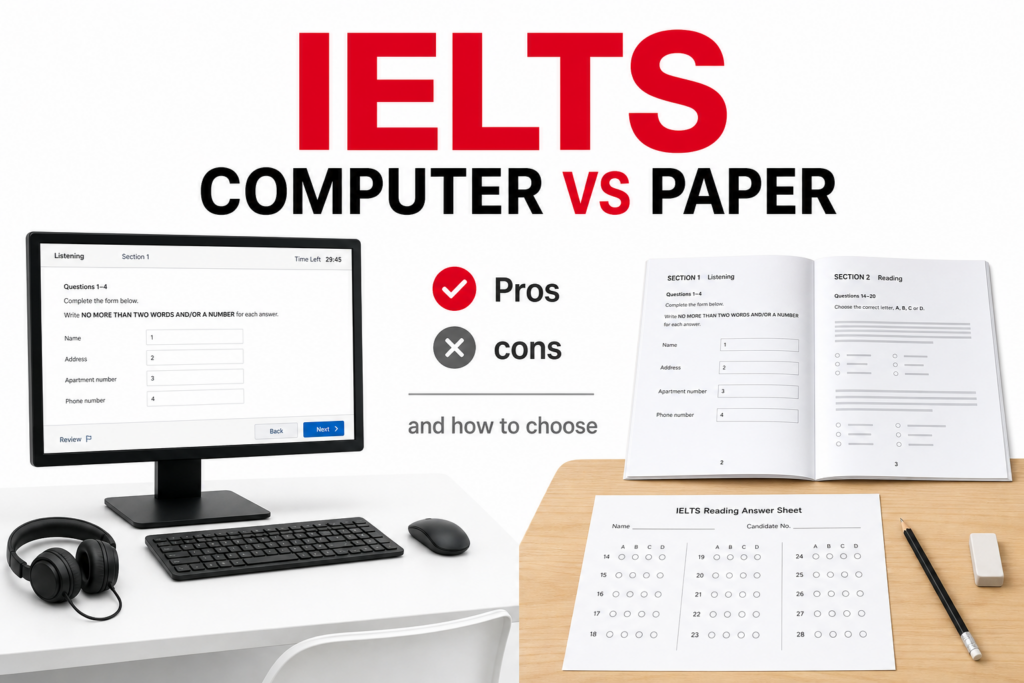
This guide breaks the decision down in a practical way. We will look at how the two formats compare in Listening, Reading, Writing, and test-day logistics, where each option gives an advantage, and the kind of candidate who usually performs better in each format. The goal is not to label one version as universally easier. The goal is to help you choose the format that gives you the best chance of hitting your target band.
What stays the same in computer-based and paper-based IELTS
Let us clear up the biggest misconception first. The format changes, but the IELTS test itself does not. The scoring system is the same. The question difficulty is the same. The speaking interview is still conducted with a real examiner. Academic and General Training content still follow the same official structures. Your band score does not receive any bonus because you used a computer, and it does not suffer any penalty because you used paper.
That means you should not choose based on rumours like “computer IELTS is easier” or “paper IELTS is more respected.” Neither claim is true. The difference is operational. How you navigate the questions changes. How you move through the reading passages changes. How you draft your writing changes. How quickly you receive results may also change. Those practical differences can matter a lot, especially if one section is already a weakness for you.
If you want a broader breakdown of section timing and scoring before deciding, read our IELTS Test Format Guide. It gives the baseline structure both delivery modes still follow.
- Same band descriptors and same official scoring
- Same question types and same section order
- Same speaking interview with a trained examiner
- Different delivery method, interface, and test-day workflow
Computer-based IELTS: the main advantages
Computer-based IELTS works well for candidates who already read and write comfortably on screens. If you type much faster than you handwrite, this format can immediately reduce pressure in Writing. Editing is easier because you can insert a sentence, delete repetition, and move through your response without crossing things out or rewriting large sections. That matters in Task 2, where planning and restructuring often separate a Band 6.5 essay from a Band 7 response.
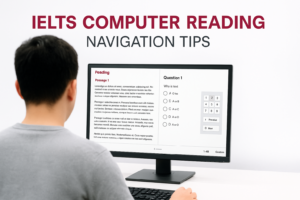
Another advantage is clarity. On a computer, your writing is always legible. If your handwriting becomes messy when you rush, computer delivery removes that risk. In Reading, many candidates also like being able to highlight text and move between the passage and questions without physically turning pages. In Listening, headphones can make the audio feel more controlled and reduce distraction from a larger room.
Results are often released faster for computer-based IELTS as well. If you are working toward a visa deadline or university application, that shorter turnaround can be a real advantage. It does not improve your score, but it may improve your timeline.
- Faster editing in Writing
- No handwriting legibility risk
- Screen navigation can feel cleaner for some candidates
- Results are often available sooner
Computer-based IELTS: the main disadvantages
The same features that help some candidates can hurt others. If you are not comfortable reading long passages on a screen, Reading may become more tiring. Some candidates skim less effectively on-screen and lose time scrolling up and down instead of seeing the whole passage spread across paper. That is not a knowledge problem. It is an interface problem, and it can affect accuracy when you are under time pressure.
Typing speed is another hidden issue. People often assume they type quickly enough because they send messages all day. IELTS Writing is different. You need to type full academic sentences, vary grammar, and proofread carefully. If you type slowly, make frequent keyboard errors, or look down at the keys constantly, computer-based IELTS can create more pressure instead of less.
There is also the concentration factor. Some candidates feel more alert with a paper booklet and less overwhelmed by screens. Others over-edit on the computer, which sounds harmless but can waste critical minutes. A screen makes it easy to keep changing sentences that were already good enough.
If you need a realistic benchmark before you choose, it is worth working through a few timed tasks and then comparing your performance against our unlimited IELTS mock tests. That is a far better decision tool than picking the format based on comfort alone.
Paper-based IELTS: the main advantages
Paper-based IELTS still suits a large number of candidates, especially those who process information better visually on a physical page. In Reading, many people find it easier to scan, underline, circle keywords, and keep track of location when they can see the whole passage in front of them. If you are the kind of learner who annotates naturally, paper can feel more intuitive and less fatiguing.
Paper also works well for candidates who plan Writing by hand anyway. Some people think more clearly when they sketch a quick idea map, cross out weak vocabulary, or jot supporting points in the margin. That tactile process can help them produce a more coherent essay, even if handwriting the final answer takes longer.
Another practical advantage is familiarity. If most of your school, university, or English-test practice has been paper-based, sticking with paper may reduce test-day friction. Familiar rhythm matters. A format that feels normal is often easier to manage when nerves kick in.
- Easier annotation for many Reading candidates
- Less screen fatigue during long passages
- Natural fit for hand-written planning
- Often better for candidates who prefer a traditional exam feel
Paper-based IELTS: the main disadvantages
The biggest drawback is Writing speed. If your handwriting slows down when you think, or becomes hard to read when you rush, paper-based IELTS can cost you marks indirectly. Examiners are trained to assess language, not handwriting style, but unclear writing makes your work harder to process and increases the risk of avoidable mistakes.
Paper also makes editing slower. If you want to change the structure of a paragraph, you cannot simply move text around. You have to cross out, squeeze new ideas into limited space, or rewrite sections mentally while keeping momentum. That can be especially frustrating for candidates who refine their essay as they go.
There is one more issue many candidates underestimate: transferring answers. In paper-based Listening, you usually write on the question paper first and then transfer answers to an answer sheet. That creates one more task to manage accurately. A simple spelling mistake or transfer slip can cost a mark that had nothing to do with actual listening ability.
- Handwriting quality matters more under pressure
- Editing is slower and messier
- Answer transfer creates an extra accuracy risk
- Results may take longer depending on the test centre
How to decide which format is better for your score
The cleanest way to choose is to stop thinking about preference in the abstract and test your actual behaviour. Ask yourself four concrete questions.
- Do I type faster and more accurately than I handwrite?
- Can I read long passages comfortably on a screen for an hour?
- Do I rely on circling, underlining, and margin notes to stay organised?
- When I practise timed writing, which format produces the stronger final answer?
If your answers point strongly in one direction, the choice is usually obvious. Fast typists with neat screen habits often do better on computer-based IELTS. Candidates who annotate heavily and dislike long screen reading often do better on paper. The key is not your opinion about the format. It is the quality of the work you produce inside the official time limit.
One useful comparison is to treat this like any other IELTS decision: protect the section that is most likely to fall below your target. If Writing is your weakest skill and typing helps you organise faster, computer delivery may be the safer option. If Reading is your weak section and paper helps you track detail more accurately, paper may be the better defensive choice.
Best format by candidate type
While no rule fits everyone, some patterns show up repeatedly.
Computer-based IELTS usually suits: candidates who type daily for work or study, candidates with messy handwriting, candidates who want faster results, and candidates who feel comfortable switching between windows, tabs, or digital documents in normal life.
Paper-based IELTS usually suits: candidates who read more effectively on printed pages, candidates who annotate heavily, candidates who feel mentally fresher away from screens, and candidates who trust their handwritten planning process more than typed drafting.
There is also a middle group: candidates who could succeed in either format. If that is you, choose based on the section where you need the biggest practical edge, not the section where both already feel easy.
Ready to find out your IELTS band score?
Take the IELTS Express Pre-Test for just $4.99 and get your personalised band prediction with a 14-day improvement plan.
FAQ: IELTS computer vs paper based pros cons
Is computer-based IELTS easier than paper-based IELTS?
No. The test difficulty and scoring are the same. Computer-based IELTS only feels easier if typing, screen reading, and digital navigation suit your habits better than handwriting and paper annotation.
Do universities or migration authorities prefer one IELTS format over the other?
No. Institutions care about your official IELTS score, not whether you completed the test on paper or on a computer. Both formats are accepted when booked through official IELTS providers.
Which IELTS format gives faster results?
Computer-based IELTS often returns results faster than paper-based IELTS, although exact timing depends on the test provider and location. If deadlines matter, always check the current turnaround before booking.
Is Writing better on computer or paper?
That depends on how you produce your best work. If you type quickly and edit efficiently, computer-based Writing is often better. If you think more clearly by hand and your handwriting stays neat under pressure, paper can still be a strong option.
Should I switch formats close to my test date?
Only if practice evidence shows the other format clearly improves your performance. Changing formats late without timed practice can create unnecessary friction and hurt confidence on test day.
Final decision: choose the format that protects your weakest section
When candidates ask about IELTS computer vs paper based pros cons, they often want a simple winner. There is no honest universal answer. The right choice depends on which delivery method helps you stay accurate, calm, and efficient across the full test. If you type better than you write, want faster results, and handle screen reading well, computer-based IELTS is often the better fit. If you read better on paper, annotate constantly, and trust your handwritten process, paper-based IELTS may protect your score more effectively.
The smart move is to make the choice with evidence. Run timed practice in both conditions if possible, compare your output honestly, and pick the format that gives you fewer avoidable mistakes. IELTS is hard enough already. Do not lose marks because you booked a delivery mode that fights your natural working style.