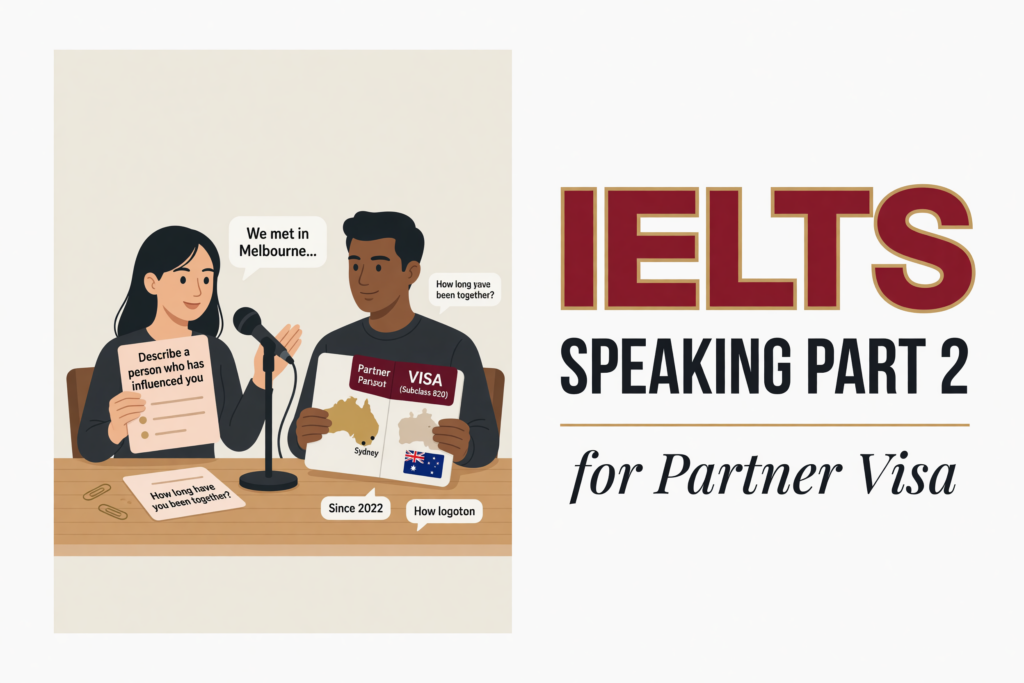
If you are searching for IELTS Speaking Part 2 for Partner Visa, you are probably asking a very practical question: how much does this cue card section matter when your visa plans depend on a safe English result? That matters because many applicants spend too much time memorising random sample answers and not enough time building a speaking method they can repeat under pressure. Before you book or rebook a test, take the IELTS Express Pre-Test to get a clearer picture of your current band level and whether speaking is already the section putting your result at risk.
Part 2 can feel stressful because you have to speak alone for up to two minutes while staying organised, natural, and relevant. For partner visa applicants, that pressure often feels heavier because the test is linked to timelines, application costs, and peace of mind. The good news is that you do not need a dramatic story or a perfect accent. You need a reliable structure, clear language, and enough control to protect your speaking score when the stakes are real.
What IELTS Speaking Part 2 for Partner Visa usually means in practice
When people search for IELTS Speaking Part 2 for Partner Visa, they are usually not asking whether the cue card exists in the test. They are asking whether this section could quietly lower the Speaking band they need for their visa pathway. In practice, that is the right question. Part 2 matters because it tests fluency, organisation, vocabulary, and pronunciation in one uninterrupted response, and that short performance can influence how stable your whole Speaking score looks.
The exact visa requirement should always be checked against current official guidance and your personal circumstances. Even so, the preparation logic is simple. If Speaking is your weakest skill, ignoring Part 2 is risky. A candidate can sound comfortable in short Part 1 questions and still lose control when asked to speak for two minutes on one topic.
- Part 2 strongly affects the impression you create in Speaking
- One weak long answer can expose problems with fluency and organisation
- Partner visa preparation should focus on repeatable score control, not lucky topics
Why this part becomes a problem for otherwise capable candidates
Many partner visa applicants use English every day with family, friends, or at work. That can create false confidence. Everyday communication helps, but IELTS Speaking Part 2 is still an exam task. It rewards structure, timing, development, and clear delivery under pressure. Those are not always the same skills you use in normal conversation.
Another common problem is assuming that any personal story will work if you speak confidently enough. Candidates often choose a story too late, change direction halfway through, or repeat simple language because they have no clear speaking map. A better approach is to prepare a flexible response framework you can adapt to common themes such as family, travel, study, work, and migration. If you want a broader view of the test, this IELTS Speaking Test complete guide is a useful starting point.
What examiners are really listening for in Part 2
Examiners are not judging whether your story is exciting. They are listening for whether you can keep speaking with enough fluency, organise your ideas clearly, use vocabulary naturally, and pronounce words clearly enough to stay easy to understand. In plain language, they want a response that feels controlled, relevant, and human.
This is useful for partner visa candidates because it removes some of the mystery. You do not need an advanced speech full of memorised expressions. You need a simple answer that starts clearly, develops logically, and ends naturally. A well-shaped answer with steady language is usually safer than an ambitious answer that sounds half-rehearsed and half-lost.
- Name the topic clearly at the start
- Follow a simple timeline or structure
- Add specific reasons and details instead of vague statements
- Finish with a clear feeling, result, or final judgement
IELTS Speaking Part 2 for Partner Visa needs a safer score strategy
If your visa timeline matters, one good practice answer is not enough. You need a speaking strategy that still works when you are nervous, tired, or given a topic you did not expect. That means testing whether your speaking quality stays stable across several cue card themes, not only your favourite ones.
A safer strategy starts by identifying what usually goes wrong. Some candidates run out of ideas after forty seconds. Others speak for longer but become repetitive, disorganised, or unclear. Some rely on memorised openings that sound polished at first and then collapse when the real cue card takes a different angle. If you want a stronger idea of your current consistency, access unlimited IELTS mock tests and compare how well your speaking holds up across different topics.
The goal is not to sound clever. The goal is to sound stable. Stable speaking usually scores better than impressive speaking that breaks apart under time pressure.
A practical structure that works under pressure
Most partner visa candidates do better when they stop trying to invent a perfect answer and start using a repeatable structure. A simple four-part shape works well for many cue cards. First, say what the thing, person, event, or situation is. Second, explain when and where it happened. Third, give the reason it mattered. Fourth, explain the result or how you felt about it.
This structure is useful because it buys time without sounding artificial. Each part gives you a clear job, which makes it easier to keep speaking. If you only rely on memory, silence often appears halfway through the answer. If you rely on structure, you can keep moving even when the topic is not ideal.
- Topic: what are you talking about?
- Context: when, where, or with whom did it happen?
- Reason: why was it important?
- Result: what happened, and why does it matter now?
How to choose examples that sound natural and safe
One of the smartest things you can do is choose examples from your real life that are easy to explain. They do not need to be impressive. In fact, ordinary examples are often better because you can describe them more naturally. A visit with your partner’s family, an important phone call, a study decision, or a travel plan can all work if the story has clear detail and a believable reason behind it.
For partner visa candidates, migration-related life events can feel especially relevant, but do not force every answer to become a visa story. That often sounds unnatural. Instead, keep a small bank of genuine personal experiences that can be adapted across several cue card themes. If you are also preparing around migration-focused score requirements, the IELTS for Partner Visa complete guide can help you keep the bigger picture in view.
A natural answer usually includes a specific detail, a simple reason, and one feeling that sounds believable. That is enough. You do not need cinematic storytelling.
Common mistakes that quietly lower partner visa speaking results
One common mistake is memorising one polished answer and trying to force it onto every topic. Examiners can usually hear when an answer does not quite fit the question. Another mistake is spending too long on background information and never reaching the main point. That weakens organisation and can make the answer feel thin even if you spoke for the full time.
There is also a language mistake that catches many otherwise capable candidates. They keep repeating basic words such as good, nice, happy, and important instead of adding slightly more precise language. The answer then sounds flatter than it needs to. Precision does not mean using difficult words. It means choosing simple words that actually fit the meaning.
- Do not force one memorised story onto every cue card
- Do not spend one minute on setup and ten seconds on the real answer
- Do not repeat the same simple adjectives too often
- Do not panic if the topic feels ordinary; ordinary topics often produce the most natural answers
How to build fluency without sounding memorised
Fluency in Part 2 does not mean speaking very fast. It means keeping the answer moving with enough continuity and control. You can build that by practising transitions that feel natural, such as what stands out most, the main reason for that, or what made it memorable. These phrases help you connect ideas without sounding like a script.
You should also practise speaking from bullet points rather than full sentences. In the real test, you get one minute to prepare notes, not a full script. If your practice always depends on memorised paragraphs, you are training the wrong skill. A better routine is to make short note prompts and then speak around them in a natural way.
If your preparation still feels scattered, see our IELTS preparation plans and compare the level of support that matches your visa timeline and speaking target.
What a realistic improvement plan looks like
Speaking improvement is usually less dramatic than people hope, but more predictable than they fear. If your Part 2 answers are currently disorganised, structure alone can lift the quality quickly. If your structure is already acceptable, the next gains often come from stronger detail selection, better transition language, and cleaner pronunciation of common word groups.
A realistic weekly plan might include three timed cue cards, one review session where you listen back to yourself, one vocabulary session focused on replacing repeated words, and one session where you practise one-minute planning only. That rhythm works because it combines performance and correction. You are not only talking more. You are also learning how to stop repeating the same weaknesses.
Midway through preparation, it is worth checking whether your speaking performance is actually improving or only feeling more familiar. That kind of evidence matters more than motivation alone.
How Part 3 connects to your Part 2 performance
Many candidates treat Part 2 as an isolated task, but it often shapes what happens next. If your cue card answer is clear and controlled, you usually enter Part 3 feeling calmer and more organised. If Part 2 goes badly, panic can carry forward into the discussion questions.
This matters for partner visa candidates because the safest speaking result usually comes from consistency across the whole interview. A strong Part 2 answer does not need to be perfect, but it should leave you settled enough to keep thinking clearly. That is one reason why repeatable structure matters so much. It protects not only the cue card itself, but also your mindset for the rest of the test.
Before the FAQ, use this quick checkpoint if you want a clearer sense of whether your current speaking level is already close to safe:
Ready to find out your IELTS band score?
Take the IELTS Express Pre-Test for just $4.99 and get your personalised band prediction with a 14-day improvement plan.
FAQ: IELTS Speaking Part 2 for Partner Visa
Does IELTS Speaking Part 2 matter for a partner visa result?
Yes. Part 2 matters because it can reveal how well you organise ideas, maintain fluency, and use language over a longer answer. That can affect the strength of your overall Speaking band.
Do I need advanced vocabulary to score safely in Part 2?
No. You need accurate and natural vocabulary, not flashy vocabulary. Clear, well-chosen words are usually safer than difficult words you cannot control properly.
Should I memorise cue card answers before the test?
It is better to memorise a structure than a full answer. A rigid script often sounds unnatural and can break down when the real topic changes slightly.
What is the biggest mistake partner visa applicants make in Speaking Part 2?
One of the biggest mistakes is relying on general speaking ability without building a clear response structure. Many candidates can communicate well, but still lose marks because the answer becomes repetitive or disorganised.
How should I practise if Part 2 is my weakest area?
Practise short planning, timed speaking, and honest review. Record yourself, check where the answer becomes weak, and then fix that exact pattern instead of just doing more random cue cards.
Protect your speaking score before it delays your visa plans
The real issue behind IELTS Speaking Part 2 for Partner Visa is not whether the cue card feels scary. It is whether your speaking system is reliable enough when timing, stress, and real consequences are involved.
If Part 2 is your weak section, fix it directly. Build a repeatable structure, practise with topics you did not choose yourself, and check whether your fluency stays stable when the pressure rises. That is far more useful than guessing, memorising, or hoping for a friendly topic. A calmer speaking process usually leads to a safer result, and a safer result makes the rest of the visa journey much less painful.