If you are comparing Ielts Vs Oet For Nurses Australia, you are probably trying to avoid an expensive mistake. The wrong test choice can cost time, money, and confidence, especially if you need English results for AHPRA registration, nursing job applications, or migration planning. Before you lock yourself into one path, take the IELTS Express Pre-Test to see whether IELTS is already close to your target or whether another option may suit you better.
Many nurses hear simple advice like “OET is easier” or “IELTS is more recognised”, but those shortcuts are not enough. The better question is which exam matches your current English profile, your timeline, and the exact score pattern you need. For some nurses, OET feels more natural because the language is clinical and job-related. For others, IELTS is safer because the format is more familiar, the preparation materials are broader, and the scoring system is easier to track.
What IELTS vs OET for nurses Australia really means
When nurses search for IELTS vs OET for nurses Australia, they are usually not asking for a theoretical comparison. They want to know which test gives them the best chance of getting the required English result without wasting multiple attempts. That is the right focus. Both exams can be accepted in Australian healthcare pathways, but the smarter choice depends on test fit, not online rumours.
In practice, the decision often comes down to three things: the style of English you handle best, the score profile you are most likely to achieve, and how much preparation time you realistically have. Nurses who are strong in workplace communication may feel more comfortable with healthcare scenarios in OET. Nurses who prefer a broader academic-style exam may do better with IELTS. The point is not which test sounds kinder. The point is which one protects your result.
- Choose based on score reliability, not marketing claims
- Check the exact requirement for your pathway before booking
- Match the test format to your real strengths under pressure
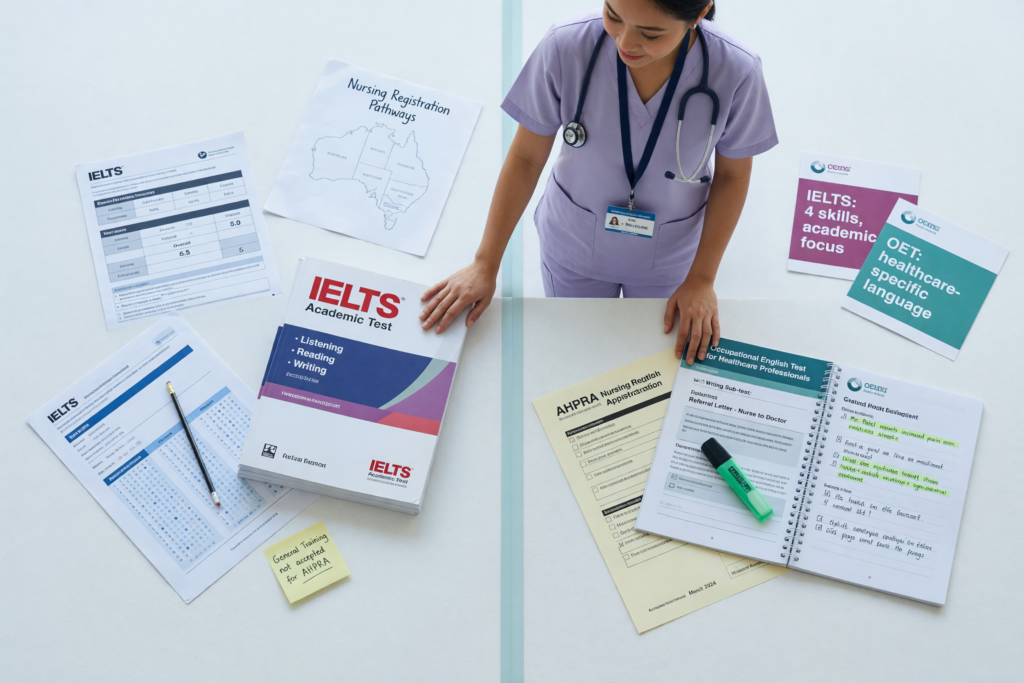
How IELTS and OET differ for nursing candidates
IELTS tests general academic English across Listening, Reading, Writing, and Speaking. Even when the goal is nursing registration, the tasks are not specifically about hospital work. You may read general texts, write an essay, and speak about common topics. That makes IELTS flexible, but it can also feel disconnected from your professional world.
OET, by contrast, is built around healthcare communication. For nurses, the tasks use medical or clinical contexts, especially in Reading, Listening, and Writing. The Writing task is usually a referral or discharge-style letter rather than an essay. The Speaking test uses role plays connected to patient care. Many nurses like that because the language feels more relevant. That said, relevance does not automatically mean easy. If your grammar, listening accuracy, or time control are shaky, OET can still punish those weaknesses.
Which test is usually easier for nurses
This is where bad advice spreads fast. OET is often described as easier for nurses because the content is healthcare-related. There is some truth in that. If you already communicate in clinical settings and feel confident with patient-centred language, OET may feel more intuitive than writing a formal IELTS Task 2 essay. The context can reduce mental load because you are not starting from zero.
But “more familiar” is not the same as “easy”. OET still requires careful reading, accurate listening, disciplined writing, and controlled speaking. Some nurses struggle because they assume professional experience alone will carry them through. It will not. You still need exam technique. On the other side, IELTS may feel harder at first, but it can become very manageable if you like structured preparation and want a broad bank of practice resources. If you need stronger exam repetition before choosing, access unlimited IELTS mock tests and compare how stable your performance stays across different sections.
- OET may feel easier if clinical communication is already one of your strengths
- IELTS may feel safer if you prefer familiar exam formats and broad study resources
- Neither test is easy if your weak skill is still weak
Scoring differences that matter in real life
One of the biggest differences in the IELTS vs OET for nurses Australia decision is scoring clarity. IELTS uses band scores, which many candidates already know. You can track progress in half-band steps and see fairly quickly whether one section keeps dragging you down. For people who like measurable progress, that helps.
OET uses letter grades and score ranges, which can feel less intuitive at first if you have spent years hearing people talk about IELTS 7.0 or 7.5. Some nurses still prefer OET scoring because it feels tied more directly to professional communication outcomes. Others find IELTS easier to plan around because the band language is so widely understood in migration and education discussions.
The important thing is not which system looks nicer on paper. It is which exam lets you hit the required threshold more consistently. If one test leaves you strong in three skills but repeatedly short in one, that is the risk you need to solve.
Writing is often the deciding factor
For many nurses, the biggest split between IELTS and OET is the writing task. In IELTS, you usually need to produce a structured essay under time pressure. That means planning an argument, organising paragraphs, and controlling grammar while staying relevant to the question. Nurses who have not written essays for years often find this the most frustrating part of the exam.
In OET, the writing task is profession-specific. For nurses, it is usually a formal healthcare letter based on case notes. Many candidates prefer this because the task looks more practical and closer to real work. If you already know how to communicate clearly about patient needs, the structure may feel more natural.
Still, do not romanticise it. OET Writing can be harsh if you are weak at selecting relevant details, organising notes, or keeping the tone appropriately professional. IELTS Writing can also be improved quite quickly once you build a repeatable essay system. If your main concern is whether you can lift writing fast enough, see our IELTS preparation plans and compare which kind of support fits your timeline and target score.
Speaking and listening: where confidence can mislead you
Many nurses assume OET Speaking must be safer because it uses healthcare role plays. Sometimes it is. If you are comfortable speaking kindly and clearly with patients, that format can feel less artificial than IELTS Speaking topics about studies, work, hobbies, or daily life. The role-play context gives you something practical to do, which helps some candidates relax.
But familiarity can also hide sloppy habits. In OET Speaking, candidates may rely on warmth and general fluency while missing the language control the test still expects. In IELTS Speaking, the task may feel less relevant to nursing, but it is often easier to prepare systematically because the format is very well documented. Listening has a similar trade-off. OET listening content may sound more familiar, but if you lose detail under pressure, that familiarity does not save you.
Availability, cost, and preparation resources
Practical factors matter more than people admit. Test dates, local availability, rebooking flexibility, and preparation resources can all affect your result. IELTS usually has a large ecosystem of materials, practice tests, tutors, and online explanations. That makes it easier to find help quickly if your timeline is tight.
OET preparation has grown, but it is still more specialised. That can be a benefit if you want targeted healthcare-focused training, but it can also mean fewer cheap or free resources compared with IELTS. Cost and convenience can differ by centre and date as well, so it is worth checking the real options in your area instead of assuming one exam is automatically easier to schedule.
- Compare real test dates before deciding
- Check whether you have enough preparation material for your weaker skills
- Think about retake risk, not only first-attempt cost
A safer way to choose between IELTS and OET
The safest approach is evidence, not opinion. Start by checking the current English test acceptance rules for your exact pathway. Then compare your own strengths honestly. If essay writing is a major weakness but workplace communication is strong, OET may be the better fit. If you already understand IELTS scoring, have solid general English, and want broad practice materials, IELTS may be the cleaner path.
Do not choose based only on what colleagues say felt easier. Their strengths may not match yours. A nurse who speaks confidently with patients may still struggle with OET writing. Another nurse may hate IELTS essays but perform very steadily once a good structure is in place. The right exam is the one that gives you a repeatable result, not the one that sounds less scary on social media.
Ready to find out your IELTS band score?
Take the IELTS Express Pre-Test for just $4.99 and get your personalised band prediction with a 14-day improvement plan.
FAQ: IELTS vs OET for nurses in Australia
Is OET easier than IELTS for nurses in Australia?
Sometimes, but not always. OET may feel more natural if you are strong in clinical communication, but it still demands disciplined exam technique. IELTS can be safer for candidates who prefer a widely practised format and clearer score tracking.
Do Australian nurses have to take OET instead of IELTS?
No. Many pathways accept more than one English test, but you must check the current rule for your exact registration, visa, or employment pathway before booking.
Which writing task is usually better for nurses?
Nurses who dislike essay writing often prefer OET because the task is a healthcare letter. Nurses who are comfortable with structured argumentative writing may still do well in IELTS.
Can I prepare for IELTS faster than OET?
That depends on your starting point. IELTS often has more general practice materials, which can speed up study. OET can be faster if your professional communication habits already match the exam style.
What is the safest way to decide?
Compare the official acceptance rules, your weakest skill, and the kind of task you can repeat under pressure. If possible, do practice work for both formats before paying for a real test attempt.
Choose the exam that protects your nursing pathway
The real answer to Ielts Vs Oet For Nurses Australia is not a universal winner. It is a fit question. If OET matches your communication style better, that may lower your risk. If IELTS gives you stronger structure, wider resources, and more predictable progress, that may be the smarter choice.
Either way, the goal is the same: protect your timeline, reduce avoidable retakes, and choose the path that gives you the most reliable result. That is a much better strategy than chasing the exam that someone else called easier.