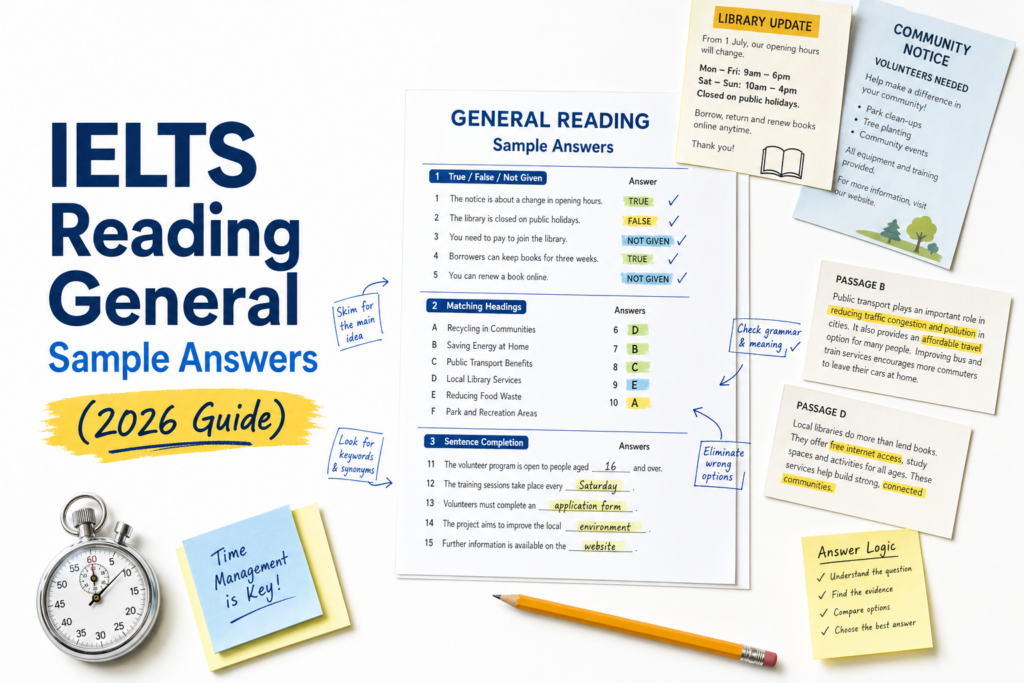
If you are searching for IELTS Reading General sample answers, you probably want more than a list of letters and short responses. You want to understand why a strong answer is correct, how it matches the question, and what mistakes cause candidates to lose easy marks. Before you assume your Reading score is already safe enough, take the IELTS Express Pre-Test to get a clearer picture of your current band score and the sections that still need work.
That matters because sample answers are only useful when you study them properly. Many candidates look at an answer key, notice what they got wrong, and move on too quickly. A better approach is to treat each sample answer as evidence. You need to see the proof in the text, the wording limit in the instructions, and the paraphrase that links the question to the passage. Once you use sample answers that way, your practice becomes much more accurate.
What IELTS Reading General sample answers should actually teach you
Strong sample answers are not there to impress you. They are there to teach you how the test works. In General Training Reading, the answer is rarely just a random word lifted from the page. It usually reflects a specific reading skill: spotting a date, following a rule, recognising a paraphrase, or understanding a contrast.
That is why a simple answer key is not enough on its own. If you only compare your answer with the correct one, you may miss the real lesson. A useful sample answer shows both the final response and the reason it works. When you understand that reason, you can repeat the process in the next practice test instead of guessing again.
If you need a wider picture of the section structure, this IELTS test format guide helps explain how the Reading paper is organised and why different question types need slightly different approaches.
Why candidates misuse sample answers and stay stuck
Many candidates use sample answers too passively. They finish a paper, check the key, and tell themselves they almost knew the answer. That feels comforting, but it does not improve the next score. The gap between “I can see it now” and “I would have found it in the test” is often quite large.
Another common problem is focusing only on vocabulary. Vocabulary matters, but it is not the only reason answers go wrong. In IELTS Reading General, candidates also lose marks because they ignore the word limit, misread instructions, choose an answer that is too broad, or spend too long on one question and rush the next set.
Good sample-answer review should therefore answer three questions: where was the proof, what exact wording was accepted, and what mistake caused the original error? If you do not answer those questions, you risk repeating the same pattern in every practice session.
How to read sample answers for Section 1 questions
Section 1 usually contains short practical texts such as notices, advertisements, leaflets, or simple instructions. The answers often look easy, which is exactly why candidates become careless. Sample answers in this section should teach precision, not just speed.
Imagine a notice about a community course that says registration closes on Friday and payment must be made online. If the question asks, “How must participants pay?” the correct sample answer may be online. A candidate who writes pay online before Friday may think the answer is stronger, but it breaks the rule if the instruction says NO MORE THAN ONE WORD.
That is one of the biggest lessons in IELTS Reading General sample answers: a correct idea in the wrong form is still wrong. In Section 1, you should train yourself to check the instruction first, then locate the specific detail, and then copy only what the question allows.
How sample answers help with paraphrasing in Section 2
Section 2 often includes workplace or everyday functional texts where the wording in the question does not exactly match the wording in the passage. This is where sample answers become especially useful. They show you how the test uses paraphrasing instead of simple word-matching.
For example, a workplace guide might say staff must submit supporting documents, while the question asks what employees need to provide. The correct sample answer may be supporting documents. A candidate who hunts only for the word provide may think the answer is missing.
When you review sample answers, look for these language shifts. Ask yourself which word in the question was rephrased in the passage. This habit helps you stop depending on exact repeated vocabulary. If your wider strategy for General Training Reading still feels shaky, you can access unlimited IELTS mock tests and practise this under realistic timing instead of only reviewing isolated questions.
Using sample answers to improve Section 3 accuracy
Section 3 usually contains the longest and most demanding passage. Here, sample answers should help you understand logic and passage structure, not only isolated facts. The question may require you to connect an idea across a paragraph, interpret a writer’s point, or avoid a nearby trap answer.
Suppose a passage explains that flexible work arrangements improve staff retention in some industries but are harder to apply in roles requiring fixed on-site coverage. A careless candidate may answer that flexible work is always effective. A stronger sample answer will show that the real point is more limited and depends on context.
This is why reviewing sample answers for longer passages should include the proof line and the surrounding sentence. The answer often lives in a small contrast such as however, although, or in some cases. If you only read the final answer and not the reasoning, you miss the part that actually improves your score.
Three common answer patterns you should notice
When you study enough IELTS Reading General sample answers, clear patterns begin to appear. Recognising these patterns makes the test feel less random and much more manageable.
- Direct factual answer: common in notices, forms, and short practical texts where the answer is a date, fee, place, or rule.
- Paraphrased answer: common when the question and passage describe the same idea with different wording.
- Careful logic answer: common in true, false, not given or more detailed longer-passage questions where meaning must be compared closely.
These patterns matter because they tell you how to search. A factual question rewards scanning. A paraphrase question rewards flexible vocabulary awareness. A logic question rewards slower comparison. The best candidates adjust their reading speed and attention based on the kind of answer they need.
How to turn sample answers into a real study method
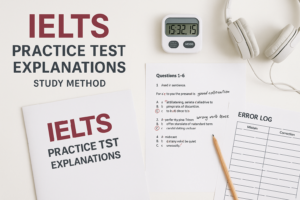
The smartest way to use sample answers is to create a repeatable review routine. After each practice set, return to every wrong answer and label the cause. Was it timing, vocabulary, instruction error, paraphrase confusion, or careless copying? Then write one short lesson beside it.
For example, your note might say, “Missed the word limit”, “Did not notice paraphrase”, or “Changed answer without evidence”. That quick diagnosis is far more useful than simply writing the correct answer in a different colour and moving on.
You should also revisit the text and highlight the proof line. This trains your eyes to connect the question with the exact supporting evidence. Over time, your review becomes less emotional and more practical. If your preparation still feels scattered, you can see our IELTS preparation plans and follow a more structured path instead of guessing which weakness matters most.
Sample answers will not help if your timing is collapsing
There is one important warning here. Sample answers are useful, but they cannot rescue poor timing on their own. Some candidates study answer keys very carefully and still underperform because they never practise finding the answer within the time pressure of the real test.
That is why you need both review and rehearsal. First, understand why a sample answer is right. Then, do another timed set and see whether you can find similar answers more efficiently. If your review improves but your speed does not, your final score may still stay unstable.
A practical timing split for General Training Reading is often around 15 minutes for Section 1, 20 minutes for Section 2, and 25 minutes for Section 3. The exact numbers can vary slightly, but the principle is simple: do not let early easy-looking questions steal the time needed for the harder final section.
What strong IELTS Reading General sample answers reveal about high scorers
When you look closely at strong sample answers, you start to notice the habits behind them. High scorers do not always know every word in the passage. They usually do three things well: they follow instructions carefully, they search with a clear purpose, and they do not panic when the wording changes.
They also protect easy marks. In early sections, they avoid over-reading. In later sections, they stay calm enough to compare meaning properly instead of guessing from topic similarity. That balance matters because Reading is not only a language test. It is also a decision-making test under pressure.
Seen that way, sample answers become more than a correction tool. They become a model of how accurate thinking looks on test day. That is the real value: not memorising answers, but learning the behaviour that produces them.
Ready to find out your IELTS band score?
Take the IELTS Express Pre-Test for just $4.99 and get your personalised band prediction with a 14-day improvement plan.
FAQ: IELTS Reading General sample answers
Are IELTS Reading General sample answers enough to improve my score?
No. They help most when you use them to understand proof, paraphrasing, and answer form. You still need timed practice so you can apply those lessons under exam conditions.
What should I check first when reviewing a sample answer?
Check the instruction and word limit first, then find the proof line in the passage. After that, compare the wording carefully so you can see whether the question used a paraphrase.
Why do I still get answers wrong even when I understand the passage later?
This usually happens because understanding after the test is easier than finding the answer during the test. The issue may be timing, weak navigation, or missing a paraphrase under pressure.
How many sample answers should I review in one study session?
Quality matters more than quantity. It is often better to review a smaller number carefully, with proof lines and error labels, than to rush through a large set without learning much from it.
Can sample answers help with true false not given questions?
Yes. They are especially helpful when you compare the statement with the exact wording in the passage and notice whether the idea is confirmed, contradicted, or simply not stated.
Your next step with sample answers
Use IELTS Reading General sample answers as a training tool, not a scoreboard. Look for the proof, respect the instruction, notice the paraphrase, and record the mistake pattern that caused the original error. That is how answer review starts producing better marks.
If you do that consistently, Reading becomes much less mysterious. You stop hoping the next paper will somehow feel easier, and you start building a method that works even when the wording changes or the pressure rises.