If you are preparing for IELTS Writing Task 2 for University Australia, you are probably dealing with more than one pressure at the same time. You may need the right overall band score, a safe Writing band, and enough confidence to write clearly under strict time limits. For many future students, Writing Task 2 feels risky because one weak essay can damage an otherwise good result. Before you keep guessing whether your current writing level is already safe for your study goal, take the IELTS Express Pre-Test to get a clearer view of your band score and the areas that still need work.
The good news is that IELTS Writing Task 2 responds well to structure. You do not need to sound like a university professor. You need to answer the question directly, build a clear position, support your ideas properly, and control your grammar well enough that the examiner never has to fight your meaning. That matters even more for students who want to study in Australia, because university pathways often depend on dependable academic English rather than vague potential.
Why IELTS Writing Task 2 matters for university entry in Australia
For many students, Writing is the section that feels least predictable. Reading and Listening can feel more objective, while Speaking gives you a chance to recover in real time. Writing Task 2 is different. You have to plan, organise, and express your ideas alone, within 40 minutes, while also meeting the band descriptors for task response, coherence and cohesion, lexical resource, and grammatical range and accuracy.
That matters for Australian university applicants because the required IELTS profile is often not only about the overall score. Many institutions also care about section minimums. A student with a strong overall band can still face delays if Writing drops below the required threshold. If you need the wider pathway context first, this IELTS for University Australia complete guide is a useful place to review score expectations and planning considerations.
What examiners actually want in Task 2
A lot of candidates make IELTS Writing Task 2 harder than it needs to be because they imagine the examiner wants something dramatic or deeply academic. In reality, the examiner wants a clear answer to the question, sensible development of ideas, and language that is accurate enough to communicate your meaning smoothly. You are not being marked on whether your opinion is exciting. You are being marked on whether your argument is relevant, organised, and well expressed.
Strong essays usually do four things well:
- answer the exact question instead of a nearby topic
- present a clear position early and maintain it
- develop main ideas with explanation and examples
- stay easy to follow from introduction to conclusion
When those basics are stable, your score becomes much safer. When they are missing, advanced vocabulary alone will not rescue the essay.
How IELTS Writing Task 2 for University Australia differs from casual English writing
Students often confuse everyday fluent English with exam-ready written English. In casual writing, you can wander a little, repeat yourself, or rely on tone to carry the message. In IELTS Writing Task 2, that usually costs marks. The essay must feel controlled. Each paragraph needs a purpose, and each sentence needs to move the argument forward.
This is especially important for future university students because academic study in Australia expects organised reasoning. IELTS is not the same as writing a university essay, but there is some overlap. Examiners reward clarity, logical sequencing, and relevant support. That means your practice should not focus only on generating ideas. It should also train you to shape those ideas into a clean argument that another person can follow quickly.
A reliable essay structure you can use under time pressure
One of the safest ways to improve IELTS Writing Task 2 for University Australia is to use a repeatable structure. You do not need ten templates. You need one dependable framework that works across common question types such as opinion, discussion, advantages and disadvantages, problem and solution, and double question essays.
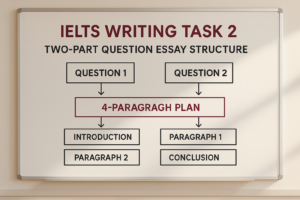
A practical structure looks like this:
- Introduction: paraphrase the question and state your position clearly
- Body Paragraph 1: present one main idea, explain it, and support it with a relevant example
- Body Paragraph 2: present a second main idea or balanced contrast, then develop it properly
- Conclusion: summarise your position without introducing new arguments
This structure is effective because it protects coherence. It stops you from listing many weak ideas instead of developing two strong ones. If your practice still feels inconsistent, it helps to access unlimited IELTS mock tests and test whether your structure still holds up when the clock is running.
How to plan in the first five minutes without wasting time
Many students either over-plan or do not plan at all. Both habits are expensive. If you plan for too long, you start writing in a rush. If you start immediately, your essay often loses direction halfway through. A smarter approach is to spend a few minutes making three decisions before you write your first sentence.
First, identify the exact question type and what it is asking you to do. Second, choose your position. Third, decide the two main body ideas that will support that position. That is enough. You do not need a perfect essay in note form. You just need a clear road map.
A quick plan might include:
- your direct answer to the question
- two body paragraph topics
- one example or real-world context for each paragraph
- a reminder of any contrast or limitation you want to mention
This small planning habit often creates a large score difference because it reduces repetition, contradiction, and messy paragraphing later.
What a strong university-pathway Task 2 paragraph looks like
A strong paragraph does not only make a point. It also explains why that point matters. Many candidates write a topic sentence and then add another sentence that says almost the same thing in different words. That looks like development, but it is really repetition.
A better paragraph usually follows a simple internal pattern: point, explanation, example, link back. For example, if you argue that universities should teach practical workplace skills alongside theory, your paragraph might explain how that prepares students for real employment, then give an example of internships, project-based learning, or industry collaboration. That makes the idea specific and convincing.
If you want a stronger benchmark for paragraph control, the IELTS Writing Task 2 band score strategy guide is a useful reference for how examiners separate safe essays from stronger ones.
Common mistakes students make in IELTS Writing Task 2 for University Australia
Some mistakes are so common that they deserve blunt attention. One is answering the general topic instead of the exact question. Another is writing an introduction that sounds polished but never gives a clear opinion. A third is presenting examples that are too vague to help the argument.
Other frequent problems include:
- writing body paragraphs that mix too many ideas
- using memorised phrases that sound unnatural
- forcing advanced vocabulary that is not fully understood
- making grammar errors in long sentences that were too ambitious
- running out of time and producing a weak conclusion
These issues matter because they quietly pull down more than one band criterion at once. For example, an unclear position affects task response and coherence together. A badly controlled long sentence can damage grammar and clarity at the same time.
How to improve vocabulary without sounding forced
For this kind of essay, vocabulary improvement is usually about precision, not performance. You do not need rare words in every paragraph. You need the right words for academic discussion. Terms such as access, outcome, practical skills, financial pressure, academic support, and employment prospects are useful because they fit common university-related topics naturally.
It also helps to build flexible phrase families rather than isolated words. For example, instead of memorising one clever adjective, learn practical combinations such as meet entry requirements, cope with academic demands, develop independent study habits, and improve written communication. Those collocations sound more natural and are easier to control under pressure.
If your preparation still feels scattered, you can see our IELTS preparation plans and use a more structured study process instead of trying to fix Writing by intuition alone.
Time management for a calmer 40-minute essay
Good candidates still lose marks when time management collapses. A practical model is to spend about 5 minutes planning, 30 minutes writing, and 5 minutes checking. The exact split can vary slightly, but the principle matters. You need time at the end to catch grammar slips, repeated words, and missing articles or endings.
During the writing stage, keep moving paragraph by paragraph. Do not chase the perfect introduction for seven minutes. A clear introduction is enough. The body paragraphs carry most of the score because that is where your argument actually lives. If one sentence becomes messy, simplify it and continue. The examiner rewards control more than theatrical complexity.
Students who want a university place often put extra pressure on themselves here, which is understandable. But panic usually makes the writing worse. A repeatable timing method is much more useful than emotional intensity.
How to practise Task 2 if your test date is getting close
If your exam is near, stop trying to improve everything at once. Use a short cycle that connects writing, review, and repair. Write one full Task 2 essay under timed conditions, then review it honestly against the band criteria. After that, rewrite only the weakest part. Sometimes the best use of time is not another full essay but a better version of one poor body paragraph or introduction.
A practical short-cycle plan might include:
- one timed essay every two or three days
- one focused paragraph drill on the days between
- one vocabulary review session based on your own common topics
- one grammar review session focused on sentence clarity, not random exercises
This approach works because it turns practice into correction. You are not just producing more essays. You are closing the gap between weak habits and stronger ones.
Ready to find out your IELTS band score?
Take the IELTS Express Pre-Test for just $4.99 and get your personalised band prediction with a 14-day improvement plan.
FAQ: IELTS Writing Task 2 for University Australia
What band do I need in IELTS Writing Task 2 for University Australia?
The required band depends on the university and course, but many institutions look at section minimums as well as the overall score. That is why a weak Writing result can still create a problem even if your total band looks competitive.
Is IELTS Writing Task 2 harder for university applicants?
The task itself is the same for all candidates, but university applicants often feel more pressure because academic entry requirements can depend on a safe Writing band. That pressure makes structure and time control even more important.
How many body paragraphs should I write in Task 2?
For most essays, two well-developed body paragraphs are enough. More paragraphs are not automatically better. Clear development is usually more valuable than extra structure that becomes thin or repetitive.
Should I memorise essay templates for IELTS Writing Task 2?
You can use a reliable structure, but memorised language should be used carefully. If it sounds unnatural or does not fit the exact question, it can damage your score instead of helping it.
What is the fastest safe way to improve IELTS Writing Task 2?
The fastest safe improvement usually comes from better planning, clearer paragraph development, and more honest review of repeated mistakes. Most students improve more through controlled correction than through writing large numbers of unchecked essays.
Your next step toward a safer Writing score
IELTS Writing Task 2 for University Australia becomes more manageable when you stop treating it like a creativity test and start treating it like a structure test. Answer the exact question, build two clear body ideas, support them properly, and keep your language controlled enough that your meaning stays clean from start to finish.
If you are aiming for university entry, that is actually encouraging. You do not need magic. You need a repeatable writing process that still works when the clock is running. Build that process now, test it under pressure, and your Writing score becomes much less of a gamble.