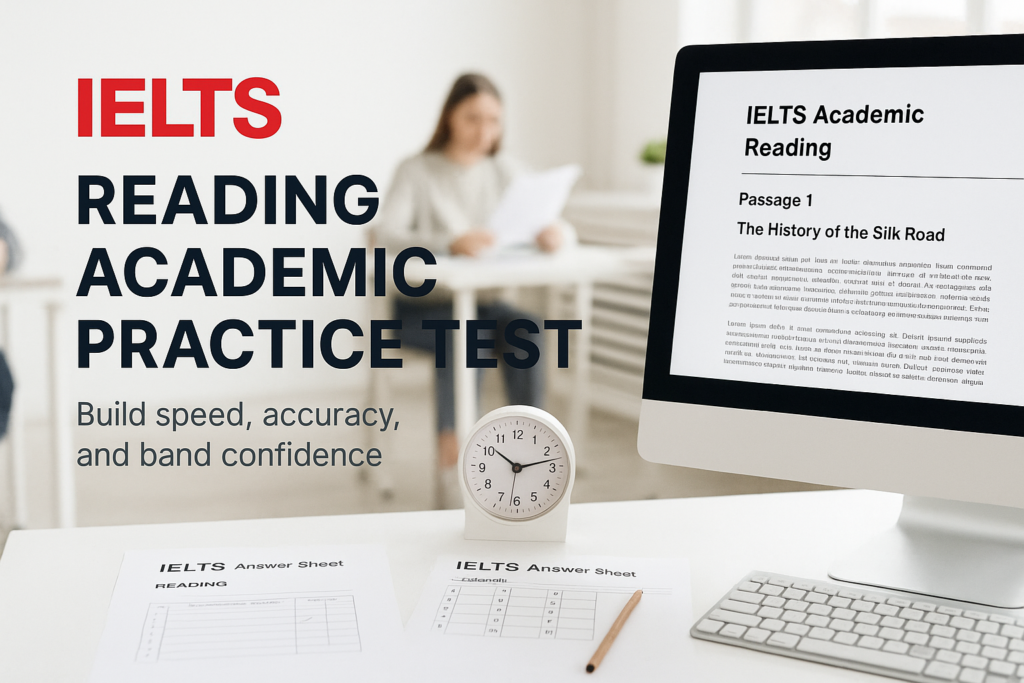
If you are searching for an IELTS Reading Academic practice test, you probably want more than a random passage and an answer key. You want practice that actually helps you read faster, answer more accurately, and understand why your score keeps rising or stalling. Many candidates do plenty of reading practice but still waste time, misread question instructions, or panic when the passage feels dense. Before you assume you are already close to your target score, take the IELTS Express Pre-Test to get a quick band prediction and a clearer view of what needs work.
What an IELTS Reading Academic practice test should help you measure
A good practice test is not only about getting a final number out of forty. It should show how you are performing under realistic pressure. In the Academic Reading test, your score depends on more than vocabulary. You need timing control, accurate scanning, calm decision-making, and a clear plan for different question types.
That means a useful IELTS Reading Academic practice test should help you answer three questions. First, are you finishing on time. Second, which question types are hurting your score most. Third, are your mistakes caused by language, attention, or weak strategy. If your practice is not showing those patterns, you are working hard without getting enough feedback.
Why many candidates practise reading but do not improve enough
One common problem is passive practice. A candidate completes a test, checks the answers, feels annoyed by the score, and moves on. That can feel productive, but it misses the real value of the exercise. The score tells you the outcome. It does not automatically tell you why the outcome happened.
Another problem is practising in a way that does not match the real exam. Some students do one passage at a time with unlimited time, read every word too carefully, or stop whenever they feel tired. That can be useful for learning, but it is not enough on its own. A real IELTS Reading Academic practice test should also train pacing. If you want a broader view of how Academic Reading fits into the full exam, the IELTS Exam Guide gives a helpful overview.
How the Academic Reading test is structured
The IELTS Academic Reading test contains three passages that usually become harder as you move forward. You have sixty minutes in total, and that includes transferring your answers on computer or paper. The texts often come from books, journals, magazines, or newspapers and are written for a non-specialist but educated audience.
Question types can include multiple choice, matching headings, true false not given, yes no not given, sentence completion, summary completion, matching information, and diagram or table completion. That mix matters because each task demands a slightly different reading habit. Some require a fast search for keywords. Others require careful understanding of the writer’s exact meaning.
If you do not know the structure well, practice tests can feel chaotic. Once the structure becomes familiar, your attention can move away from panic and towards execution.
How to use an IELTS Reading Academic practice test properly
The best way to use a practice test is in two stages. First, do the test under realistic conditions. Set a strict sixty-minute limit, remove distractions, and commit to moving on when time is gone. Second, review the paper slowly and diagnose the misses.
During review, ask better questions than “What was the correct answer.” Ask things like:
- Did I misunderstand the question instruction?
- Did I choose an answer too quickly because of a similar keyword?
- Did I spend too long on one difficult item?
- Did I miss a paraphrase in the passage?
- Did my concentration drop in passage three?
That kind of review is where improvement starts. A practice test is not just a test. It is a map of your habits. If you want more exam-style repetition once you know your weak areas, access unlimited IELTS mock tests and practise with a clearer purpose.
The biggest timing mistakes in Academic Reading
Time pressure is one of the biggest reasons candidates underperform. Some people spend too long trying to understand every sentence in passage one, then arrive at passage three with too little time left. Others rush the early sections, make preventable mistakes, and then feel forced to chase the clock for the rest of the test.
A more stable approach is to treat timing as a budget. You are not trying to read beautifully. You are trying to find enough meaning to answer accurately within the limit. Many candidates do well when they aim for roughly twenty minutes per passage, while staying flexible if one section is unusually demanding.
If timing is a major weakness, build your practice around shorter goals first. For example, see how long it takes you to complete one question set accurately, then gradually tighten the limit. That is often more effective than repeatedly doing full tests badly and hoping the pace will fix itself.
Question types that usually cause the most trouble
Not all errors mean the same thing. A candidate who struggles with matching headings may have a different problem from someone who misses true false not given questions. That is why every IELTS Reading Academic practice test should be broken down by question type after marking.
Common trouble spots include:
- True False Not Given: candidates often confuse “false” with “not given” when the passage does not directly comment on the statement
- Matching Headings: candidates choose based on one interesting word rather than the main idea of the whole paragraph
- Summary Completion: candidates ignore word limits or choose words that fit the topic but not the grammar
- Multiple Choice: candidates find one familiar phrase and stop checking the other options carefully
Once you know which question types are draining marks, your practice becomes more efficient. Instead of saying “my reading is bad,” you can say “my passage tracking is fine, but paraphrase recognition in summary tasks is weak.” That is the kind of problem you can actually fix.
How to review wrong answers so your score actually rises
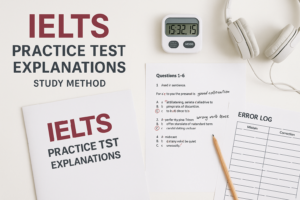
Good review is active. Do not only circle the correct answer and move on. Re-open the passage, find the evidence, and explain the mistake in plain language. If you cannot explain why your original answer failed, there is a good chance you will repeat the same mistake next time.
A simple review framework works well:
- Error type: timing, vocabulary, paraphrase, inference, or carelessness
- Trigger: what in the question or passage led you in the wrong direction
- Correction: what you should have noticed instead
- Prevention: one small rule to apply next time
For example, if you missed a true false not given item because the passage discussed a related idea but never confirmed the exact statement, your prevention rule might be: “Do not choose false unless the text clearly contradicts the statement.” Small rules like that create real score growth over time.
A simple weekly plan for Academic Reading practice tests
You do not need to do a full reading test every day. In fact, too many full tests can become wasteful if you never review them properly. A better plan mixes full-test pressure with targeted repair work.
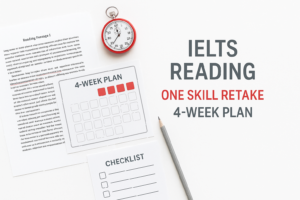
A practical weekly routine could look like this:
- Day 1: complete one full IELTS Reading Academic practice test under strict timing
- Day 2: review every wrong answer and group mistakes by question type
- Day 3: redo one weak question type with a shorter focused drill
- Day 4: practise one difficult passage and track your time per section
- Day 5: complete a second timed test and compare patterns with day one
This routine works because it combines measurement and repair. You are not just collecting scores. You are turning scores into action. If you want more structured support while building this routine, see our IELTS preparation plans and choose the level of guidance that fits your timeline.
How to tell if your current reading score is really test-ready
Many candidates get one encouraging practice score and assume they are ready. That can be risky. A better sign of readiness is consistency across several tests. If your score jumps between bands because your timing or focus keeps breaking down, you probably need more stabilisation before test day.
Look for patterns across at least three recent practice tests. Are you hitting your target score repeatedly. Are your mistakes becoming more predictable and manageable. Are you recovering better when a passage feels difficult. Consistency matters because the real exam rewards calm execution, not one lucky attempt.
It also helps to compare your reading performance with your wider exam profile. If your reading score is holding but other sections are wobbling, a full strategy check can save time. The IELTS Preparation Complete Guide is useful if you need that bigger-picture view.
What to do on test day if a reading passage feels unusually hard
Even strong candidates sometimes hit a passage that feels awful. The mistake is to treat that moment like a crisis. If one section feels dense, keep working the method. Read the task carefully, locate the relevant area, and avoid sinking too much time into one stubborn item.
Remember that every question carries the same marks. If you burn five minutes on one impossible answer, you may lose easier marks later. Make a sensible decision, move forward, and come back if time allows. That discipline is part of what a good IELTS Reading Academic practice test should be building in advance.
On test day, the goal is not to feel comfortable every second. The goal is to stay effective even when one part feels messy.
Ready to find out your IELTS band score?
Take the IELTS Express Pre-Test for just $4.99 and get your personalised band prediction with a 14-day improvement plan.
Frequently Asked Questions
How often should I do an IELTS Reading Academic practice test?
For most candidates, one or two full timed tests each week is enough if you review them properly. More than that can become less useful if you are only checking scores and not analysing mistakes.
What is a good score in an IELTS Reading Academic practice test?
A good score depends on your target band. The important point is not one isolated result. It is whether you can reach your target consistently across multiple timed tests.
Why do I get different scores on different reading practice tests?
Score variation often comes from timing, concentration, and question-type weakness rather than pure English level. Reviewing patterns across several tests usually shows what is causing the swings.
Should I read every word in the Academic Reading test?
No. You need enough understanding to answer accurately, but not every sentence deserves the same level of attention. Strong candidates shift between skimming, scanning, and closer reading depending on the task.
Can practice tests alone improve my IELTS Reading score?
Practice tests help a lot, but only if they are paired with review and targeted correction. Repeating full tests without learning from the mistakes usually leads to slower progress.
Your next step with Academic Reading practice
An IELTS Reading Academic practice test is most useful when you treat it as training, not just measurement. Use it to build timing control, question awareness, and a better understanding of the mistakes that are costing you marks.
If you keep practising under realistic conditions, review errors honestly, and fix one weakness at a time, your score becomes much easier to improve and much easier to trust before test day.