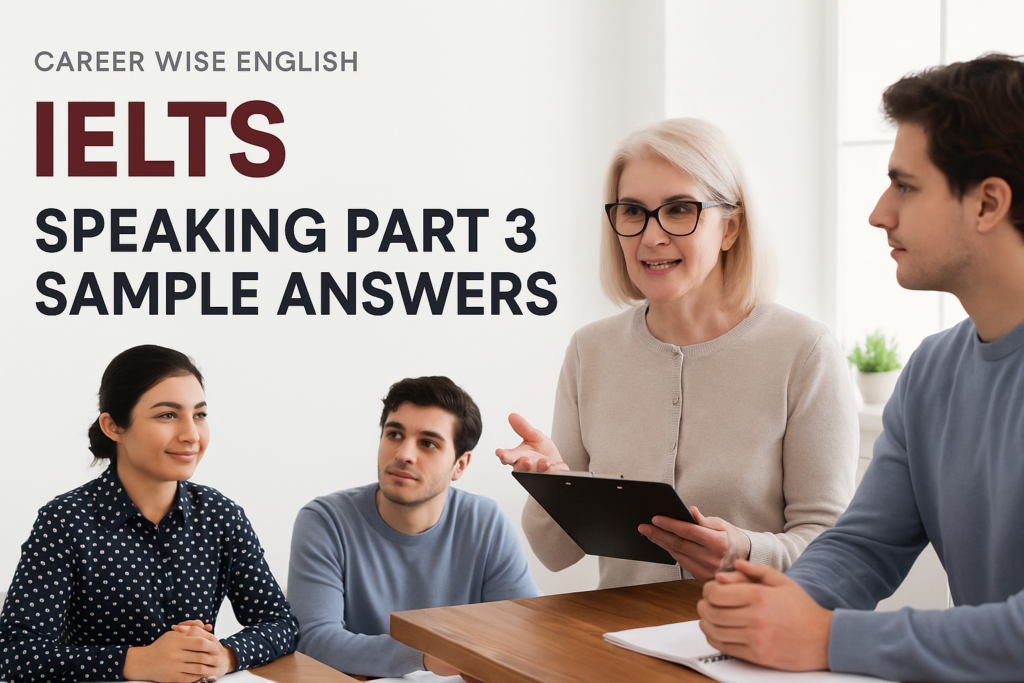
If you are searching for IELTS Speaking Part 3 sample answers, you probably want more than a few polished lines to memorise. You want to hear what a strong answer sounds like when the examiner starts asking broader questions about society, education, technology, work, or daily life. Part 3 is where many candidates lose control because the questions become less personal and more analytical. Before you keep guessing whether Speaking is already stable enough, take the IELTS Express Pre-Test to get a quick band prediction and see where your discussion answers start to weaken.
What IELTS Speaking Part 3 sample answers should teach you
Good sample answers are not scripts to copy word for word. They are models that show you how to answer directly, add a reason, and then extend the point in a natural way. In Part 3, the examiner is not looking for a perfect lecture. They are listening for clear ideas, relevant support, flexible language, and steady fluency under pressure.
That is why strong IELTS Speaking Part 3 sample answers usually sound quite simple on the surface. The speaker gives a clear view, explains it, and stays organised. The answer feels natural because it is built on a useful structure rather than on memorised phrases.
Why Part 3 feels harder than Parts 1 and 2
Part 1 stays close to familiar life. Part 2 gives you one minute to prepare a longer response. Part 3 removes both supports. The examiner may ask you to compare generations, discuss social change, or explain why public behaviour is different now from the past. If your ideas are not organised quickly, the answer can become vague.
Many candidates assume the problem is vocabulary, but very often the real problem is answer shape. They start speaking before they know their main point, then try to repair the answer halfway through. If you want a stronger overview of how these discussion questions fit into the full interview, the IELTS Speaking Test complete guide is a useful companion.
IELTS Speaking Part 3 sample answers work best when you notice the pattern
The most useful pattern for Part 3 is simple:
- Answer: give your view in the first sentence
- Reason: explain why you think that
- Support: add an example, contrast, cause, or result
- Extension: add a second angle if it helps
This matters because Part 3 answers do not need to be long to score well. They need to be developed. A short but complete answer is usually better than a long answer that circles around the same idea.
Once you understand this pattern, IELTS Speaking Part 3 sample answers become much more useful. Instead of copying exact language, you start hearing the logic behind a high-scoring response.
Sample answer set 1, education and children
Question: Do you think children learn better alone or in groups?
Sample answer: I think children usually learn better in groups, at least for many school activities, because they can hear different ideas and learn how to explain their thinking. For example, if they work on a problem together, one child may understand the task faster while another may be better at explaining it in simple language. That said, individual study is still important when they need quiet time to focus or revise.
Why it works: The answer is direct, balanced, and extended. It does not stop at a basic opinion. It gives a reason, a practical example, and a small qualification.
Question: Has the role of teachers changed in recent years?
Sample answer: Yes, I think it has changed quite a lot. In the past, teachers were often seen mainly as the source of knowledge, but now students can access information almost instantly online. Because of that, teachers are becoming more like guides who help students judge information, stay organised, and think critically rather than just memorise facts.
Why it works: This answer compares past and present clearly. The language is natural, and the main point is developed without becoming too abstract.
Sample answer set 2, technology and daily life
Question: Do people rely too much on technology today?
Sample answer: In many ways, yes. Technology makes daily life much easier, but I think many people now depend on it even for simple tasks they used to manage on their own. A clear example is navigation. Many people cannot travel even short distances without using a map app. That convenience is useful, of course, but it can also make people less independent in small everyday situations.
Why it works: The speaker gives a position, then supports it with a familiar example. The final sentence adds a thoughtful consequence, which makes the answer feel complete.
Question: Is technology making communication better or worse?
Sample answer: I would say it is doing both. On the positive side, people can stay in touch across long distances much more easily than before, which is especially helpful for families and international students. On the other hand, some forms of online communication feel quite shallow, so people may interact more often but connect less deeply. It really depends on how the technology is used.
Why it works: This answer handles a balanced question well. It shows both sides clearly and ends with a sensible overall judgement.
If you want to test whether you can produce answers like these consistently rather than only recognise them on the page, access unlimited IELTS mock tests and record several Part 3 questions in one sitting.
Sample answer set 3, work and lifestyle
Question: Why do some people change jobs frequently?
Sample answer: I think there are a few reasons for that. Some people move jobs because they want better pay or clearer career growth, while others do it because they feel bored or unsupported in their current role. I also think younger workers are often more willing to leave quickly if a job does not match their expectations, especially if they value flexibility more than long-term stability.
Why it works: The answer groups the reasons neatly instead of listing random points. It sounds thoughtful but still easy to follow.
Question: Do you think work-life balance is more important now than in the past?
Sample answer: Yes, I think it is more important now, partly because modern work can follow people everywhere through phones and laptops. In the past, many workers could leave their job at the workplace, but now messages and deadlines often continue after hours. As a result, people are more aware that without some balance, stress can build up quite quickly.
Why it works: The speaker explains the change clearly and links it to a real modern habit. The answer stays specific, which gives it more weight.
How to build your own answers from these examples
The safest way to use IELTS Speaking Part 3 sample answers is to borrow the structure, not the wording. If you memorise full answers, they often sound smooth in practice but stiff in the real exam. The moment the examiner changes the topic slightly, the prepared language no longer fits naturally.
A better method is to train with short planning prompts. Before answering, ask yourself four quick questions:
- What is my main view?
- Why do I think that?
- What example or result can support it?
- Is there a second side I should mention?
That tiny mental checklist helps you produce flexible answers on almost any common Part 3 theme. It also reduces panic because you are not trying to invent a perfect answer all at once.
Common mistakes people make when using sample answers
The first mistake is copying the tone too exactly. Some candidates read polished sample answers and start speaking in a style that does not sound like them. The answer may be grammatical, but it feels unnatural and rehearsed.
The second mistake is aiming for complexity too early. Candidates see a strong sample answer and assume they need harder vocabulary or longer sentences. In reality, most high-value answers are built from clear ideas, sensible linking, and well-chosen examples. Complexity without control usually lowers quality.
The third mistake is ignoring timing. A sample answer on the page can look short, but spoken naturally it may already be long enough. If you keep adding ideas after the answer is complete, you may drift off topic or become repetitive.
A simple practice routine for IELTS Speaking Part 3 sample answers
If you want real improvement, use sample answers actively rather than passively. Read one question, answer it aloud in your own words, then compare your response with a model answer. Do not ask only, “Was my grammar correct?” Ask whether your answer had a clear shape.
A practical weekly routine could look like this:
- Day 1: answer five Part 3 questions on one theme and record them
- Day 2: compare your answers with strong models and notice where yours stopped too early
- Day 3: repeat the same questions and add one stronger support layer
- Day 4: focus on reducing repetition and improving link words
- Day 5: switch to a new theme and keep the same answer pattern
If you are preparing for a test date, keep that practice routine simple and repeatable. Steady review usually helps more than constantly switching methods.
Ready to find out your IELTS band score?
Take the IELTS Express Pre-Test for just $4.99 and get your personalised band prediction with a 14-day improvement plan.
Frequently Asked Questions
Are IELTS Speaking Part 3 sample answers safe to memorise?
No, not word for word. They are much more useful as models for structure, development, and natural language. Memorised answers often sound stiff when the real question changes slightly.
How long should a Part 3 answer be?
There is no exact length, but most strong answers include a direct opinion, a reason, and one supporting layer such as an example or consequence. If your answer ends after one sentence, it is probably too short.
Do I need advanced vocabulary to sound strong in Part 3?
No. Precise and natural vocabulary is far more useful than difficult words used awkwardly. Clear ideas and steady organisation matter more than trying to sound overly academic.
What topics appear in IELTS Speaking Part 3?
Common topics include education, technology, work, transport, family life, public behaviour, and social change. The exact wording varies, but the answer pattern stays quite similar.
What is the fastest way to improve with IELTS Speaking Part 3 sample answers?
The fastest improvement usually comes from speaking aloud, recording your answers, and comparing them with good models. That helps you notice where your answers become vague, repetitive, or unfinished.
Your next step with Part 3
IELTS Speaking Part 3 sample answers are most useful when they teach you how to think under pressure, not when they give you lines to perform. Keep your answer structure simple, support your ideas with one clear example or result, and stay flexible enough to sound like a real person rather than a rehearsed candidate.
If you can do that consistently, Part 3 becomes much less unpredictable. And that usually makes the whole speaking test feel more manageable.