If you are searching for IELTS Speaking Part 2 time management, you are probably dealing with one of two annoying problems. Either you use the one-minute preparation time badly and start speaking with no real plan, or you begin well and then run out of things to say before the examiner stops you. Both problems are common. The good news is that they are usually fixable with a simple routine, not a complicated strategy.
Before you keep guessing whether Speaking is really the section slowing down your overall result, take the IELTS Express Pre-Test to get a quick band prediction and see where your current level sits under pressure.
What IELTS Speaking Part 2 time management really means
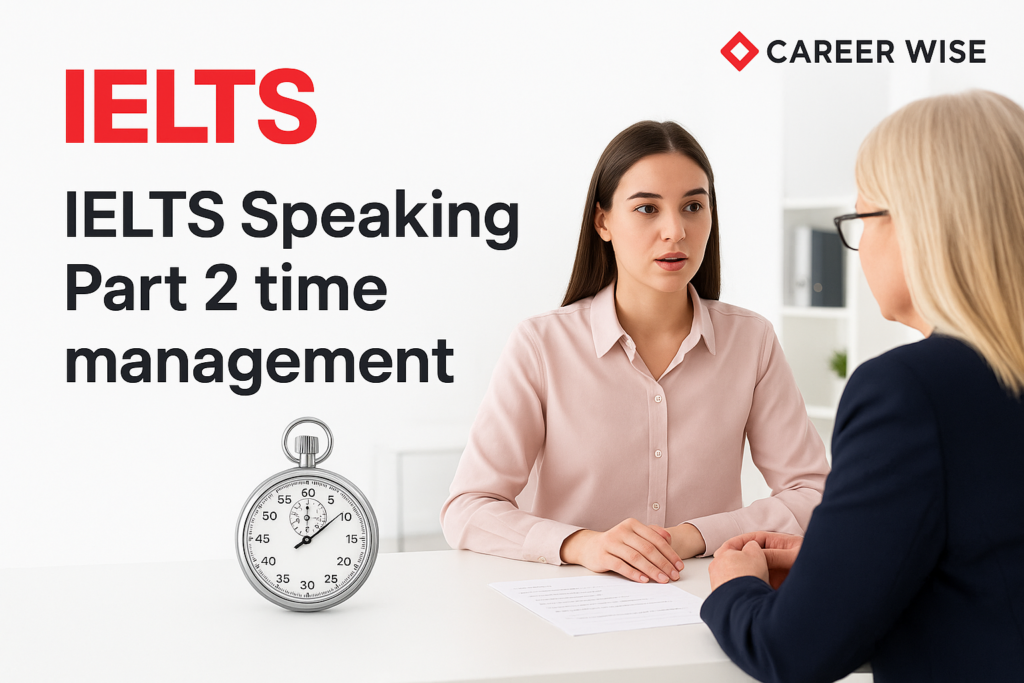
In Part 2, you receive a cue card, one minute to prepare, and up to two minutes to speak. Time management in this section is not about speaking fast. It is about using both stages properly. During the first minute, you need to build a route through the answer. During the two-minute talk, you need enough structure to keep moving without repeating yourself.
Many candidates misunderstand the task. They think time management means filling every second with words, so they rush from the first sentence and sound tense. Others think they should be very careful, so they speak too slowly, leave big pauses, and finish early. Neither approach works well. The examiner wants a response that feels controlled, natural, and developed.
If you already know the basic format but still feel unsure about how Part 2 fits into the full interview, the IELTS Speaking Test complete guide gives useful context.
Why candidates run out of time or finish too early
Most timing problems come from weak planning rather than weak English. A candidate gets a cue card, writes too much in the preparation minute, and then spends the answer trying to remember the notes. Another candidate writes almost nothing, starts speaking immediately, and hopes ideas will appear. Then the answer becomes vague after forty seconds.
A second problem is poor detail control. Some candidates spend too long on the background, such as where they were or when the event happened, and have nothing left for the more important part, which is why the topic mattered. Others jump straight to the ending without enough middle detail. This creates an answer that feels short even when the grammar is acceptable.
There is also a confidence issue. Under pressure, candidates often panic when they hear themselves pause. Then they speed up, repeat old points, or begin a new idea without finishing the previous one. Good IELTS Speaking Part 2 time management helps because it reduces that panic. You know what comes next, so you do not need to force the answer forward.
A simple structure for the one-minute preparation stage
The best use of the preparation minute is to write four short prompts, not full sentences. Those prompts should cover the full answer shape:
- Main choice: the person, place, object, event, or activity you will describe
- Background: when it happened, where it happened, or how it started
- Development: two details that make the topic specific
- Meaning: why it mattered, what changed, or what you learned
That is enough for most cue cards. In real test conditions, short prompts are much safer than long notes because they give you direction without trapping you in memorised language. For example, if the cue card asks you to describe a useful skill you learned, your notes might look like this:
- Skill: cooking basic meals
- When: first year living away from family
- Detail: saved money, became more organised
- Why important: independence, confidence
Notice that these notes are not beautiful. They do not need to be. They only need to keep you on track for two minutes.
How to divide the full two-minute answer
If you want better IELTS Speaking Part 2 time management, it helps to think of the answer in blocks instead of one long stream. You do not need to count seconds exactly, but you should have a rough sense of balance.
- First 20 to 30 seconds: introduce the topic clearly and give quick background
- Next 50 to 60 seconds: develop the topic with specific details or actions
- Final 30 to 40 seconds: explain why the topic matters and leave the answer in a strong place
This kind of balance prevents two common mistakes. First, it stops you from spending a full minute only on the set-up. Second, it stops you from ending with nothing more than, “and that is it”. Strong endings matter because they make the answer feel complete.
If you want to practise this in a more realistic way, access unlimited IELTS mock tests and record several Part 2 answers back to back. That is one of the easiest ways to hear whether your timing breaks down in the middle or at the end.
What to do if you feel yourself running out of things to say
Running out of ideas usually happens because the answer is too general. If you notice this happening, do not panic. Move to one of three safe expansions. First, add a specific example. Second, explain a reason. Third, describe the result.
Here is a simple pattern you can use in the moment:
- Example: “One moment I remember clearly is…”
- Reason: “The main reason this stood out to me was…”
- Result: “After that, I realised…”
These are useful because they are natural spoken phrases, not fancy exam tricks. They buy you a little time while also improving the content. If your topic is a memorable teacher, you can move from describing the teacher to one class, one piece of advice, or one result that changed your study habits. That creates real development instead of filler.
A lot of candidates think they need new vocabulary when they get stuck. Usually they need a better follow-up question in their own head. Ask yourself, what happened, why did it matter, and what changed because of it. Those questions often rescue the answer.
What to do if you are speaking too fast
Speaking too fast feels productive, but it often creates more problems than it solves. Your pronunciation becomes less clear, grammar slips increase, and the answer can sound rushed rather than fluent. Fast speech also burns through your content too early. Then you reach the one-minute mark with nothing solid left to say.
A better target is steady pace. You do not need to slow down dramatically. You only need to give each idea room to land. One practical way to do this is to make sure each main point has a small follow-up. For example, if you say a place was relaxing, explain what made it relaxing. If you say a friend was helpful, explain what they actually did.
Pauses are not automatically bad. Short thinking pauses are normal in spoken English. The real problem is panic after a pause. If you stop for a second, keep calm and move to your next note point. That sounds much better than racing through the rest of the answer just to make up for lost time.
How to practise time management before test day
You do not need endless speaking practice to improve timing. You need targeted practice with a clock and honest review. A simple four-step routine works well:
- Step 1: choose one cue card and give yourself exactly one minute to prepare
- Step 2: record a full answer and speak until the two minutes end
- Step 3: listen back and mark where the answer became vague, repetitive, or rushed
- Step 4: repeat the same cue card with better balance
This method works because it shows your real habit patterns. Maybe you always spend too long on the opening. Maybe you are strong in the middle but weak at the ending. Maybe you leave your best point too late. Once you know the pattern, you can fix it much faster.
If you are studying close to an exam deadline and want a more structured plan, see our IELTS preparation plans and choose the support level that matches your timeline.
A sample timing plan for a common cue card
Imagine the cue card asks you to describe a person who gave you useful advice. A rough timing plan might look like this:
- Opening: say who the person was and when they gave the advice
- Middle detail one: explain the situation you were facing at the time
- Middle detail two: explain the advice itself and how you reacted
- Ending: explain why you still remember it and how it helped later
That answer shape is easy to control because each stage has a purpose. You are not trying to invent a speech. You are walking through a short story. The same logic works for topics about places, skills, events, and objects. Good timing often comes from better storytelling, even in a simple exam answer.
If you need more examples of how strong long-turn answers are built, the IELTS Speaking Part 2 sample answers page is a useful companion to this guide.
Common IELTS Speaking Part 2 time management mistakes
Some mistakes appear again and again. The first is writing full sentences during the planning minute. That nearly always creates pressure later. The second is choosing a topic that is too broad, such as talking about all sports instead of one sport or all holidays instead of one trip. Broad topics are harder to control in two minutes.
The third mistake is repeating the cue card prompts one by one without turning them into a natural answer. That can sound mechanical. The fourth is finishing early and then adding weak filler like “it was nice” or “that is all I can say”. The fifth is speaking as if every sentence must be perfect. That usually increases hesitation.
A calmer approach works better. Choose one clear example. Use short notes. Build the answer in a simple order. Then accept that a few small imperfections are normal. The examiner is not expecting a polished speech. They are listening for control, clarity, and development.
Ready to find out your IELTS band score?
Take the IELTS Express Pre-Test for just $4.99 and get your personalised band prediction with a 14-day improvement plan.
Frequently Asked Questions
How should I use the one-minute preparation time in IELTS Speaking Part 2?
Use it to write short prompts, not full sentences. A simple note plan with topic, background, two details, and meaning is usually enough to guide the full answer.
What if I finish my Part 2 answer before two minutes?
This usually means the answer was too general or not developed enough. Add one example, one reason, or one result to each main point so the response has more depth.
Is it bad if I pause during IELTS Speaking Part 2?
No. Short pauses are normal. The problem is not the pause itself. The real issue is panic after the pause, which can make the rest of the answer rushed or repetitive.
Should I speak quickly to make sure I fill the two minutes?
No. Speaking quickly often makes pronunciation less clear and causes you to run out of content early. A steady pace with better detail is much safer.
What is the best way to practise IELTS Speaking Part 2 time management?
Practise with a real one-minute planning stage and a real two-minute recording. Then listen back and check where your timing breaks down. Repeat the same cue card with a better structure.
Your next step with Part 2 timing
Strong IELTS Speaking Part 2 time management is really about control. Use the preparation minute to build a route, not a script. Use the two-minute talk to develop one clear example with enough detail and a proper ending. When you do that, timing stops feeling like a fight.
Start by recording three cue cards this week using the four-part note system from this guide. You will hear very quickly whether your problem is weak planning, rushed delivery, or thin detail. Once you know that, improvement gets much easier.