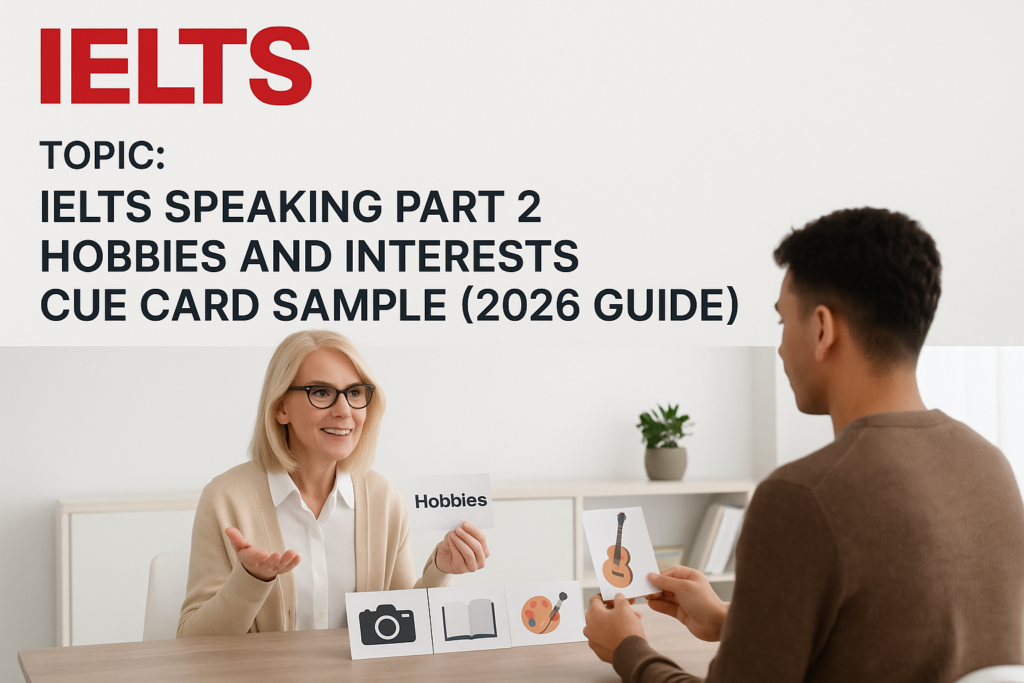
If you are searching for an IELTS Speaking Part 2 Hobbies And Interests cue card sample, you probably want more than a model answer to copy. You want to see how a strong response is built, why it sounds natural, and how you can adapt the same method when your real cue card is slightly different on test day. This topic appears simple, but many candidates still give thin answers because they describe the hobby without adding enough story, detail, or personal meaning.
Before you spend another week guessing whether Speaking is really the section holding your score down, take the IELTS Express Pre-Test to get a quick band prediction and see where your current level is under exam pressure.
What this cue card is really testing
An hobbies and interests cue card is not only testing whether you know a hobby word like reading, cooking, swimming, or photography. The examiner is listening for your ability to sustain a two-minute answer with clear structure, relevant detail, and natural language. That means you need more than a list of things you enjoy. You need a simple story shape that helps the answer move forward.
Most cue cards in this area ask you to describe a hobby or interest you enjoy, when you started it, how often you do it, and why it matters to you. Those prompts are useful because they already suggest a structure. If you follow them mechanically, however, the answer can sound flat. A better approach is to use the prompts as a route, then add one or two details that make the answer feel real.
An IELTS Speaking Part 2 Hobbies And Interests cue card sample answer
Here is a realistic cue card style prompt:
- Describe a hobby or interest that you enjoy.
- You should say:
- what it is
- when you became interested in it
- how often you do it
- and explain why it is important to you
Sample answer:
I would like to talk about photography, which has become one of the most enjoyable hobbies in my life. I first became interested in it a few years ago when I borrowed a friend’s camera during a short family trip. Before that, I used my phone to take basic photos, but I had never really paid attention to things like light, angle, or composition.
What started as simple curiosity gradually became a regular interest. At first, I mostly took photos of everyday scenes such as parks, streets, and food when I went out with friends. Later, I began watching online tutorials and learning how small changes in timing and position could make a photo look much more professional. These days, I usually spend some time on photography during weekends, especially if I visit somewhere new or even if I just go for a walk in my local area.
What I like most about this hobby is that it makes me notice details that I would normally ignore. For example, I pay more attention to colour, weather, and the way people interact with a place. It also helps me relax because I have to slow down and focus on one moment instead of rushing through everything. On top of that, I enjoy looking back at old photos because they help me remember particular stages of my life quite clearly. That is why photography is more than just a casual interest for me. It gives me both enjoyment and a different way of seeing ordinary things.
Why this sample answer works
This answer works because it does not try to sound overly clever. The speaker chooses one clear hobby, explains how it started, shows how it developed, and finishes with personal meaning. That already covers the cue card fully. Many candidates lose marks because they stop after naming the hobby and saying it is fun. The stronger answer goes one step further and explains why it became meaningful.
Notice that the language is natural rather than memorised. The answer includes useful phrases such as I first became interested in it, what started as, and what I like most about it. These phrases are flexible, so you can reuse the same pattern for hobbies like cooking, painting, reading, playing football, dancing, or gardening.
If you want to practise this under timed conditions instead of only reading samples, access unlimited IELTS mock tests and record a few long-turn responses in one sitting. That is often the fastest way to hear whether your answer sounds natural or rehearsed.
How to structure a hobbies and interests answer for two full minutes
A simple structure is usually enough to carry you through the full response. You do not need a complicated note system. In the one-minute preparation time, write only short prompts for four stages:
- Main choice: the hobby or interest you will describe
- Beginning: when or how you became interested in it
- Current habit: how often you do it or what it involves now
- Meaning: why it matters, what it gives you, or what changed because of it
That route keeps the answer organised. It also stops you from speaking in circles. A common problem in Part 2 is repetition. Candidates say the hobby is interesting, relaxing, and enjoyable, but they are really making the same point three times. Structure prevents that by giving each part of the answer a different job.
Useful language for hobbies and interests cue cards
You do not need a long vocabulary list for this topic, but you do need language that helps you describe development, routine, and personal impact. Some useful phrases include:
- To introduce the hobby: I would like to talk about…, one hobby I really enjoy is…, an interest that has stayed with me is…
- To explain the beginning: I first became interested in it when…, I got into it during…, it started as a casual activity but…
- To describe frequency: I usually do it on weekends, I try to make time for it every week, I do it whenever I need to relax
- To explain value: it helps me switch off, it gives me a sense of progress, it allows me to be creative, it helps me stay focused
The key is to choose phrases you can say comfortably. Do not force vocabulary that feels formal or unnatural. In speaking, clear language often scores better than ambitious language used awkwardly.
Common mistakes candidates make with this cue card
The first mistake is choosing a hobby that is too broad. For example, saying that your hobby is sports can make the answer hard to develop because it is too general. It is better to choose one clear activity such as badminton, swimming, drawing, or baking. Narrower topics are easier to describe with specific detail.
The second mistake is giving only facts. A candidate says when they started, how often they do it, and where they do it, but the answer still sounds empty because there is no personal meaning. The examiner wants to hear what the hobby gives you. Does it reduce stress, build confidence, connect you with friends, or improve a skill? That part often lifts the answer.
The third mistake is sounding memorised. If your answer feels too polished, it can become stiff. The safest path is to memorise a structure, not a script. That gives you flexibility if the cue card changes from a hobby you enjoy to an interest you want to learn more about, or from a current hobby to one you had in the past.
How to adapt the sample to different hobby topics
A good IELTS Speaking Part 2 Hobbies And Interests cue card sample should help you with more than one exact question. The same answer pattern can be reused across many hobby-related prompts.
- If the hobby is active: focus on routine, energy, health benefits, and enjoyment
- If the hobby is creative: focus on self-expression, learning, and satisfaction
- If the hobby is social: focus on friendships, shared experiences, and motivation
- If the hobby is quiet or personal: focus on relaxation, concentration, and reflection
For example, if your hobby is cooking, the answer can move from learning simple recipes to enjoying the process and sharing food with family. If the hobby is reading, you can explain when the habit started, what kinds of books you prefer, and how it expands your thinking. The structure stays similar, but the details change.
If your preparation feels too scattered and you want more organised support before test day, see our IELTS preparation plans and choose the level that suits your timeline.
A simple one-minute planning example
During the preparation minute, keep your notes short. For the photography sample above, your note page could look like this:
- Hobby: photography
- Started: family trip, borrowed camera
- Now: weekends, parks, streets, tutorials
- Why important: relaxing, notice details, save memories
That is enough. You are not trying to write the whole answer. You are only making sure you have a beginning, middle, and end. Candidates who improve in Part 2 usually get better at this exact skill. They stop wasting the preparation minute on full sentences and start using it to map the answer.
How to practise this topic effectively before the test
The best way to practise hobbies and interests cue cards is to record yourself and listen back honestly. Start with one sample answer pattern, then change the hobby and keep the structure. That trains flexibility, which is much safer than repeating one memorised response.
A practical practice cycle could look like this:
- Day 1: answer one hobby cue card and one interest cue card under timed conditions
- Day 2: listen for repetition, weak detail, and places where the answer becomes vague
- Day 3: redo the same topics with stronger examples and clearer personal meaning
- Day 4: switch to new hobby topics but keep the same four-part structure
Small review loops like this usually help more than reading endless sample pages without speaking. The real test rewards usable speaking habits, not silent understanding.
Ready to find out your IELTS band score?
Take the IELTS Express Pre-Test for just $4.99 and get your personalised band prediction with a 14-day improvement plan.
Frequently Asked Questions
How long should my hobbies and interests Part 2 answer be?
You should aim to keep speaking until the examiner stops you, which is usually close to two minutes. A shorter answer often means there was not enough development.
Is it safe to memorise an IELTS Speaking Part 2 Hobbies And Interests cue card sample?
No. It is much safer to learn the structure and a few flexible phrases. Full memorisation often sounds stiff when the real cue card is slightly different.
What hobby should I choose if I have many interests?
Choose the one you can describe most clearly with real detail. A simple hobby with a clear story is better than an impressive hobby you cannot explain naturally.
Do I need advanced vocabulary for a hobbies cue card?
No. You need vocabulary that fits the topic naturally and helps you explain why the hobby matters. Clear, precise language is usually more effective than difficult words used awkwardly.
What if my hobby sounds boring?
That is usually not a problem. Examiners are not scoring how exciting the hobby is. They are scoring how well you speak about it. Even a quiet hobby can become a strong answer if it includes clear detail and personal meaning.
Your next step with hobby cue cards
A strong hobbies and interests answer is usually simple, personal, and easy to follow. Choose one clear hobby, explain how it began, add specific detail about what you do now, and finish with why it matters to you. That approach is much safer than trying to sound impressive.
If you want to know whether your current speaking level is already close to your target band, start with the pre-test and then record three hobby-related cue cards using the same structure from this guide. That will show you much more than reading one more sample answer.