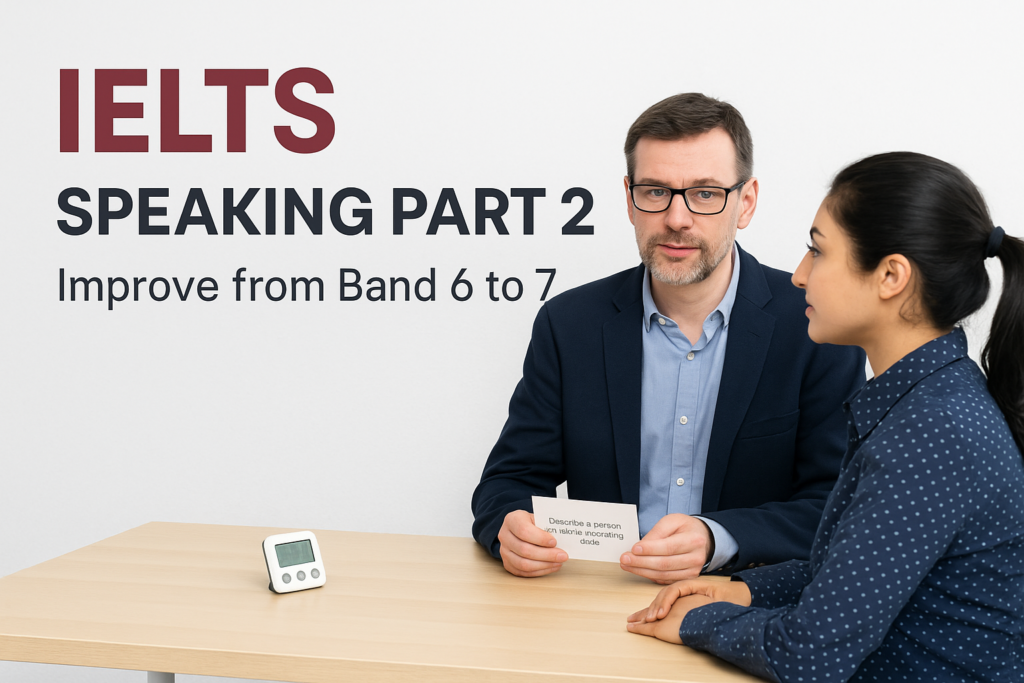
If you are searching for IELTS Speaking Part 2 improve from band 6 to 7, you are probably in a familiar spot. You can already speak well enough to answer the cue card, keep going for close to two minutes, and avoid the worst mistakes, but your score still refuses to move. That is frustrating because band 6 often feels close to band 7 on the surface. In practice, the difference is usually not about speaking more. It is about speaking with better control, clearer development, and less strain.
Before you keep guessing whether Speaking is really the skill holding you at band 6, take the IELTS Express Pre-Test to get a quick band prediction and see where your result is actually under pressure.
What usually keeps candidates at band 6 in IELTS Speaking Part 2
A band 6 answer in Part 2 is often understandable and relevant, but it still has weak patches. The candidate may hesitate too much when ideas run thin, repeat the same point in slightly different words, or rely on safe vocabulary for too long. Sometimes the answer has enough content, but the structure feels loose. It starts reasonably well, drifts in the middle, then finishes without much impact.
That matters because the examiner is not listening only for grammar or vocabulary. They are listening for fluency and coherence, lexical resource, grammatical range and accuracy, and pronunciation. In a two-minute long turn, those areas show up quickly. If your answer sounds uneven, the band usually stays uneven as well.
Many candidates at this level are not far away. They do not need a brand new personality or a fake “native” accent. They usually need a tighter method so the English they already have comes out in a more organised way.
What band 7 sounds like in Part 2
If you want IELTS Speaking Part 2 improve from band 6 to 7, you need a realistic picture of the target. A band 7 answer usually sounds steadier from beginning to end. The speaker can keep talking without too many obvious breakdowns, develop ideas with enough detail, and use vocabulary with more flexibility. Mistakes still happen, but they do not dominate the impression.
Band 7 does not mean perfect grammar or fancy expressions in every sentence. It usually means the answer feels complete. The examiner can follow it easily. The speaker gives one clear example, supports it with specific detail, and finishes with a reason, reflection, or result. There is less padding and less panic.
If you want a wider explanation of how the long turn fits into the full interview, read the IELTS Speaking Test complete guide. It helps because many Part 2 problems start with an unclear understanding of what the examiner is really scoring.
The fastest way to improve from band 6 to 7, fix your structure first
Most candidates try to solve Part 2 with vocabulary lists. That is not useless, but it is rarely the fastest fix. Structure usually gives you the quickest improvement because it affects fluency, coherence, grammar control, and confidence at the same time.
A simple structure works well for most cue cards:
- Main choice: say clearly what person, place, object, or experience you will talk about
- Background: explain when, where, or how it happened
- Development: add two or three specific details that move the answer forward
- Meaning: explain why it mattered, what changed, or what you learned
This sounds basic because it is basic. That is the point. Under exam pressure, simple structures survive. Complicated note systems usually collapse halfway through the answer. If your Part 2 still feels shaky in timed practice, access unlimited IELTS mock tests so you can record full speaking runs and hear where your answer actually starts to wobble.
How to make your ideas sound more developed, not just longer
One common band 6 habit is filling time without really developing the answer. A candidate says the place was beautiful, the person was helpful, or the event was important, but the answer stays thin. The examiner hears language, but not enough substance.
To move toward band 7, each main point needs one layer of development. After you make a statement, add one of these:
- An example: one moment that proves the point
- A reason: why that detail mattered
- A result: what happened next
- A feeling: how the experience affected you
For example, do not stop at “my teacher was supportive.” Add what the teacher actually did, when it happened, and why it changed your confidence. That turns a general answer into a believable one. Better development also helps your fluency because you have somewhere to go next instead of circling the same idea.
If you want a more technical framework for the long turn, the IELTS Speaking Part 2 and Part 3 framework is useful because it shows how strong answers keep moving without sounding rehearsed.
The language shift that helps band 6 candidates sound more natural
Another problem at band 6 is that the answer often sounds either too simple or too forced. Some candidates rely on safe words like good, nice, interesting, and happy too often. Others try to fix that by pushing in advanced expressions they cannot control naturally. Both approaches can hold the band down.
The better move is precision. Replace vague words with clearer ones that still feel easy to say. Instead of good, you might say helpful, practical, relaxing, or stressful. Instead of saying something was very nice, explain what made it memorable. Clear language is usually more convincing than ambitious language that sounds borrowed.
You also need smoother linking. Not fancy linking, just natural linking. Phrases like “what I remember most,” “the main reason was,” “one thing that stood out,” and “after that” often work better than stiff academic connectors. Band 7 speaking usually sounds organised, not over-polished.
If you are working toward a test date and want more guided help, see our IELTS preparation plans and choose the level of support that fits your timeline.
How to use the one-minute planning time better
If you want IELTS Speaking Part 2 improve from band 6 to 7, do not waste the preparation minute writing full sentences. That habit usually creates more pressure. You end up trying to remember a mini script instead of speaking freely.
Write only short prompts. A useful note plan might look like this:
- Topic: cousin who helped me choose a course
- When: after secondary school
- Detail 1: explained university options
- Detail 2: shared personal experience
- Why important: reduced stress, gave direction
That is enough. The notes give your answer shape without trapping you in memorised language. Candidates who jump from band 6 to 7 often get better at this one small skill. They stop trying to write the answer and start planning the route through it.
Common band 6 habits that stop the score from moving
Some problems appear again and again in Part 2 answers. The first is repeating the same point because time is still left. The second is choosing an example that is too broad, which makes the answer vague. The third is speaking in short, separate blocks instead of connecting ideas into one flowing response. The fourth is overcorrecting grammar in real time and creating extra pauses.
You do not fix these by speaking faster. In fact, rushing usually makes them worse. A calmer rhythm helps more. Give one clear point, develop it, then move on. If you make a small grammar mistake, keep going unless the meaning is badly damaged. Band 7 speakers are not error-free. They are just less derailed by minor slips.
Another useful habit is listening back to your own recordings honestly. Most candidates can hear their real problems once they stop relying on memory. You will notice where the answer becomes repetitive, where the detail runs out, and where your voice gets flatter because you are trying too hard to sound correct.
A seven-day practice method to move from band 6 to band 7
Improvement in Part 2 usually comes from short feedback loops, not endless theory. A practical seven-day cycle can work well:
- Day 1: record three Part 2 answers under timed conditions
- Day 2: listen for pauses, repetition, and vague ideas
- Day 3: redo the same cue cards using the four-part structure
- Day 4: focus only on adding better detail through example, reason, and result
- Day 5: practise vocabulary precision, replacing weak words with clearer choices
- Day 6: answer two unfamiliar cue cards with only one minute of planning
- Day 7: compare your newest recordings with Day 1 and note what improved
This routine works because it keeps the target practical. You are not trying to become perfect in one week. You are trying to become more stable, more specific, and easier to follow. That is exactly the territory where band 7 starts to become realistic.
Ready to find out your IELTS band score?
Take the IELTS Express Pre-Test for just $4.99 and get your personalised band prediction with a 14-day improvement plan.
Frequently Asked Questions
Is band 7 in IELTS Speaking Part 2 much harder than band 6?
It is harder, but not in a mysterious way. The jump usually comes from better control, stronger development, and more natural language, not from sounding perfect.
What is the biggest reason candidates stay at band 6 in Part 2?
The most common reason is weak development. Many candidates can start an answer, but they do not extend ideas clearly enough to keep the response strong for the full two minutes.
Should I memorise answers if I want to improve from band 6 to 7?
No. Memorised answers often sound stiff and can break down quickly if the cue card changes slightly. It is safer to memorise a structure and a few flexible phrases instead.
How long should I practise Part 2 each day?
You do not need hours every day. Twenty to thirty focused minutes with recording and review can be far more useful than long, passive study sessions.
Can vocabulary alone push my Part 2 score from 6 to 7?
Usually not. Better vocabulary helps, but the bigger gains usually come from clearer structure, stronger detail, and steadier fluency under pressure.
Your next step
If you want IELTS Speaking Part 2 improve from band 6 to 7, think in terms of control, not magic. Choose one clear example, build it with simple structure, and develop each point a little more than feels obvious. That alone can change how your answer sounds to an examiner.
Start by recording three cue cards this week. If the pattern is still hesitation, repetition, or weak detail, fix that first. It is a more honest path to band 7, and usually a faster one too.