If you are looking for an IELTS Writing Task 2 Artificial Intelligence essay sample, you probably want more than a polished paragraph that sounds clever but teaches very little. Most candidates need a realistic model they can actually learn from. Before you assume your writing is already close to your target band, take the IELTS Express Pre-Test to get a clearer picture of your current level and the habits still holding you back.
Artificial intelligence is a useful IELTS topic because it sits across work, education, ethics, and daily life. That makes it easy to write too broadly. A stronger Task 2 response stays narrow, answers the exact question, and develops each idea with enough control to sound convincing. That is what this guide focuses on.
What examiners want from an AI-themed Task 2 essay
An artificial intelligence topic does not change the scoring system. Examiners still mark task response, coherence and cohesion, lexical resource, and grammatical range and accuracy. In simple terms, they want to see whether you answered the question fully, organised your ideas well, used vocabulary with enough range, and controlled your grammar well enough for the meaning to stay clear.
The danger with AI essays is that candidates often chase big ideas instead of clear ones. They start talking about robots, future jobs, education, medicine, and human relationships all in the same essay. That usually weakens the response because the argument loses shape. A better essay picks one line of discussion and follows it properly.
- Answer the exact question, not the whole topic of artificial intelligence
- Give each body paragraph one clear job
- Use examples that support the main point rather than filling space
- Prefer controlled language over ambitious but shaky wording
Why artificial intelligence questions can be harder than they first look
Many IELTS candidates feel comfortable with this topic because AI appears in the news so often. That confidence can backfire. A familiar topic often leads to vague writing. Candidates make broad claims such as AI will change everything or technology is both good and bad, then move on without proper explanation. Those lines sound relevant, but they do not give the examiner much to reward.
A stronger response defines the issue early. Is the question about employment, education, creativity, ethics, or convenience? Is it asking for an opinion, a discussion, or a problem-solution structure? Once that is clear, the essay becomes much easier to control. If you want a broader framework for how strong responses are built, the IELTS Writing Task 2 band score strategy guide is a useful companion.
A sample question you can practise with
Here is a common IELTS-style question on this theme:
Some people believe that artificial intelligence will make human workers unnecessary in many industries. Others think AI will improve human work rather than replace it. Discuss both views and give your own opinion.
This is a discuss both views essay with an opinion. That means you need to explain each side fairly and still make your own position clear. For this sample, the position will be that artificial intelligence will replace some routine jobs, but overall it will reshape work more than eliminate the need for human workers completely.
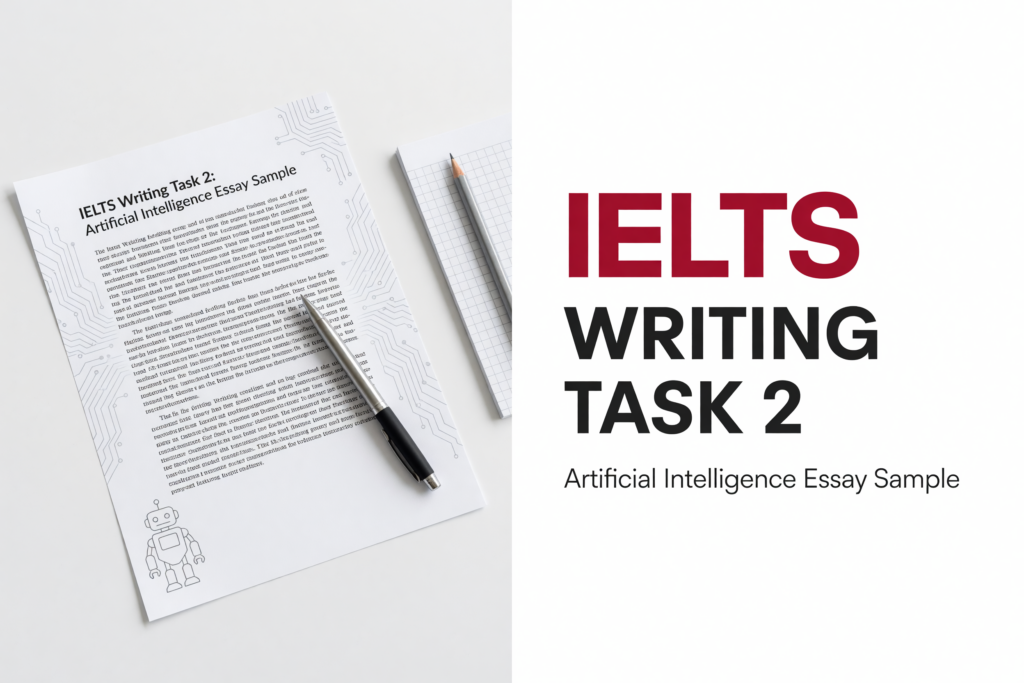
IELTS Writing Task 2 Artificial Intelligence essay sample
Sample essay:
Artificial intelligence is becoming more common in workplaces, and this has led to debate about whether human workers will still be needed in the future. While some people believe AI will replace employees across many industries, I agree with those who think it will mainly change the nature of human work rather than remove it completely.
On the one hand, there are strong reasons for believing that artificial intelligence will replace a large number of workers. In sectors such as manufacturing, transport, and customer service, many tasks are repetitive and rule-based, which makes them suitable for automation. Machines and software can often complete these duties faster, more cheaply, and with fewer mistakes than people. For example, chatbots can now handle simple customer enquiries, and automated systems can process large amounts of data in seconds. As companies usually want to reduce costs and increase efficiency, it is understandable that they may rely more on AI and employ fewer people in some roles.
On the other hand, AI is more likely to transform work than to remove the need for human workers entirely. Many jobs require judgement, emotional understanding, creativity, and ethical decision-making, which machines still struggle to manage well. Teachers, nurses, managers, and lawyers, for instance, do far more than follow fixed instructions. They respond to human needs, explain difficult ideas, and make decisions in situations that are not always predictable. In addition, new technology often creates fresh roles, such as AI trainers, data specialists, and systems reviewers. In my opinion, this suggests that the workforce will change, but people will continue to play a central role.
In conclusion, artificial intelligence is likely to replace some routine jobs, especially where tasks are repetitive and highly structured. However, I believe it will mostly change the way people work rather than make human workers unnecessary, because many professions still depend on judgement, communication, and adaptability.
Why this sample sits around Band 7 level
This essay works because the position is clear from the introduction and stays consistent to the end. The first body paragraph explains why some jobs may disappear, and the second explains why many jobs still need people. Nothing feels confused about the direction.
The support is also specific enough without becoming overcomplicated. The essay uses examples such as chatbots, manufacturing, teachers, and nurses to make the points concrete. That matters because IELTS examiners reward development, not just opinion. A simple idea explained properly is worth more than a dramatic idea left half-finished.
- The opinion is easy to identify from the start
- Each body paragraph stays focused on one side of the debate
- The examples feel relevant and believable
- The conclusion closes the argument without repeating every sentence
The language is also strong enough for a good score. It is not trying too hard. That is often what Band 7 writing looks like in real life. It is clear, organised, and controlled.
Useful vocabulary and sentence patterns for this topic
You do not need to memorise the full sample. What helps more is noticing the language patterns that organise the essay clearly. AI topics usually involve comparison, cause and effect, and balanced judgement, so it helps to build a small set of phrases that support those moves.
- While some people believe …, I agree with those who think …
- There are strong reasons for believing that …
- Many tasks are repetitive and rule-based
- AI is more likely to transform work than to remove the need for …
- This suggests that the workforce will change, but …
These patterns are useful because they guide the argument. They do not just decorate it. If you want to test whether you can use this kind of structure under exam pressure, it helps to access unlimited IELTS mock tests and compare how stable your writing stays in timed conditions.
Common mistakes in artificial intelligence essays
One common mistake is turning the topic into a science fiction discussion. IELTS does not reward wild predictions unless they connect directly to the question. Another mistake is using memorised language about technology that only partly fits the prompt. Examiners can usually tell when a candidate is forcing prepared content into the wrong essay.
Candidates also lose marks when they try to sound too academic. They write long sentences filled with abstract vocabulary, then lose grammar control halfway through. That is not a good trade. Clear writing usually scores better than showy writing.
- Answering the broad topic instead of the exact question
- Using vague claims without explaining how or why they are true
- Forcing memorised technology phrases into a different prompt
- Writing overlong sentences that create avoidable grammar errors
If those problems sound familiar, the fix is usually structural. Plan the argument first, then build the language around it. That is much safer than hoping strong vocabulary will rescue a weak response.
How to plan your own essay in under five minutes
In the exam, a short planning stage can save you from a messy essay later. You do not need a full paragraph plan. You need a map. For an artificial intelligence topic, that usually means deciding what the two views are, what your opinion is, and what examples you can explain quickly.
- Underline the task words and the exact topic focus
- Decide your opinion before you write the introduction
- Give paragraph one a clear purpose and paragraph two a different one
- Choose one or two examples you can explain in plain language
- Leave a few minutes at the end to check grammar and repetition
This process sounds basic, but it works. Most weaker essays are not weak because the candidate had no ideas. They are weak because the ideas were not arranged properly. If you want more support around that process and your target date, see the IELTS preparation plans and compare the option that fits your study timeline.
How to make your opinion clear without sounding repetitive
Many candidates worry that they must repeat their view in every paragraph. That usually makes the writing sound mechanical. A better approach is to make the opinion clear in the introduction, support it through paragraph choice and explanation, and restate it naturally in the conclusion.
In this sample, the position is that AI will change work more than eliminate it. The first body paragraph still explains the opposing view fairly, but the second paragraph gives stronger reasons and wider relevance to the writer’s own position. That balance feels more natural than repeating “I believe” in every few lines.
You can also show your opinion through word choice. Phrases such as more likely to, mainly, and rather than help express a measured view. That is often useful in IELTS because many Task 2 questions do not need extreme answers.
Use this sample to build flexibility, not memorisation
The best use of an IELTS Writing Task 2 Artificial Intelligence essay sample is not to copy it word for word. It is to study how the argument is built. Notice how the introduction frames the debate, how each paragraph stays controlled, and how the conclusion returns to the same central judgement.
If you can repeat that method with a new AI question, you are learning something that will actually help on test day. Before the FAQ, use this as your practical checkpoint:
Ready to find out your IELTS band score?
Take the IELTS Express Pre-Test for just $4.99 and get your personalised band prediction with a 14-day improvement plan.
FAQ: IELTS Writing Task 2 Artificial Intelligence essay sample
Is this IELTS Writing Task 2 Artificial Intelligence essay sample good enough for Band 8?
It is closer to a solid Band 7 model. A Band 8 essay would usually show slightly sharper development, more flexible vocabulary, and tighter control of complex grammar.
Should I memorise an artificial intelligence essay before the test?
No. It is better to learn the structure and reasoning. Memorised essays often become awkward when the real question changes angle.
What kinds of AI ideas are safe to use in Task 2?
Use practical ideas you can explain clearly, such as automation, efficiency, human judgement, education tools, or customer service. The safest idea is usually the one you can develop well.
Do I need advanced vocabulary to write about artificial intelligence?
No. You need enough topic language to stay precise, but clear everyday academic English is safer than difficult words you cannot control.
How should I practise after reading a sample like this?
Write your own response to a different AI question under timed conditions, then compare your structure, clarity, and paragraph control with the sample.
Study the structure, then write your own version
This topic can feel intimidating because artificial intelligence sounds broad and modern, but the scoring logic stays the same. Read the question carefully, narrow the issue early, and give each paragraph one clear role.
If you can do that under timed conditions, your writing becomes much more reliable. That is the real lesson from a good sample essay. Clear structure, relevant support, and language you can control will take you further than trying to sound brilliant.