If you are searching for IELTS Speaking Part 2 Weather And Seasons cue card sample, you probably do not just want a model answer to memorise. You want a safe way to speak for two minutes without freezing, repeating yourself, or wandering away from the cue card. That is the real challenge in Part 2. Before you spend another week guessing, take the IELTS Express Pre-Test to see whether speaking is already the section putting your target band score at risk.
This topic looks simple because weather and seasons are familiar, but that is exactly why many candidates underperform. They give broad, generic comments such as “I like summer because it is fun” and then run out of detail after thirty seconds. A stronger answer is specific, organised, and easy to develop. You do not need a dramatic life story. You need a clear structure, a few natural details, and enough language range to sound comfortable under exam pressure.
Why this cue card is harder than it looks
Weather and seasons are everyday topics, so candidates often assume the answer will come naturally. In practice, the familiarity can work against you. Because the topic feels easy, people stop planning and start talking too early. That leads to vague ideas, repeated adjectives, and a response that sounds thinner than it should.
Examiners are not scoring how interesting the season is. They are listening for fluency, coherence, vocabulary, grammar control, and pronunciation. A simple topic still needs a developed answer. You must be able to move beyond basic statements and explain why a season matters to you, what experiences are linked to it, and how it affects your routine or feelings.
- Familiar topics still need structure
- Generic ideas run out quickly
- Specific examples usually lift fluency and coherence
- A calm two-minute story is safer than a clever but unstable answer
What the cue card is usually testing
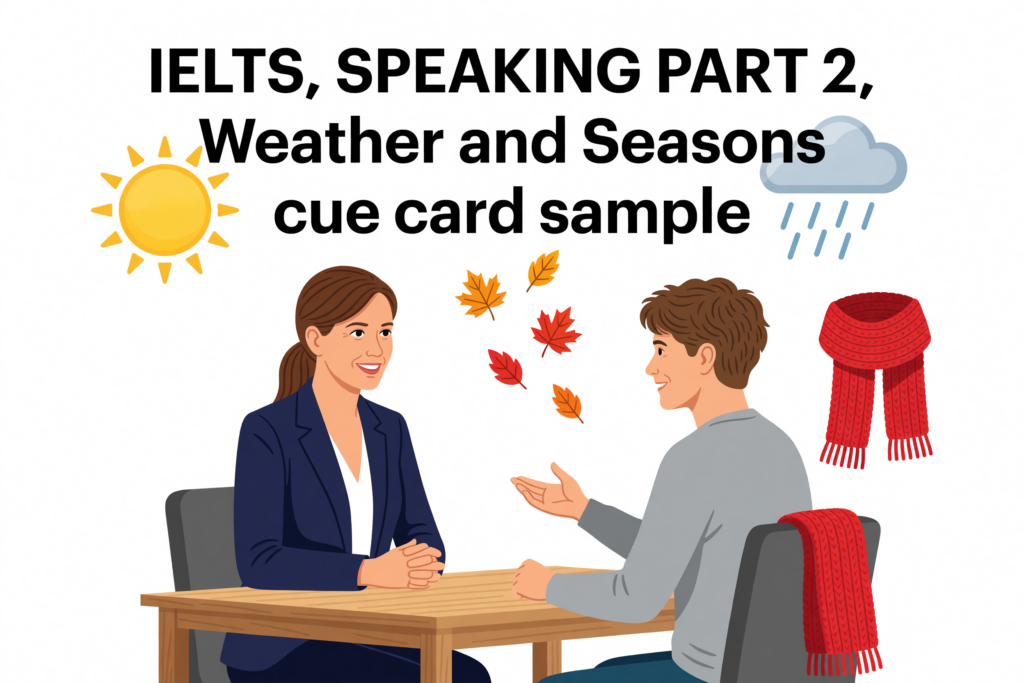
An IELTS Speaking Part 2 Weather And Seasons cue card sample normally asks you to describe a season, a type of weather, or a time when weather affected your plans. The test is not about meteorology. It is about whether you can organise a response, extend it with relevant details, and keep speaking naturally for around two minutes.
That means the best answer usually includes a clear opening, a few connected details, and a natural ending. The main goal is to show that you can keep one idea moving naturally without sounding lost or over-rehearsed.
Think of the cue card as a short story with a purpose. You are not listing weather vocabulary. You are showing that you can take a familiar topic and shape it into an answer with direction.
A reliable structure for this topic
Most candidates do better when they use a four-part answer instead of improvising from start to finish. First, identify the season or weather type clearly. Second, explain when or where it matters to you. Third, give one or two specific examples. Fourth, finish with a personal reflection or comparison.
This structure helps because it creates movement. The answer does not stay stuck at the level of “I like winter” or “summer is my favourite”. It becomes a small narrative. For example, you might mention that you prefer the rainy season because it changes your daily routine, reminds you of a family place, and helps you focus on study or work.
- Start by naming the season or weather type clearly
- Say when you usually experience it
- Add a real example, memory, or routine
- End with why it remains important to you
If your current speaking feels inconsistent across topics, access unlimited IELTS mock tests so you can compare whether your Part 2 performance stays stable beyond your favourite cue cards.
Sample answer: Weather and seasons cue card
Here is a natural sample you can learn from without copying word for word:
“I would like to talk about winter, which is probably the season I feel most comfortable in. In the place where I grew up, winter was never extremely harsh, but it was cool enough to change the atmosphere completely. The mornings felt calmer, the air was cleaner, and people seemed less tired than they did in summer.
What I like most about winter is that it makes my daily routine more productive. I sleep better, I can concentrate for longer, and I usually feel more motivated to study or work. I also associate winter with family dinners and short weekend trips, so for me it has an emotional side as well as a practical side.
One memory that stands out is a trip I took with my family to a mountain area a few years ago. It was not snowing, but the weather was cold enough for us to wear jackets, drink hot tea outside, and spend a lot of time walking around. I still remember that trip because it felt peaceful and very different from our normal routine.
Overall, I prefer winter because it helps me feel calmer, more focused, and more comfortable. Even though some people love summer, I think winter suits my personality much better.”
This answer works because it is specific, easy to follow, and personal without sounding memorised. It moves from general preference to daily effect, then to a memory, then to a final judgement.
Useful language without sounding rehearsed
Strong candidates prepare flexible language, not fixed scripts. For this topic, you can safely build phrases around preference, routine, memory, and comparison. That gives you enough range to sound natural while staying easy to control.
- “I tend to prefer…”
- “What stands out to me is…”
- “I associate that season with…”
- “It affects my routine because…”
- “Compared with summer, it feels…”
- “One memory that comes to mind is…”
What you should avoid is forcing high-level vocabulary that you would never use in normal speech. If you say “precipitation” when you are clearly uncomfortable with the word, it does not make the answer better. Clear language with good control usually scores more safely than awkward “advanced” language, especially when the examiner is judging how naturally you can keep the answer moving.
Common mistakes in weather and seasons answers
The most common mistake is staying too general. Candidates say they like spring because flowers are beautiful or summer because they can travel, but they never develop the idea. Another mistake is giving a memorised answer that sounds polished at the start and then collapses once the prepared material ends.
Timing is another issue. Some people spend too long on the introduction and then have no detail left for the second minute. Others jump between different seasons and lose coherence. A much safer plan is to choose one season, build one clear line of development, and keep your examples connected to that choice.
- Do not describe every season in one answer
- Do not stay at the level of textbook vocabulary lists
- Do not speak too fast just to fill the time
- Do not memorise a script you cannot adapt
How to practise this cue card for a real band score gain
The best practice method is not repeating one model answer until it sounds smooth. That only creates false confidence. Instead, prepare three versions of the topic. One can be about your favourite season. One can be about weather that disrupted a plan. One can be about a season that matters for study, work, or family life. That forces you to stay flexible while using the same speaking structure.
Record yourself and check three things. First, do you keep speaking without long pauses? Second, do your details stay relevant to the cue card? Third, does your ending sound complete rather than sudden? When those three areas improve, your Part 2 score usually becomes safer.
If you are close to booking your exam and want a practical view of support options, see our IELTS preparation plans and compare the level of feedback that matches your timeline and target score.
How to adapt the sample instead of memorising it
The smartest way to use an IELTS Speaking Part 2 Weather And Seasons cue card sample is to borrow the structure, not the exact wording. Keep the same logic, but switch the season, the personal reason, and the memory. That way your answer still sounds natural if the examiner gives a slightly different angle.
For example, the same framework could work for spring, rainy weather, or a time when a storm changed your plans. You would still start by naming the weather clearly, then explain why it matters, then add an example, and then finish with a final reflection. This approach is much safer than memorising full sentences because it gives you room to think in real time.
Ready to find out your IELTS band score?
Take the IELTS Express Pre-Test for just $4.99 and get your personalised band prediction with a 14-day improvement plan.
FAQ: IELTS Speaking Part 2 Weather And Seasons cue card sample
Do I need to talk for the full two minutes?
You should aim to speak close to two minutes, because stopping very early can make the answer feel underdeveloped. You do not need to hit the time perfectly, but you need enough relevant detail to show fluency and control.
Can I use a simple season like summer or winter?
Yes. The season does not need to be unusual. A simple choice is often better because you can explain it more naturally and add real examples without forcing ideas.
Should I memorise a weather and seasons sample answer?
No. Memorising exact answers is risky because the real cue card may change slightly. Learn a flexible structure and a small set of natural phrases instead.
What vocabulary is useful for this topic?
Useful vocabulary includes words about routine, mood, temperature, comfort, travel, and memory. What matters most is that you can use the words accurately and naturally in full sentences.
What if I run out of ideas after one minute?
Use a backup path: explain a specific memory, compare the season with another one, or describe how it affects your study, work, or social life. Those three moves can help you extend the answer without sounding random.
Final takeaway
The real value of an IELTS Speaking Part 2 Weather And Seasons cue card sample is not the sample itself. It is the method behind it. If you learn how to organise your answer, add specific details, and finish with a clear personal judgement, this topic becomes much easier to control.
That matters because Part 2 is rarely lost on vocabulary alone. It is usually lost on weak development, unstable fluency, or answers that sound generic. Build a repeatable structure, test it across a few related topics, and make sure your speaking still holds together when the cue card changes. That is the kind of preparation that protects your band score when the exam is real.