If you want to improve IELTS Reading General from band 6 to 7, you are probably not struggling with the absolute basics anymore. You can usually follow the passages, find many answers, and finish enough of the paper to stay competitive. The problem is that small errors keep repeating. Before you assume Reading is already good enough, take the IELTS Express Pre-Test to see whether your current habits really match the score you need.
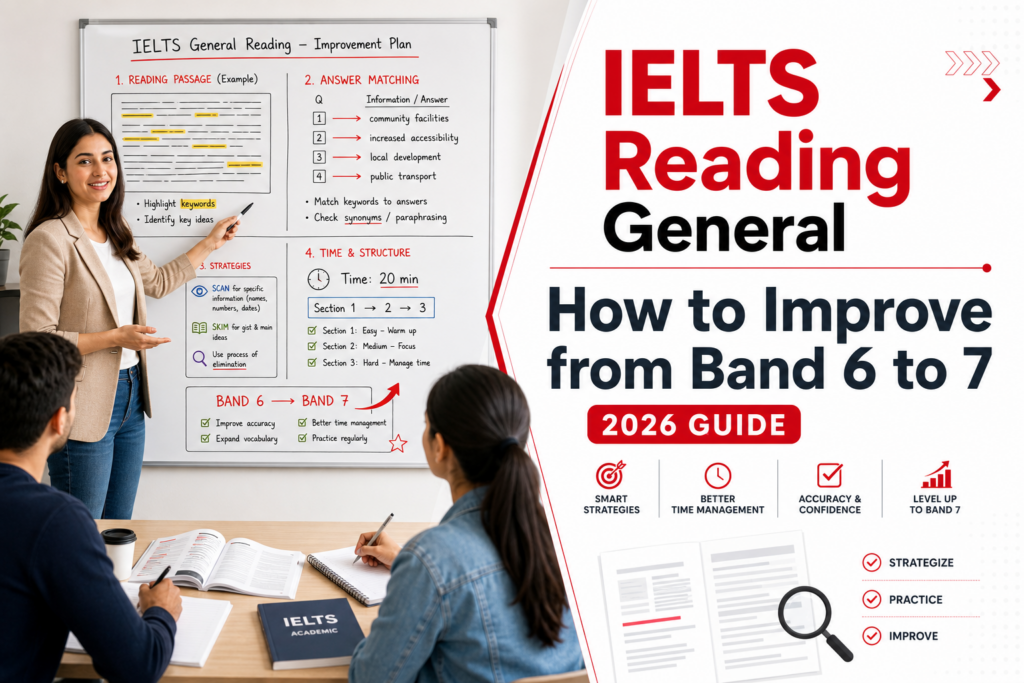
The jump from Band 6 to Band 7 is important because it usually means your reading becomes more controlled, more accurate, and more consistent under pressure. At Band 6, candidates often understand the text reasonably well but still lose marks through rushed judgement, weak handling of paraphrasing, and avoidable timing mistakes. At Band 7, those leaks become smaller. You do not need perfect reading. You need cleaner decisions across the whole test.
What changes between Band 6 and Band 7 in General Reading
Band 6 readers are often capable but uneven. They can answer easier questions well, but they still fall into traps when wording shifts, when a paragraph contains several similar ideas, or when one difficult item disrupts the rhythm of the section. Their score is not low because they cannot read. It is low because their process is not yet reliable enough.
Band 7 readers tend to be steadier. They still meet unfamiliar words and confusing options, but they recover faster and verify meaning more carefully. They are less likely to choose an answer just because one keyword appears in the passage. They pause long enough to test the exact idea.
- Band 6 readers often find the right area but choose the wrong answer
- Band 7 readers confirm the meaning before locking the answer in
- Band 6 readers lose rhythm after one awkward question
- Band 7 readers protect the next mark even when one answer feels uncertain
Why Band 6 candidates stay stuck longer than expected
Many candidates at this level think they only need more practice tests. Practice matters, but repetition alone does not usually create the jump. The real issue is that Band 6 mistakes can feel almost reasonable. You may read a sentence, see familiar language, and choose an option that sounds right enough. Later, when you check the answer key, the correct answer looks close to your choice, not wildly different. That makes the problem harder to diagnose.
This is why Band 7 improvement usually comes from better analysis, not just more volume. You need to understand exactly why your wrong answer was wrong. Often the passage did not fully support it, or the question was narrower than you realised, or a contrast word changed the meaning late in the sentence. If your wider Reading system still feels scattered, the IELTS Reading General tips and strategies guide is a useful companion because it explains the section structure and common scoring leaks more broadly.
IELTS Reading General improve from band 6 to 7 by sharpening evidence control
The most reliable path upward is stronger evidence control. That means you should be able to point to the line, sentence, or idea that supports your answer. At Band 6, many candidates already locate the right paragraph. The extra step is proving that the selected answer matches the passage more precisely than the alternatives.
This matters because IELTS rewards exact reading. A partly correct option is still wrong. A heading that matches one detail but misses the paragraph’s main role is still wrong. A statement that seems true in everyday life but is not clearly supported by the text is still wrong. Band 7 readers build the habit of checking that last layer instead of trusting the first plausible option.
- Read around the evidence instead of relying on one isolated phrase
- Check the subject and limit words such as only, mainly, some, or most
- Watch for contrast when the sentence turns with however, but, although, or instead
- Reject answers with partial truth when they do not fit the full meaning
That discipline often feels slower at first, but it usually saves time overall because it reduces the number of answers you have to second-guess later.
How paraphrasing quietly blocks a Band 7 score
Paraphrasing is one of the biggest reasons competent candidates stay at Band 6. They know the topic, they understand much of the passage, and they still lose marks because the wording on the question sheet does not match the wording in the text exactly. In General Reading, the language may be less academic than in Academic Reading, but the test still relies heavily on paraphrase.
For example, the question may mention a refund, while the passage says money will be returned. A notice may say bookings are essential, while the question refers to advance reservation. A job advertisement may mention prior experience, while the option uses the phrase previous work history. If you only hunt for identical words, you can miss the answer even when you understood the idea.
A useful training method is to review wrong answers by rewriting the key relationship in simpler words. Ask yourself what the passage was really saying and how the test expressed that same idea differently. Over time, that makes you calmer around unfamiliar wording because you stop expecting exact word matches every time.
Question types that usually decide the jump from Band 6 to Band 7
The step from Band 6 to Band 7 is rarely decided by the easiest completion tasks. More often, it is decided by question types that demand clean interpretation. True False Not Given, matching headings, matching information, and multiple choice often separate stronger Band 6 candidates from genuine Band 7 readers.
In True False Not Given, the challenge is precision. Candidates at Band 6 often understand the general topic but blur the line between contradiction and absence of information. In matching headings, they may choose the heading that fits an interesting example rather than the paragraph’s overall function. In multiple choice, they may eliminate too fast and keep an option that sounds sensible but is not fully supported.
- True False Not Given: compare the statement to the text line by line
- Matching headings: choose the paragraph’s central job, not its loudest detail
- Multiple choice: wait for exact support, not general familiarity
- Matching information: confirm both location and meaning before deciding
If you want score movement, classify your last few Reading papers by question type. The recurring weakness is often clearer than you expect.
Timing at Band 7 level is more about decision quality than speed
Many candidates talk about time management as if they simply need to read faster. Usually, that is not the real issue at this stage. The bigger issue is decision timing. How long do you stay trapped on one doubtful question? How quickly do you recognise that rereading the same sentence again is no longer helping? When do you move on and protect easier marks later in the paper?
Band 7 readers are not reckless, but they are decisive. They give difficult questions a clean second look, not five confused ones. They move efficiently through simpler sections so they can preserve attention for the more demanding material. They understand that a perfect process is not necessary, but a disciplined one is.
If you need more exam-like repetition while training that discipline, it helps to access unlimited IELTS mock tests and review not only your score, but also where your timing began to slip. That usually reveals whether the problem comes from one question type, one section, or one emotional habit after a missed answer.
How to read notices, adverts, and workplace texts more intelligently
General Reading often includes practical texts such as notices, policies, instructions, adverts, and workplace communication. Because these look familiar, candidates sometimes underestimate them. They skim too quickly, assume they know the message, and miss a condition hidden in smaller wording. That is a classic Band 6 problem.
To move toward Band 7, treat practical texts with more respect. Pay attention to who the information is for, what action is required, and what limits or exceptions apply. Many wrong answers come from missing words such as before, unless, only, or must. Those words often decide the meaning.
- Identify the purpose of the text before hunting answers
- Look for rules and exceptions because IELTS often tests them
- Track who the message applies to instead of assuming it is for everyone
- Notice dates, deadlines, and conditions carefully
This sounds simple, but it adds a layer of seriousness that often protects several easy marks.
Review habits that actually turn Band 6 mistakes into Band 7 gains
Most candidates check answers too quickly. They see the score, feel pleased or disappointed, and move on. That wastes the best part of the practice. Review is where the score shift usually happens because review forces you to understand the real cause of the error.
After each practice paper, classify every lost mark. Did you choose from a keyword match? Did you confuse Not Given with False? Did you miss a contrast word? Did you answer too early in a multiple-choice item? Did you run short of time because one question held you too long? Those labels matter because they convert vague frustration into a repair plan.
A useful review loop is simple:
- Redo the question slowly without time pressure
- Underline the exact evidence for the correct answer
- Write one sentence explaining why your answer failed
- Group repeated errors together and train the pattern directly
If you are close to your target and want a clearer support structure, see the IELTS preparation plans to compare practical options that match your timeline and band goal.
A realistic 3-week plan to improve from Band 6 to Band 7
The jump from Band 6 to Band 7 is realistic when your English is already good enough and the problem is mainly process. A short focused plan usually works better than endless random drilling. In three weeks, you can tighten your weak habits, test the correction, and track whether the same mistakes are still appearing.
A practical structure could look like this:
- Week 1: one full Reading paper, then deep review of every lost mark
- Week 1: targeted drills on the weakest question type from that paper
- Week 2: timed section practice with strict rules for moving on from doubtful items
- Week 2: paraphrase review using notices, adverts, and workplace texts
- Week 3: two full papers with written error classification after each one
- Week 3: final revision of recurring patterns and one last controlled mock test
The purpose is not to do the most practice possible. The purpose is to close the loop between test, diagnosis, and correction. That is what usually lifts a capable Band 6 reader into more consistent Band 7 territory.
Use this score jump as a control problem, not a talent problem
Many candidates think Band 7 belongs to naturally fast or gifted readers. In reality, the move from Band 6 to Band 7 often comes from better control rather than more talent. You need better evidence discipline, stronger paraphrase awareness, and calmer timing decisions. Those are trainable skills.
Before the FAQ, use this as your practical checkpoint:
Ready to find out your IELTS band score?
Take the IELTS Express Pre-Test for just $4.99 and get your personalised band prediction with a 14-day improvement plan.
FAQ: IELTS Reading General improve from band 6 to 7
How hard is it to improve IELTS Reading General from band 6 to 7?
It is challenging, but very realistic for candidates who already understand the passages reasonably well. The main work is usually reducing repeated decision errors rather than rebuilding your English from the beginning.
What is the biggest difference between Band 6 and Band 7 in General Reading?
The biggest difference is control. Band 7 readers check meaning more precisely, manage time more calmly, and lose fewer marks to paraphrasing or partial matches.
Should I do more full tests or more review if I am stuck at Band 6?
You still need full tests, but review is often the more powerful part. Without careful review, you may repeat the same mistakes and stay at the same score for longer than necessary.
Which question types should I focus on first for a Band 7 target?
Start with the question types that repeatedly cost you marks. For many candidates, that means True False Not Given, matching headings, matching information, or multiple choice.
Can vocabulary alone move my Reading score from Band 6 to Band 7?
Vocabulary helps, but it is rarely enough on its own. Most Band 6 to 7 improvement comes from better evidence checking, paraphrase handling, and timing discipline.
Build cleaner reading decisions and the score usually follows
If you want to improve IELTS Reading General from band 6 to 7, think less about magic techniques and more about cleaner reading decisions. Slow down enough to verify meaning. Respect paraphrasing. Move on from doubtful items with more discipline. Review your errors until the pattern becomes obvious.
Band 7 usually appears when your process becomes steadier across the full paper. That is good news, because steady habits can be trained. Fix the repeated leaks, and the next score band becomes much more reachable.