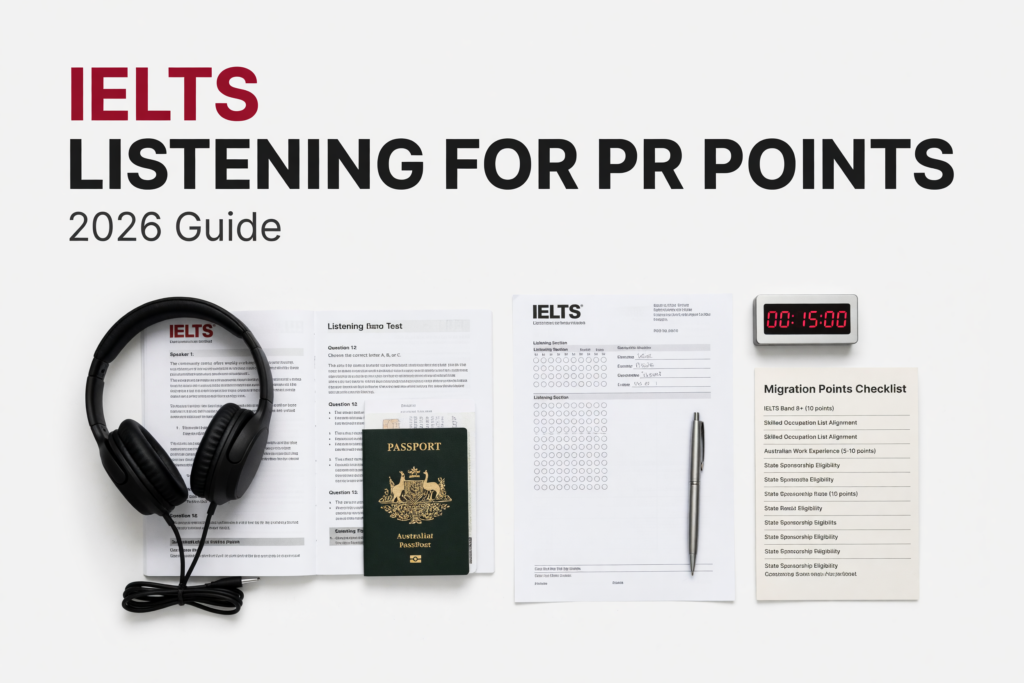
If you are searching for IELTS Listening for PR Points, you are probably trying to answer a high-stakes question: how much can one Listening score help or hurt your migration plan? That matters because a points strategy often looks strong on paper until one section misses the level you need. Before you book another test, take the IELTS Express Pre-Test to see whether your current English profile is already close to the threshold you need.
Listening often feels more objective than Writing or Speaking. There is no essay to organise and no interview nerves to manage. Even so, it can quietly block a better PR outcome when candidates lose marks through timing, distractors, spelling, or late concentration drops. A more useful approach is to understand how Listening fits into the wider PR points picture, then prepare for the exact score pattern your pathway requires.
What IELTS Listening for PR Points usually means in practice
When people search for IELTS Listening for PR Points, they are rarely asking whether Listening creates migration points by itself. In most cases, they want to know how the Listening band contributes to the English category linked to their PR outcome. That distinction matters because migration systems usually reward the overall section profile, not one isolated skill.
In practical terms, Listening is one part of the band combination that helps determine whether you sit at a lower, safer, or more competitive English level for your application. If Listening falls below the required line, the whole result pattern may stay stuck at the lower category even when your other sections are strong. That is why Listening deserves deliberate attention rather than casual practice.
- Listening usually matters as part of the wider English result profile
- One weak Listening band can block a better PR outcome
- The goal is not a lucky score once, but a score you can repeat
Why the Listening band can affect your PR points strategy
A lot of candidates focus on the overall IELTS band because it sounds simpler. Migration planning is usually less forgiving than that. Many pathways care about section minimums, which means a good overall score is not enough if one band slips under the required level. Listening is often the section people underestimate because they assume everyday English exposure will carry them through.
That assumption often backfires. IELTS Listening is not just about understanding English in a general sense. It is about tracking detail under time pressure, predicting what kind of answer is needed, and avoiding traps designed to test accuracy. If your migration plan depends on reaching a stronger English category, Listening may be the section that decides whether the points increase actually happens.
For broader context around how English levels fit into migration planning, the IELTS for PR Points complete guide is worth reviewing alongside your section-level preparation.
What score targets usually matter most
The right Listening target depends on the exact visa, points pathway, and official English category attached to your case. You should always verify the current requirement for your own application. Still, the planning logic is straightforward. Most candidates are not simply trying to pass the test. They are trying to secure a result profile that supports a better points outcome.
That means your Listening target should be based on repeatable performance, not your best-ever practice result. If you only hit the required band on a perfect day, that is not a safe migration strategy. A better plan is to aim for a small buffer so one difficult section, one missed instruction, or one lapse in concentration does not undo months of preparation.
- Know the exact section target linked to your migration goal
- Plan for a repeatable score, not a one-off peak
- Build a margin if Listening has been inconsistent
If you want a clearer picture of whether your current performance is stable enough, access unlimited IELTS mock tests and compare your Listening results across several timed attempts.
Why strong candidates still lose marks in IELTS Listening
Listening can look simple because the test moves forward in a fixed order and the audio gives you the answer somewhere. That creates false confidence. Strong candidates still lose marks because IELTS does not reward rough understanding. It rewards precise understanding at the exact moment the information appears.
Common errors are surprisingly consistent. Candidates hear a familiar word and write too early. They miss a correction because the speaker changes the detail a second later. They know the answer but spell it badly. They follow the first half of Section 4 well, then lose focus for thirty seconds and give away several marks in a row. In a PR points context, those are not small mistakes. They are exactly the sort of mistakes that keep a score one band below target.
- Writing an answer before the speaker finishes the full detail
- Missing corrections, dates, or number changes
- Losing marks through spelling and word-form errors
- Dropping concentration in the later sections
IELTS Listening for PR Points needs a threshold strategy
If your migration timeline is active, random practice is not enough. You need a threshold strategy. That means identifying the exact habits that keep your Listening score below the band you need, then training those habits directly. If your score is already above the target, the goal changes from improvement to stability.
This is why review matters more than volume. Doing ten practice tests without understanding the pattern of your errors often changes very little. A sharper approach is to review each lost mark and ask why it happened. Did you miss signpost language? Did you fail to predict the answer type? Did you confuse singular and plural? Did you ignore the word limit? Once you name the pattern, Listening becomes much more manageable.
If your overall IELTS plan still feels scattered, see our IELTS preparation plans and compare the support option that matches your score goal and timeline.
The Listening skills that matter most when points are on the line
Not every Listening weakness costs the same number of marks. Migration-focused candidates usually have a few repeat problems that keep pulling the score down. Fixing those repeat problems is often the fastest way to protect a points outcome.
- Prediction: know whether you are listening for a name, number, place, noun, or time expression before the audio reaches the gap
- Distractor control: expect the speaker to mention one option, reject it, then give the real answer
- Spelling accuracy: make your answer correct in content and form, not just approximately right
- Section 4 stamina: stay mentally engaged when the speech becomes faster and denser
- Instruction discipline: respect word limits and transfer the answer in the form the test requires
Candidates who improve these five areas often raise their Listening score faster than candidates who only keep replaying full tests. The section becomes much less stressful when you know exactly what skill is being tested at each moment.
How to prepare efficiently before your next test date
You do not need a complicated study system to improve Listening. You need a short, disciplined cycle that gives feedback quickly. Start with one timed Listening paper under proper exam conditions. Then review every missed answer in detail. After that, spend the next few sessions targeting the pattern that caused most of the losses.
A practical weekly structure could look like this:
- one full timed Listening test
- one deep review session with error categories
- two short drills on distractors, spelling, or prediction
- one Section 4 focus session for concentration and note tracking
- one repeat timed paper to check whether the same errors remain
This kind of cycle is effective because it treats Listening as a performance skill. You are not only trying to understand the audio. You are training your timing, attention, and answer discipline under pressure.
How to decide whether your Listening score is safe enough
A single good result is encouraging, but it is not always enough evidence for a migration decision. The better question is whether your target Listening band appears consistently across multiple attempts. If your score swings up and down, Listening may still be the unstable section in your English profile even when the best result looks strong.
A safe score usually has three features. First, you can repeat it under timed conditions. Second, you can still reach it when the audio topic feels unfamiliar. Third, you are not depending on perfect concentration from start to finish just to scrape over the line. That is the kind of score profile that supports a PR points strategy with less risk.
Before the FAQ, use this checkpoint if you want a clearer view of your likely band level before your next booking:
Ready to find out your IELTS band score?
Take the IELTS Express Pre-Test for just $4.99 and get your personalised band prediction with a 14-day improvement plan.
FAQ: IELTS Listening for PR Points
Does IELTS Listening give PR points on its own?
Usually, no. Listening normally matters as one part of the overall English result profile linked to your migration pathway. A stronger Listening band helps when it supports the section minimums needed for a higher English category.
What Listening band should I aim for if I want more PR points?
You should aim for the exact band level required by the English category relevant to your case, plus a small safety margin if your Listening score has been unstable. Always confirm the current official requirement for your application.
Why do candidates lose Listening marks even when their English is good?
Because IELTS Listening tests precision under time pressure. Many candidates understand the topic but still miss marks through distractors, spelling mistakes, correction traps, and late concentration drops.
Can one weak Listening score stop a stronger PR points outcome?
Yes. If your migration pathway depends on meeting section thresholds across all four skills, one Listening band below the line can stop the whole English profile from moving into the higher category.
How should I prepare if Listening is the section blocking my migration plan?
Review your errors by pattern rather than only doing more full tests. Focus on prediction, distractors, spelling, and Section 4 concentration so your improvement targets the marks you are actually losing.
Protect the band that can quietly protect your points
IELTS Listening for PR Points is really about control, not guesswork. You are trying to build an English score profile that supports a migration outcome without one section quietly dragging the result down.
Know the band target your pathway requires. Test whether your score is repeatable. Fix the small Listening habits that leak marks under pressure. When you do that, Listening stops being the section you hope will be fine and becomes a section that actively protects your PR strategy.