If you are preparing for ielts writing task 2, you already know this section can move your overall band up or down quickly. Many candidates in Australia are strong in speaking and listening, but writing remains the barrier for migration, university entry, or professional registration. The issue is usually not effort. It is strategy. You need to understand what the examiner marks, what errors reduce your band, and how to practise in a way that gives measurable improvement.
This guide focuses on that exact problem. It gives you a practical, section-specific plan for candidates in Australia who need higher writing performance in a limited timeline.
What IELTS Writing Task 2 Is Really Testing
IELTS Writing Task 2 is a formal argument essay of at least 250 words. You get 40 minutes. The examiner is not looking for difficult vocabulary in every sentence. They are marking your ability to present a clear position, develop ideas logically, and control grammar with enough range and accuracy.
Task 2 is worth twice as much as Task 1 in the Writing module. That weighting is why this section has such a strong effect on your final writing band.
IELTS Writing Task 2 Band Descriptors, Simplified
There are four criteria, each worth 25 percent:
- Task Response: You answer the question directly and develop your position with relevant support.
- Coherence and Cohesion: Your essay is easy to follow. Paragraphing and linking are logical.
- Lexical Resource: Vocabulary is precise, natural, and suitable for formal writing.
- Grammatical Range and Accuracy: You use a mix of sentence structures with controlled errors.
If you have not checked your full profile across all modules yet, take an IELTS Express Pre Test first. It helps you confirm whether Writing Task 2 is the main bottleneck or part of a broader score pattern.
Why Australia-Based Candidates Lose Marks in Writing
Most candidates do not lose marks because they have no ideas. They lose marks because they misread the prompt, go off-topic in body paragraphs, and rush the final review. In Australia, this is common among full-time workers who study after hours and rely on passive reading instead of timed writing.
Typical mark-reducing patterns include:
- Writing a memorised template that does not fit the exact question type.
- Giving broad statements without concrete explanation.
- Using complex grammar inaccurately to sound advanced.
- Ignoring topic-specific vocabulary and repeating basic words.
- Finishing late and skipping error correction.
For broader exam context, this IELTS exam guide explains how writing performance affects your full test strategy.
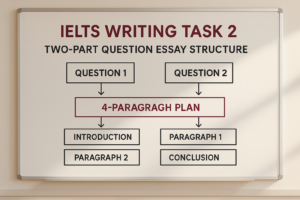
A Practical Essay Structure That Improves Scores
Use a stable framework. Do not improvise structure under time pressure.
1) Introduction (2 to 3 sentences)
Paraphrase the question and state your position clearly. Avoid vague openings.
2) Body Paragraph 1
Present your strongest point. Explain why it matters. Add a specific example.
3) Body Paragraph 2
Present a second developed point. Keep one clear central idea in the paragraph.
4) Final Paragraph
Restate your position in direct language. Do not introduce new arguments.
This format works for opinion, discussion, and problem-solution prompts because it keeps logic clear for both writer and examiner.
Mistakes Checklist for Faster Improvement
Run this checklist during your final 4 to 5 minutes:
- Did I answer every part of the question?
- Does each body paragraph support my stated position?
- Do topic sentences match paragraph content?
- Did I overuse one linking word like “however”?
- Are there obvious subject-verb agreement errors?
- Did I check article usage: a, an, the?
- Did I include at least one relevant example per body paragraph?
Many Band 6.0 scripts move toward 6.5 simply by reducing avoidable grammar and cohesion errors at review stage.
7-Day IELTS Writing Task 2 Sprint Plan
If your test date is close, use this one-week cycle:
- Day 1: Write one essay under timed conditions. Get a baseline.
- Day 2: Analyse errors by criterion and rewrite weak paragraphs.
- Day 3: Practise idea generation for 10 common topics.
- Day 4: Write one full essay with strict timing again.
- Day 5: Grammar repair session on sentence control and punctuation.
- Day 6: Write one high-pressure mock essay and self-score.
- Day 7: Light review, phrase bank revision, and rest.
Pair this with speaking and reading maintenance. This IELTS speaking test guide is useful if your spoken fluency also needs structured work.
How to Target Band 7 Without Overcomplicating Language
Band 7 writing is usually clear and controlled, not overly academic. You can reach it by doing the fundamentals consistently:
- Use precise vocabulary, not rare words forced into wrong contexts.
- Write topic sentences that make paragraph purpose obvious.
- Develop points with brief cause-effect explanation.
- Use a mix of simple and complex sentences that remain accurate.
- Leave time for correction every single essay.
For long-term preparation structure, see the IELTS preparation complete guide.
FAQ: IELTS Writing Task 2
How many words should IELTS Writing Task 2 be?
At least 250 words. Most strong responses sit around 260 to 290 words, with clear development and controlled timing.
Can I use personal examples in IELTS Writing Task 2?
Yes. Personal or hypothetical examples are acceptable if they support your argument and remain relevant.
Is complex grammar required for Band 7?
You need some range, but accuracy matters more than complexity. Clear, mostly error-free sentences score better than risky, incorrect structures.
How often should I practise before test day?
For noticeable improvement, write 3 to 4 timed essays per week and review them by criterion, not just by total band guess.
What is the fastest way to improve IELTS Writing Task 2?
Use timed writing, criterion-based review, and focused rewriting of weak paragraphs. Passive reading alone is slower.
Your Next Step Before Test Day
Strong writing scores come from repeatable process, not luck. If you keep your structure stable, answer the exact question, and review errors with discipline, you can move your writing band in a realistic timeframe. Start with one diagnostic essay today, then apply a targeted weekly cycle until your test date.