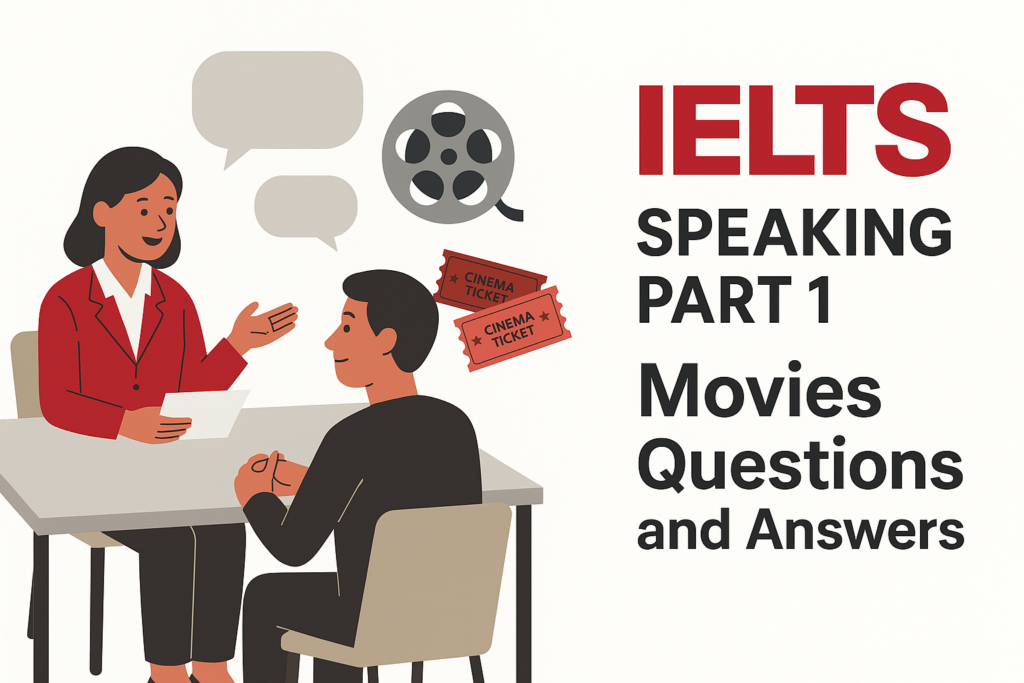
IELTS Speaking Part 1 Movies questions and answers are useful to practise because movies are familiar, but many candidates still give answers that are too short, too general, or too memorised. You may be asked what films you like, how often you watch movies, whether you prefer watching at home or in a cinema, or what kind of films are popular in your country. Before you build a long list of model answers, take the IELTS Express Pre-Test to check your current speaking band range and see whether fluency, vocabulary, or answer development is the main issue.
The movies topic is not testing your knowledge of film history. The examiner is checking whether you can answer ordinary personal questions clearly and naturally. A strong Part 1 answer usually needs two to four sentences: a direct answer, one reason, and a small example. This guide gives you common movie questions, natural sample answers, useful vocabulary, common mistakes, and a short practice routine.
IELTS Speaking Part 1 Movies Questions And Answers: What To Expect
Movies can appear as a simple everyday topic in IELTS Speaking Part 1. The examiner may ask about your habits, preferences, cinema visits, favourite genres, childhood memories, or whether people in your country enjoy going to the cinema. The questions are simple, but your language still needs control.
You do not need to sound like a film critic. In fact, answers that try to sound too clever can become unnatural. It is better to speak clearly about real habits. If you rarely watch movies, say that, then explain what you watch instead. Honesty is easier to develop than a fake answer.
- Answer the question directly first.
- Add one reason for your opinion or habit.
- Give one small example if it fits.
- Use natural vocabulary, not memorised phrases.
- Stop before the answer becomes a Part 2 speech.
Common IELTS Speaking Part 1 Movie Questions
These questions are common examples for the movies topic. The examiner may change the wording, so practise flexible ideas rather than one fixed script.
- Do you like watching movies?
- What kind of movies do you enjoy?
- How often do you watch movies?
- Do you prefer watching movies at home or in a cinema?
- Did you watch many films when you were a child?
- Who do you usually watch movies with?
- Are movies popular in your country?
- Do you prefer local films or foreign films?
- Have your movie habits changed in recent years?
- Would you like to watch more movies in the future?
When you practise, choose five questions and answer each one in about 20 to 30 seconds. If your answer is only one sentence, add a reason. If it becomes too long, remove one detail.
Sample Answers About Movie Habits
Question: Do you like watching movies?
Yes, I do, although I do not watch them every day. I usually watch a film on the weekend because it helps me relax after a busy week.
Question: How often do you watch movies?
I watch movies maybe once or twice a month. I used to watch them more often, but now I usually choose shorter videos or series because they fit my schedule better.
Question: Who do you usually watch movies with?
I normally watch movies with my family or a close friend. I enjoy talking about the story afterwards, especially if the ending is surprising or emotional.
These answers are short, but they are not empty. Each one answers the question, adds a reason, and includes a small personal detail. That is the target for Part 1.
If you want broader speaking practice, the IELTS Speaking Part 1 sample answers page can help you compare answer length across different topics.
Sample Answers About Film Types And Preferences
Question: What kind of movies do you enjoy?
I usually enjoy comedies and dramas. Comedies are good when I want something light, but dramas are more interesting when the characters feel realistic.
Question: Do you prefer local films or foreign films?
I watch more foreign films because they are easier to find online, but I still like local films when the story feels close to real life. They often show familiar places, problems, and humour.
Question: Do you like action movies?
Sometimes, yes. I enjoy action films if the story is strong, but I lose interest if the movie only has fights, noise, and special effects.
Preference answers are a good chance to use contrast. You can say you like one type of movie in one situation and another type in a different situation. This gives you more grammar range without forcing difficult language.
Cinema Or Streaming: How To Answer Comparison Questions
Many candidates get movie questions about watching films at home compared with going to the cinema. These answers are useful because they allow you to compare comfort, cost, sound quality, screen size, convenience, and atmosphere.
Question: Do you prefer watching movies at home or in a cinema?
I usually prefer watching movies at home because it is cheaper and more comfortable. However, for a big action film, the cinema is better because the screen and sound make the experience more exciting.
Question: Are cinemas popular in your country?
Yes, cinemas are still popular, especially for new releases and family outings. At the same time, many people now stream movies at home because it is more convenient.
Notice the balance in these answers. They do not give a one-sided opinion when real life is more mixed. IELTS rewards clear communication, and a simple contrast often sounds more natural than an extreme answer.
If you need realistic pressure practice, access unlimited IELTS mock tests and record your Part 1 answers without pausing to plan every sentence.
Useful Vocabulary For Movie Answers
You do not need advanced cinema vocabulary for Part 1. You need accurate words that help you explain your taste, habits, and reasons. Use vocabulary that sounds like normal speech.
- Genre: a type of movie, such as comedy, drama, action, horror, romance, or documentary.
- Plot: the main story of a film.
- Character: a person in the story.
- Scene: one part of a movie.
- Subtitle: written words on the screen that show what people are saying.
- Streaming: watching films online through a service.
- Special effects: visual or sound effects used to make scenes look more dramatic.
- Predictable: easy to guess before it happens.
Try simple phrases such as “the plot was easy to follow”, “the characters felt realistic”, or “I watched it with subtitles”. These phrases are more useful than rare words that you cannot pronounce confidently.
How To Extend Movie Answers Naturally
The easiest method is answer, reason, example. If the examiner asks whether you like movies, answer yes or no, explain why, then mention one type of movie or one recent example. This gives the answer enough detail without becoming rehearsed.
You can also use time contrast. For example: “I watched more movies when I was younger, but now I usually watch short videos because I have less free time.” This answer gives past and present grammar naturally.
Another useful method is situation contrast. You might say: “I prefer watching at home on normal weekends, but I go to the cinema when there is a film I really want to see.” This sounds natural because preferences often depend on the situation.
For a full answer-building system, review the IELTS Speaking Part 1 tips and strategies guide and apply the same structure to the movie topic.
Common Mistakes With Movies Questions
The first mistake is giving answers that are too short. If you say, “Yes, I like movies,” the examiner has almost no language to assess. Add one reason or example so the answer has shape.
The second mistake is repeating the same words. Many candidates say interesting, nice, good, and famous again and again. Try more exact words such as funny, relaxing, realistic, emotional, predictable, confusing, entertaining, or slow.
The third mistake is pretending to love films when you do not. IELTS does not require you to be passionate about movies. If you rarely watch films, say so clearly: “Not very often, because I usually prefer series or short videos.” That is still a valid answer.
The fourth mistake is memorising a perfect answer about a favourite film and using it for every question. The examiner may ask about habits, cinemas, childhood, or your country. Prepare flexible ideas, not one speech.
If Speaking is still difficult to control, see our IELTS preparation plans and choose support that includes spoken feedback, not only written model answers.
A Seven-Day Practice Plan For Movies Questions
On day one, record answers to ten movie questions and check whether each answer starts directly. On day two, add one clear reason to every answer. On day three, practise comparison answers about cinemas and streaming.
On day four, practise past-tense answers about childhood movie habits. On day five, use movie vocabulary in short answers without forcing it. On day six, mix movies with other Part 1 topics so you can change topic smoothly. On day seven, record a full Part 1 set and write down three repeated problems.
This routine is short, but it trains the habit that matters most. You learn to answer quickly, add enough detail, and stop naturally.
Final Checklist Before Practising Movie Questions
Before test day, make sure you can answer questions about movie habits, favourite genres, cinema visits, streaming, childhood films, and whether films are popular in your country. Practise honest answers with enough detail.
Do not chase perfect model answers. A clear personal answer is usually better than a memorised answer that sounds unnatural. The examiner wants to hear your English, not a script.
The best movie answers are simple, specific, and easy to follow. Say what is true, give a reason, and add one example. If you can do that smoothly, movies becomes a safe and flexible Part 1 topic.
Ready to find out your IELTS band score?
Take the IELTS Express Pre-Test for just $4.99 and get your personalised band prediction with a 14-day improvement plan.
FAQ: IELTS Speaking Part 1 Movies Questions And Answers
What movie questions are common in IELTS Speaking Part 1?
Common questions ask whether you like movies, what kind of films you watch, how often you watch them, whether you prefer cinemas or home viewing, and whether movies are popular in your country.
How long should my movie answers be?
Most Part 1 answers should be two to four sentences. Give a direct answer, add one reason, and include a short example if it fits naturally.
Can I say I do not watch many movies?
Yes. Be honest, then explain what you usually watch instead or why you do not watch films often. The examiner is testing your English, not your movie habits.
Should I memorise IELTS Speaking Part 1 movies answers?
No. Prepare ideas and useful vocabulary, but avoid memorising full answers. The examiner can change the wording, so flexible answers are safer.
What vocabulary is useful for movies answers?
Useful words include genre, plot, character, scene, subtitles, streaming, special effects, predictable, realistic, entertaining, confusing, and emotional.