IELTS score gap analysis is the fastest way to stop guessing why your IELTS result is not moving. Instead of saying, “I need a higher band,” you compare your current section scores with the score you actually need for migration, study, registration, or work. Before you book another test, take the IELTS Express Pre-Test to estimate your current band range and identify the section most likely to block your target.
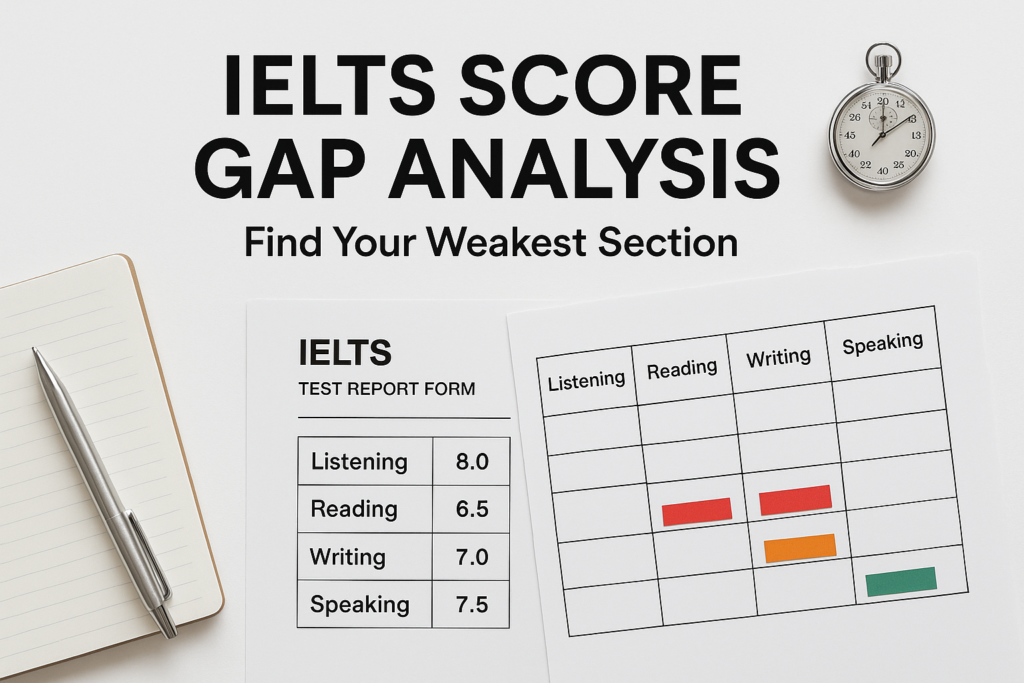
Most IELTS candidates do not have one general problem. They have a gap. Sometimes the gap is obvious, such as Writing 6.0 when the target is 7.0. Sometimes it is hidden behind a good overall score. A candidate with Listening 8.0, Reading 7.5, Writing 6.5, and Speaking 7.0 may look strong, but if the target is 7.0 each, Writing is the real problem. A score gap analysis turns that frustration into a clear plan.
IELTS Score Gap Analysis: What It Means
An IELTS score gap analysis compares three things: your required score, your current score, and the specific reasons for the difference. It is not only a band calculator. It is a diagnosis. The aim is to find the smallest number of changes that can produce the biggest improvement.
For some candidates, the gap is a section minimum. For others, it is the difference between an overall band and a higher target. Migration applicants often need each section to reach a minimum. University applicants may need an overall score plus minimum section bands. Professional registration bodies can have stricter rules again.
- Write down the exact target score for your pathway.
- Compare every IELTS section separately.
- Find the section that is furthest below target.
- Identify whether the problem is skill, timing, task understanding, or test technique.
- Build preparation around the gap, not around random practice.
Why Overall Band Score Can Mislead You
The overall IELTS band is useful, but it can hide the weakness that matters most. Listening and Reading often lift the average because they are receptive skills and easier to improve through practice volume. Writing and Speaking usually expose grammar control, development, pronunciation, and real-time language flexibility.
If your target is 7.0 each, an overall 7.0 is not enough when one section is 6.5. If your university requires Writing 6.5, an overall 7.5 will not help if Writing is 6.0. This is why score analysis must start with the requirement, not with the nicest-looking number on the test report.
When you understand the exact gap, you can stop over-practising sections that are already safe. A candidate who already has Listening 8.0 does not need the same listening schedule as a candidate stuck at 5.5. The plan should follow the evidence.
Step 1: Confirm The Score You Actually Need
Before analysing the gap, confirm the target. Do not rely on a friend’s requirement, an old forum post, or a vague memory from a migration consultation. Write down the required overall score, each section minimum, test type, validity period, and deadline.
This step matters because different pathways use IELTS differently. A skilled migration pathway may focus on section scores. A university offer may ask for an overall score with a writing minimum. A nursing, teaching, engineering, or accounting pathway may involve extra English rules through a registration or assessing body.
If you are unsure whether your current score is close enough, access unlimited IELTS mock tests and compare your result against the exact requirement. A mock test is only useful when it answers the question: what is still missing?
Step 2: Build A Section-By-Section Score Table
Create a simple table with five columns: section, current score, required score, gap, and priority. For example, Listening 7.5 to 7.0 is safe. Reading 7.0 to 7.0 is safe but should be maintained. Writing 6.0 to 7.0 is a one-band gap and high priority. Speaking 6.5 to 7.0 is a half-band gap and medium priority.
This table prevents emotional preparation. Many candidates practise the section they enjoy because it feels productive. Score gap analysis pushes you toward the section that controls the outcome. That can be uncomfortable, but it is usually where the improvement is.
Do not ignore a safe section completely. IELTS scores can fall if you stop practising under timed conditions. The goal is to maintain safe sections while giving most feedback, time, and energy to the blocking section.
Step 3: Diagnose The Type Of Gap
Not all score gaps are the same. A Listening gap might come from spelling, plurals, distractors, map questions, or losing concentration in Sections 3 and 4. A Reading gap might come from slow scanning, misunderstanding True False Not Given, weak vocabulary, or spending too long on one passage.
Writing gaps are often caused by task response, paragraph development, unclear position, grammar accuracy, or weak examples. Speaking gaps may come from short answers, repeated vocabulary, pronunciation clarity, limited Part 3 development, or sounding memorised.
This is where many candidates waste time. They know the band they need but not the reason they missed it. Without diagnosis, practice becomes repetition. With diagnosis, every session has a purpose.
Common IELTS Score Gap Patterns
The most common pattern is strong Listening and Reading with weaker Writing. This usually means the candidate understands English well but has difficulty producing accurate, organised language under test conditions. More reading alone will not fix that gap. The candidate needs writing feedback, grammar control, and task-specific planning.
Another common pattern is Speaking 6.5 when the target is 7.0. The candidate may communicate clearly but give answers that are too short, too general, or too repetitive. They may also lose pronunciation clarity during longer answers. This is a small gap, but it needs focused practice.
A third pattern is uneven Reading. Candidates may score well in practice but drop on test day because timing collapses. In that case, the gap is not only language. It is test management. Timed sets, question order, and review routines matter.
How To Prioritise Your Weakest Section
Prioritising does not mean doing only one section. It means giving the highest-value section the most deliberate practice. If Writing is one band below target, it should receive more feedback than Listening if Listening is already above target. If Speaking is only half a band short, short daily speaking drills may be enough while you protect the other scores.
Use a 60-30-10 model for a short preparation block. Spend about 60 percent of your study time on the blocking section, 30 percent on the next riskiest section, and 10 percent maintaining your strongest areas. Adjust after each mock test.
If you need structured support and feedback, see our IELTS preparation plans and choose the option that targets your actual score gap rather than buying general practice you do not need.
Writing Score Gap Analysis
Writing is the section where candidates often misread the problem. A band 6.0 essay may have plenty of ideas, but the ideas may not answer the question precisely. A band 6.5 essay may be clear but too general. A candidate chasing 7.0 needs stronger task response, better paragraph control, accurate sentence structures, and fewer repeated errors.
Analyse Writing by looking at four areas. First, does the answer fully address the question? Second, is each paragraph built around one clear point? Third, are grammar errors frequent enough to distract the reader? Fourth, is vocabulary accurate, or does it sound forced?
For more targeted help with essay improvement, the IELTS Writing Task 2 band score guide can help you connect examiner criteria with practical revision steps.
Speaking Score Gap Analysis
Speaking gaps are easiest to find when you record yourself. Do not rely on how the answer felt while speaking. Listen again and mark where you hesitated, repeated words, gave a vague example, or stopped too early. A strong answer usually has a direct response, support, and a natural extension.
For Part 1, the gap is often answer length. For Part 2, it may be organisation and detail. For Part 3, it is usually depth: candidates give a simple opinion but do not explain causes, consequences, comparisons, or examples. Band improvement often comes from extending ideas more naturally, not memorising impressive words.
The IELTS Speaking Test complete guide is useful if your score gap is linked to answer structure, topic control, or confidence under examiner pressure.
Reading And Listening Score Gap Analysis
Reading and Listening gaps often look like carelessness, but there is usually a pattern. In Listening, check whether wrong answers come from spelling, singular and plural forms, distractors, dates, numbers, or losing the speaker’s direction. In Reading, check whether errors come from vocabulary, question type, time pressure, or choosing answers from memory instead of the text.
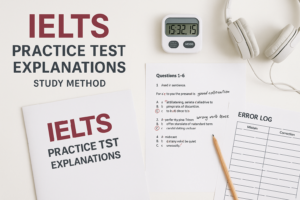
Build an error log. Do not only write the correct answer. Write why your answer was wrong. After two or three practice tests, the pattern becomes clear. If most errors are True False Not Given, practise that question type. If most errors happen in the final passage, work on timing.
For broader test structure and scoring context, read the IELTS test format guide before changing your whole study plan.
A 14-Day IELTS Score Gap Plan
Day one should be diagnostic. Complete a full test or use recent official scores. On day two, build the score gap table. On days three to five, focus on the biggest gap and collect evidence: essays, recordings, wrong-answer logs, or timed sets.
On days six to nine, practise the main weak skill with feedback. Do not simply repeat full tests. Fix the specific pattern. On day ten, take a timed section test. On days eleven and twelve, review the remaining gap. On day thirteen, complete a mixed practice session. On day fourteen, take another mock test and compare results.
The aim is not magic improvement in two weeks. The aim is clarity. By the end, you should know whether your target is close, whether you need more feedback, and which section deserves the next study block.
When A Retake Makes Sense
A retake makes sense when your gap is small, your practice results are stable, and you know exactly what went wrong in the previous test. If you missed Speaking 7.0 by half a band but your recordings are improving, a retake may be reasonable. If Writing has stayed at 6.0 for three attempts, another booking without feedback is risky.
Before retaking, check whether your practice scores match the official target. Also check whether nerves, timing, or task misunderstanding affected the result. A retake should be part of a plan, not a panic response.
Final Checklist For IELTS Score Gap Analysis
Before your next IELTS booking, confirm your target, compare every section, identify the biggest gap, diagnose the cause, and choose practice that directly addresses the issue. Keep your plan simple enough to follow and honest enough to be useful.
The best IELTS plan is not always the longest one. It is the one that protects safe scores, repairs weak sections, and connects preparation to the result you actually need. Score gap analysis gives you that structure.
Ready to find out your IELTS band score?
Take the IELTS Express Pre-Test for just $4.99 and get your personalised band prediction with a 14-day improvement plan.
FAQ: IELTS Score Gap Analysis
What is IELTS score gap analysis?
IELTS score gap analysis compares your current section scores with your required score and identifies which section, skill, or test habit is blocking your target band.
Why is my overall IELTS score high but one section still a problem?
The overall band can hide a weak section. Many pathways require minimum scores in each section, so one lower result can still block migration, study, or registration goals.
Which IELTS section should I improve first?
Start with the section furthest below your required score. If two sections are close, prioritise the one that has the highest risk or needs expert feedback, often Writing or Speaking.
Can mock tests help with IELTS score gap analysis?
Yes, if you review them properly. A mock test should show section scores, repeated mistake patterns, timing problems, and whether your target is realistic within your deadline.
How often should I repeat score gap analysis?
Repeat it after each full mock test or official IELTS result. Your preparation plan should change when the evidence changes.