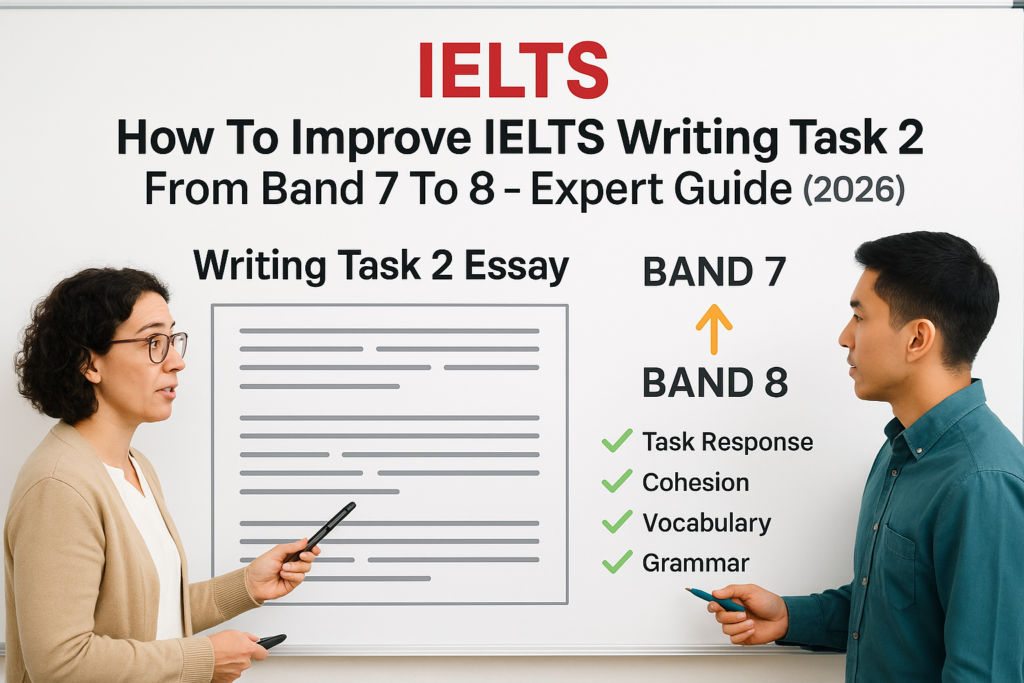
How to improve IELTS Writing Task 2 from band 7 to 8 is a different problem from learning basic essay structure. At band 7, you can usually answer the question, organise paragraphs, and use a reasonable range of grammar and vocabulary. To reach band 8, the writing must become more exact, more controlled, and more convincing. Before you keep writing another pile of essays, take the IELTS Express Pre-Test to check whether your Writing score is really sitting near band 7, or whether one hidden weakness is still pulling the result down.
The move from 7 to 8 is often small on the page but big in discipline. You do not need to sound academic for the sake of it. You need to answer every part of the task directly, build arguments that feel complete, link ideas without over-signposting, and remove the grammar slips that make the examiner hesitate. This guide shows what changes when a Task 2 essay moves from good to very strong.
How To Improve IELTS Writing Task 2 From Band 7 To 8: The Real Difference
Band 7 writing is generally clear. The candidate addresses the task, presents a position, organises ideas, and uses some complex language. The problem is that the essay may still have uneven development, occasional overgeneralisation, awkward linking, or small but repeated grammar errors.
Band 8 writing is more decisive. The position is clear throughout the essay. Each main idea is developed enough to answer the question, not just mention the topic. The paragraphs move logically, the vocabulary is natural and precise, and grammar mistakes are rare rather than distracting.
- Band 7 often answers the topic; band 8 answers the exact question.
- Band 7 has relevant ideas; band 8 develops them with stronger logic.
- Band 7 uses linking; band 8 creates flow through meaning.
- Band 7 has range; band 8 has range with control.
- Band 7 may sound good; band 8 stays accurate under pressure.
Start With Task Response, Not Vocabulary
Many candidates try to improve from 7 to 8 by memorising better words. That is usually the wrong starting point. Vocabulary helps, but Task Response is often the biggest ceiling. A band 8 essay must answer the question with a clear, well-supported position.
If the question asks whether the advantages outweigh the disadvantages, the essay must make that balance clear. If it asks to what extent you agree, the degree of agreement must be obvious. If it asks for causes and solutions, both sides need enough development. A strong essay can lose its edge when the answer drifts into a general discussion of the topic.
For broader score planning, read the IELTS Writing Task 2 band score guide and compare your current habits against the official criteria rather than judging essays by how polished they sound.
Build A Clear Position Before You Write
A band 8 essay does not discover its opinion halfway through. Before writing, decide your position in one sentence. For example: I partly agree because technology improves access to education, but it cannot replace the motivation and feedback provided by teachers. That sentence gives the whole essay a direction.
Your position should be visible in the introduction, supported in the body paragraphs, and confirmed in the conclusion. If your introduction says you partly agree but both body paragraphs argue only one side, the essay feels inconsistent. If your conclusion introduces a new opinion, the answer feels unfinished.
Spend two minutes planning the position and paragraph roles. It is faster than repairing a confused essay later. The aim is not to create a complicated plan. The aim is to prevent contradiction, repetition, and weak development.
Make Each Body Paragraph Do One Job
A common band 7 problem is a body paragraph with too many half-developed ideas. The candidate may mention cost, convenience, motivation, technology, family pressure, and government policy in one paragraph. The paragraph looks full, but the argument is thin.
For band 8, each body paragraph should have one main job. Start with a clear topic sentence, explain the idea, give a specific example or consequence, and connect it back to the question. This creates depth. Examiners reward developed ideas more than a long list of loosely connected points.
If you want to practise this under timed conditions, access unlimited IELTS mock tests and review whether each paragraph has one main claim or several unfinished claims competing for space.
Upgrade Explanation, Not Just Examples
Examples are useful, but they cannot replace explanation. Many band 7 essays give an example too quickly, before the logic is clear. A band 8 paragraph usually explains why the idea matters before adding an example.
For instance, if the topic is remote work, do not simply say that many people work from home. Explain that remote work reduces commuting time, gives employees more control over their schedule, and can increase productivity when tasks require concentration. Then add a brief example, such as office workers using saved travel time for earlier project completion.
The best examples are simple and believable. They do not need statistics or named research. They need to support the point directly. A vague example weakens the argument, while a precise ordinary example often strengthens it.
Use Cohesion Without Sounding Mechanical
Band 7 candidates often overuse linking phrases: furthermore, moreover, in addition, on the other hand, as a result. These phrases are not wrong, but if every sentence begins with a connector, the essay can sound mechanical.
Band 8 cohesion comes from the relationship between ideas. Pronouns, repeated key nouns, contrast words, cause-and-effect language, and paragraph sequencing all create flow. Sometimes the best link is not a flashy phrase. It is a sentence that clearly follows the previous one.
For example, instead of writing moreover in every second sentence, use a clear chain: This reduces stress for employees. Lower stress can improve concentration. Better concentration often leads to fewer mistakes. The logic itself creates cohesion.
Control Vocabulary Instead Of Chasing Rare Words
To improve from band 7 to 8, vocabulary needs precision. You do not need obscure words. You need the right words for the argument. Words such as significant, effective, sustainable, accessible, harmful, efficient, unequal, and practical can be powerful when used accurately.
The risk at band 7 is trying to sound advanced and producing unnatural collocations. Phrases like make a big development for society or people can get a better knowledge sound awkward. Band 8 writing usually uses strong but normal combinations: improve public health, reduce inequality, protect local communities, expand access to education.
Use topic vocabulary, but keep it under control. For more focused practice, the IELTS Writing Task 2 vocabulary list can help you build natural word groups instead of memorising isolated impressive words.
Reduce Grammar Errors That Repeat
Band 8 does not require perfect grammar, but mistakes should be rare and should not interfere with meaning. The biggest problem is not one unusual error. It is a repeated pattern: article mistakes, subject-verb agreement, sentence fragments, comma splices, plural nouns, or uncontrolled relative clauses.
Keep an error log. After each essay, identify the three most common grammar problems. Do not try to fix every possible grammar point at once. If your main issue is articles, focus on articles for a week. If your issue is long sentences collapsing, practise shorter complex sentences with one clear clause relationship.
Accuracy improves when you write sentences you can control. A clean sentence with one subordinate clause is better than a long sentence that loses agreement, punctuation, and meaning.
Write Introductions That Set Up The Essay
A band 8 introduction is not long. It paraphrases the task and gives a clear answer. It should not contain memorised background statements such as nowadays, this is a highly controversial issue in our modern society. Those phrases waste space and can sound artificial.
For an agree-disagree essay, give your position directly. For a discussion essay, mention both views and your opinion if the question asks for it. For a problem-solution essay, signal the main problem and the type of solution you will explain. The introduction should prepare the examiner for the essay that follows.
The best introductions are clean, specific, and honest. If your body paragraphs are about cost and quality, the introduction should not promise culture and technology. Alignment matters.
Write Conclusions That Confirm, Not Repeat
A conclusion should bring the argument back to the question. It does not need a dramatic final sentence. It should restate the position in a fresh way and summarise the main reason for that position.
A weak conclusion simply copies the introduction. A stronger conclusion shows the final judgement. For example: Overall, while online learning can make education more accessible, it is most effective when combined with teacher guidance because feedback and motivation remain essential for many students.
Do not introduce a new major idea in the conclusion. If the idea is important, it belongs in a body paragraph. The conclusion should close the essay, not open a new discussion.
Practise With Review, Not Volume
Writing ten essays without review is not a band 8 plan. It can strengthen the same mistakes. A better plan is to write fewer essays and review them deeply. For each essay, check task response, paragraph depth, cohesion, vocabulary accuracy, and recurring grammar errors.
Use a simple review question for each criterion. Did I answer the exact question? Does each body paragraph develop one main idea? Do the sentences connect naturally? Are my word choices precise? Which grammar mistake appears more than once?
If you are comparing support options, see our IELTS preparation plans and choose feedback that targets your weakest Writing Task 2 habit rather than giving you generic essay corrections.
A 14-Day Band 7 To 8 Writing Plan
In the first three days, diagnose your current essays. Review two or three recent Task 2 responses and identify the pattern that limits the score. Most candidates find one of four problems: unclear position, thin development, unnatural vocabulary, or repeated grammar mistakes.
From days four to ten, write targeted paragraphs rather than full essays every day. Practise one introduction, one body paragraph, and one conclusion. Focus on depth and accuracy. Twice during this period, write a complete essay under 40-minute conditions.
In the final four days, reduce new learning and increase control. Review your error log, rewrite weak paragraphs, and practise planning quickly. The goal is to walk into the test with a stable method, not a head full of last-minute phrases.
Common Mistakes That Keep Candidates At Band 7
The first mistake is writing memorised templates. Some structure is helpful, but examiners can see when the language is generic. Templates also fail when the question wording changes. Band 8 writing sounds responsive to the question.
The second mistake is overcomplicating the essay. Candidates sometimes use long sentences and abstract vocabulary to appear advanced. If the argument becomes harder to follow, the score may not improve. Clarity is a strength, not a weakness.
The third mistake is ignoring the weakest criterion. If your grammar accuracy is already strong but your ideas are underdeveloped, more grammar practice will not solve the problem. The band jump comes from the limiting factor.
Final Checklist Before You Submit Task 2
Before you finish, check the essay against five questions. Have I answered every part of the question? Is my position clear from beginning to end? Does each body paragraph develop one main idea? Have I used vocabulary naturally? Can I remove or fix one repeated grammar pattern?
This final check does not need to take long. Even two minutes can help you catch missing articles, unclear references, repeated words, or a conclusion that does not match the question. Band 8 is often built from these small controls.
The aim is not to write a perfect essay. The aim is to write an essay that is consistently clear, relevant, developed, and accurate. That is the difference between a strong band 7 and a convincing band 8.
Ready to find out your IELTS band score?
Take the IELTS Express Pre-Test for just $4.99 and get your personalised band prediction with a 14-day improvement plan.
FAQ: How To Improve IELTS Writing Task 2 From Band 7 To 8
What is the main difference between band 7 and band 8 in IELTS Writing Task 2?
Band 7 is generally clear and organised, but band 8 is more precise, better developed, more consistent, and more accurate. The position is clearer and grammar mistakes are much less noticeable.
Can vocabulary alone move Writing Task 2 from band 7 to 8?
No. Vocabulary helps, but task response, paragraph development, cohesion, and grammar control usually matter more. Rare words cannot compensate for a weak argument or unclear position.
How many essays should I write to improve from band 7 to 8?
Quality matters more than volume. Write some full timed essays, but also review them deeply and practise individual paragraphs. Repeating the same errors across many essays will not lift the score.
Is band 8 possible in Writing Task 2 without perfect grammar?
Yes. Band 8 does not require perfection, but errors should be rare and meaning should remain clear. Repeated grammar mistakes are the bigger risk.
How long does it take to move from band 7 to band 8?
It depends on the weakness. Some candidates improve quickly after fixing task response or paragraph development, while others need longer to reduce grammar errors and build consistency under timing pressure.