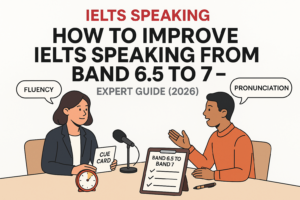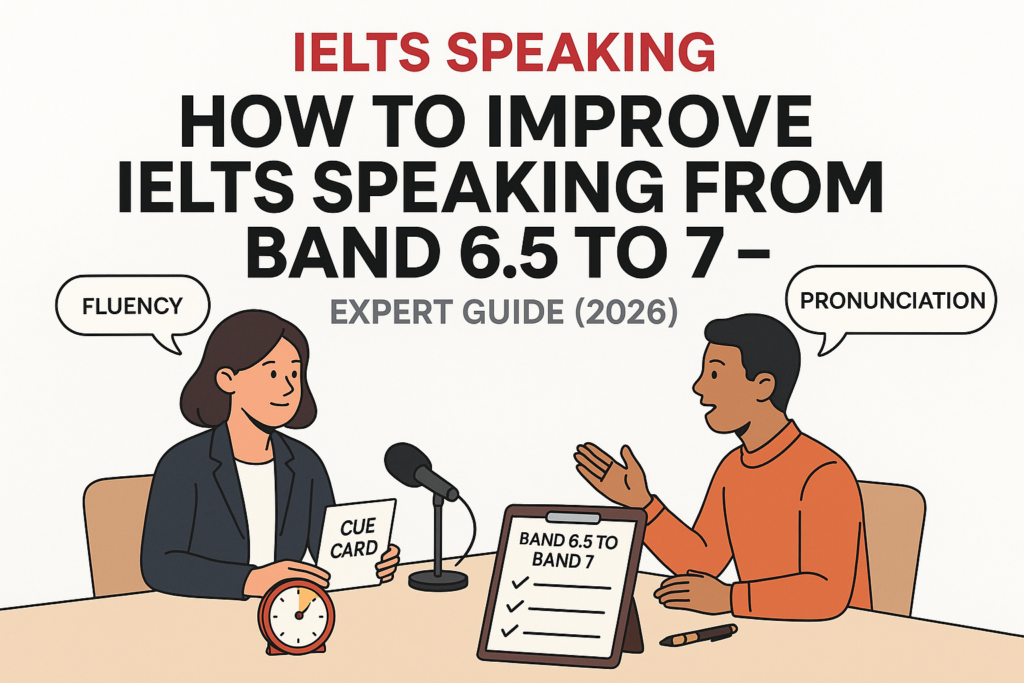
If you want to know how to improve IELTS Speaking from band 6.5 to 7, the answer is usually not “learn more impressive words”. Band 6.5 candidates can often communicate well, but their answers still have enough hesitation, vague development, repeated vocabulary, grammar slips, or pronunciation strain to stop the examiner awarding a stable Band 7. Before you practise another set of random questions, take the IELTS Express Pre-Test to check your current band range and see whether Speaking is the section holding your result back.
The jump from 6.5 to 7 is narrow, but it is not automatic. You need to make your speaking sound more controlled under test pressure. That means answering directly, extending with purpose, using flexible but natural vocabulary, reducing repeated grammar errors, and keeping pronunciation easy to follow. This guide gives you a practical route from “good but inconsistent” to a stronger Band 7 performance.
How To Improve IELTS Speaking From Band 6.5 To 7: The Real Gap
At Band 6.5, many candidates are already understandable. They can answer most questions and keep the conversation moving. The problem is that the examiner hears uneven control. Some answers sound fluent, then the candidate suddenly pauses, repeats the same idea, or loses grammar accuracy in a longer sentence.
Band 7 speaking feels more stable. You do not need perfect English. You need enough fluency, vocabulary, grammar range, and pronunciation control to make the conversation comfortable. The examiner should not have to work hard to follow your ideas.
- Develop answers without memorising full scripts.
- Use precise everyday vocabulary instead of forced rare words.
- Control common grammar patterns under pressure.
- Make pronunciation clear, with natural stress and pausing.
- Recover smoothly when you make a mistake.
Know What A Band 7 Speaker Does Differently
A Band 7 speaker can usually speak at length without obvious strain. They may hesitate occasionally, but the hesitation does not break the answer. They can paraphrase when a word is missing. They use a mix of simple and more complex grammar, with some errors, but those errors do not often confuse meaning.
The key difference is control. A Band 6.5 answer might have good content but too many small issues together. For example, the candidate may answer the question, but repeat “very good” several times, use one long unclear sentence, and stress important words weakly. A Band 7 answer is not necessarily longer. It is cleaner.
If you want pressure-tested practice, access unlimited IELTS mock tests and record yourself answering without pausing or restarting. The recording will show whether your speaking stays stable after the first answer.
Fix Fluency Without Speaking Faster
Many candidates think Band 7 fluency means speed. It does not. Speaking too fast can make pronunciation worse and grammar less accurate. Fluency means your ideas connect smoothly, with manageable pauses and enough development.
Practise using a simple answer shape: answer, reason, example, result. For a Part 1 question like “Do you enjoy cooking?” a stronger answer might be: “Yes, I do, especially on weekends. It helps me relax after a busy week, and I like trying simple recipes from different countries. I am not an expert, but I enjoy the process.” That answer is clear, developed, and natural.
For Part 2, use the cue card as a map, not a script. Prepare two or three story points and speak through them. If you forget one point, move to the next. The goal is to continue naturally, not to reproduce a perfect memorised speech.
Make Vocabulary More Specific, Not More Complicated
Band 7 vocabulary is flexible and accurate. It does not mean filling every answer with academic words. In Speaking, natural collocations usually work better than impressive but awkward expressions.
Instead of saying “It was very good” again and again, choose the exact meaning. Was it useful, relaxing, challenging, convenient, memorable, stressful, expensive, or worthwhile? These words are not rare, but they make your answer clearer. Precision is one of the easiest ways to sound more advanced.
Build small topic sets. For work, learn phrases such as tight deadlines, supportive colleagues, career prospects, work-life balance, and deal with pressure. For study, learn keep up with assignments, take notes, sit an exam, join a discussion, and manage my workload. The IELTS Speaking test complete guide can help you connect topic vocabulary with the full test format.
Stop Memorising Full Answers
Memorised answers can sound impressive for ten seconds, then collapse when the examiner changes the question. They also often sound unnatural because the language does not match the candidate’s normal speaking rhythm. Examiners are used to hearing rehearsed responses.
Memorise flexible building blocks instead. Prepare ways to compare, explain preferences, describe a past experience, and talk about future plans. For example, “I used to…, but these days…” is useful across many topics. So is “The main reason is…” or “It depends on the situation.” These frames help you organise answers without sounding scripted.
Practise answering the same question three different ways. Keep the idea similar but change the example, vocabulary, or structure. This trains flexibility, which is exactly what a 6.5 candidate often needs.
Improve Grammar By Targeting High-Value Patterns
You do not need perfect grammar for Band 7, but you need fewer repeated mistakes. Focus on patterns that appear in almost every Speaking test: past tense stories, comparisons, conditionals, future plans, reasons, and relative clauses.
For Part 2, past tense control is especially important. If the cue card asks you to describe a memorable trip, keep the story in the past unless you are talking about now. A weak answer may jump between “I go”, “I went”, and “I was go”. A stronger answer keeps the verbs consistent: “I went”, “we stayed”, “it was”, “I remember”.
For Part 3, comparisons and conditional answers matter. Practise sentences like “People in large cities tend to rely more on public transport than people in small towns” and “If schools gave students more speaking practice, they would probably feel more confident.” Short controlled complex sentences are better than long sentences that fall apart.
Use Pronunciation To Make The Examiner’s Job Easier
Pronunciation is not about having a British, Australian, or American accent. It is about being easy to understand. Band 7 pronunciation usually has clear word stress, sentence stress, pausing, and enough intonation to show meaning.
Record one answer and listen for the words that carry meaning. In the sentence “I really enjoyed the course because the teacher gave practical feedback”, the important words are really, enjoyed, course, teacher, practical, and feedback. If every word has the same stress, the answer sounds flat and harder to follow.
Use pauses before examples and contrasts. For example: “I prefer studying in the morning, because I can concentrate better. In the evening, I get distracted more easily.” Those pauses make the answer clearer and give you time to control grammar.
Handle Part 1, Part 2, And Part 3 Differently
Part 1 needs short, direct answers. Do not turn every question into a long speech. Two to four sentences are usually enough. Answer first, then add a reason or example. This shows fluency without over-talking.
Part 2 needs a longer answer, so prepare a simple story line. Use the one-minute preparation time to write keywords, not full sentences. Aim for a beginning, two details, and a reflection. If you finish early, add how you felt, why it mattered, or whether you would do it again.
Part 3 needs more abstract thinking. Give an opinion, explain it, and add an example or contrast. If the examiner asks about society, education, technology, or work, move beyond your personal life. To practise realistic question progression, review IELTS Speaking Part 2 and Part 3 strategy and apply the same framework to new topics.
Build A Seven-Day Band 7 Speaking Routine
Use a short routine rather than vague daily speaking practice. On day one, record Part 1 answers and check whether they are too short or too long. On day two, practise one Part 2 cue card twice, changing the story slightly the second time. On day three, focus only on past tense accuracy.
On day four, practise Part 3 comparisons. On day five, record yourself using topic vocabulary naturally. On day six, do a full Speaking mock test. On day seven, review the recording and write down three recurring problems. Then repeat the cycle with new topics.
If your deadline is close and you need feedback, compare IELTS preparation plans and choose support that includes Speaking correction, not only practice questions.
Common Mistakes That Keep Candidates At 6.5
The first mistake is giving answers that are fluent but vague. If every answer uses general words like good, nice, interesting, important, and different, the examiner has limited evidence of lexical range. Replace vague words with more exact meaning.
The second mistake is trying to sound formal. IELTS Speaking is a spoken test. You can use natural contractions, personal examples, and conversational phrasing. Overly formal language often sounds memorised and may reduce fluency.
The third mistake is ignoring pronunciation. Some candidates practise vocabulary and grammar for weeks but never listen to their own recordings. If your word endings, stress, or pausing are unclear, the examiner may miss the strength of your answer.
What To Do In The Final Week Before The Test
In the final week, stop collecting new vocabulary lists. Focus on performance. Record full answers, listen back, and fix the problems that repeat. Choose ten common topics and prepare ideas, not scripts. Make sure you can discuss work, study, family, technology, travel, health, education, and your hometown.
Do not practise only easy topics. Band 7 control appears when the question is unfamiliar. If you get a strange question, buy time naturally: “I have not thought about that much, but I would say…” Then give a simple answer. A clear response to a difficult question is better than a complicated response that loses control.
On test day, speak to the examiner as a person. Answer the question, extend enough, and move on. If you make a mistake, correct it quickly or continue. One mistake does not ruin the score, but panic can damage the next three answers.
Final Checklist For Moving From 6.5 To 7
Before your next Speaking test, check whether you can answer Part 1 naturally, speak for nearly two minutes in Part 2, and explain opinions in Part 3 without depending on memorised sentences. Check whether your vocabulary is specific, your grammar errors are not repeated too often, and your pronunciation is easy to follow.
The 6.5 to 7 jump is about consistency. You already have enough English to communicate. Now your job is to make that English more reliable under exam conditions. Practise with recordings, review the exact problem, and improve one feature at a time.
When your answers become clearer, more developed, and easier to follow, Band 7 becomes a realistic target rather than a lucky result.
Ready to find out your IELTS band score?
Take the IELTS Express Pre-Test for just $4.99 and get your personalised band prediction with a 14-day improvement plan.
FAQ: How To Improve IELTS Speaking From Band 6.5 To 7
How long does it take to improve IELTS Speaking from 6.5 to 7?
Many candidates can improve within a few weeks if the gap is small and they practise with recordings, feedback, and targeted correction. Larger pronunciation or fluency issues may take longer.
Do I need advanced vocabulary for Band 7 Speaking?
You need flexible, accurate vocabulary, not rare words. Specific everyday phrases used naturally are usually stronger than formal words that sound memorised.
Can grammar mistakes still happen at Band 7?
Yes. Band 7 speakers can make some grammar mistakes, but the errors should not be frequent enough to block meaning or make answers feel uncontrolled.
What is the fastest way to improve Speaking fluency?
Record timed answers and practise extending with answer, reason, example, and result. Fluency improves when you can continue without restarting or memorising full scripts.
Should I memorise IELTS Speaking answers?
No. Memorise flexible phrases and topic ideas instead. Full memorised answers often sound unnatural and can fail when the examiner asks a slightly different question.