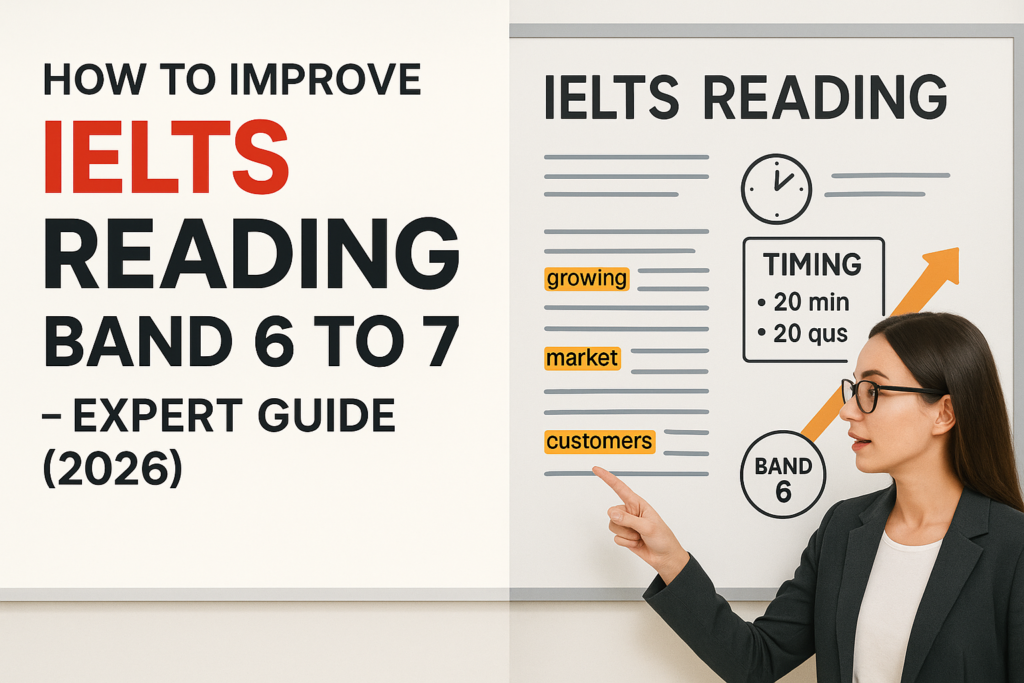
If you are asking How to improve IELTS Reading from band 6 to 7, you are probably not missing basic English. You can already understand many texts, but your score is being held down by timing, question-type errors, vocabulary gaps, or careless transfers. Before you keep repeating random reading tests, take the IELTS Express Pre-Test to check your current band range and get a focused 14-day improvement plan.
The move from Band 6 to Band 7 is usually about control. At Band 6, candidates often understand the general meaning but lose marks when the wording changes, when answers are hidden across several sentences, or when time pressure builds. Band 7 Reading requires better accuracy, faster location skills, and a calmer method for difficult questions.
What Band 6 To Band 7 Means In IELTS Reading
In IELTS Reading, the band score comes from the number of correct answers out of 40. The exact conversion can vary slightly between Academic and General Training, and between test versions, but the principle is simple: you need more correct answers with fewer avoidable mistakes.
A Band 6 reader can usually follow the main idea of a passage and answer some direct questions correctly. A Band 7 reader is more consistent. They can handle paraphrase, locate evidence quickly, and make decisions without rereading the same paragraph too many times.
- You need stronger question analysis before reading.
- You need to recognise paraphrase, not only repeated words.
- You need a timing system for all three passages.
- You need fewer spelling and transfer mistakes.
- You need review habits that explain why each error happened.
How To Improve IELTS Reading From Band 6 To 7
To improve from Band 6 to Band 7 in IELTS Reading, stop measuring progress only by the number of practice tests you complete. Full tests are useful, but they do not fix the problem by themselves. You need targeted practice that turns repeated mistakes into specific repair work.
The best approach is to diagnose your weakest question types, practise them separately, then return to full timed tests. If you only do full tests, you may repeat the same habits for weeks. If you only do isolated drills, you may improve slowly but still struggle with full-test timing.
Think of Reading as three connected skills: finding the right area of the text, understanding the exact meaning, and choosing the answer under time pressure. Band 7 needs all three. A candidate who reads well but cannot manage time may stay at Band 6.5. A candidate who skims quickly but misses detail may have the same problem.
Find The Real Reason Your Reading Score Is Stuck
Many candidates say, “My Reading is weak,” but that is too broad. You need to know what kind of weak. Are you running out of time? Are True, False, Not Given questions causing errors? Are you choosing answers from the wrong paragraph? Are spelling mistakes costing easy marks?
Take one recent Reading test and review every wrong answer. Do not only check the answer key. Write a short reason beside each mistake. The reason might be vocabulary, paraphrase, timing, grammar, confusion between similar options, or not reading the instructions carefully.
After one or two tests, patterns usually appear. If most mistakes come from one question type, drill that question type. If mistakes are spread across the test but happen near the end, timing may be the main issue. If you choose answers that are close but not exact, you need better evidence checking.
Build A Smarter Skimming And Scanning Method
Skimming means reading quickly for the general structure and main idea. Scanning means looking for a specific name, date, number, keyword, or idea. Band 7 candidates use both, but they do not skim the whole passage in a vague way and hope the answers appear.
Before reading deeply, look at the title, paragraph openings, names, dates, and repeated topic words. This gives you a mental map of the passage. Then read the questions and decide what kind of information you need. For many question types, the question comes before the detailed reading.
Good scanning also means looking for paraphrase. If the question says “reduced”, the passage may say “fell”, “declined”, “became lower”, or “was cut”. If you only search for the exact same word, IELTS Reading will feel harder than it is.
Improve Paraphrase Recognition
Paraphrase is one of the main differences between Band 6 and Band 7. At Band 6, candidates often find the right paragraph but choose the wrong answer because the wording has changed. At Band 7, you need to match meaning, not just words.
When reviewing answers, make a two-column list. In the first column, write the wording from the question. In the second, write the wording from the passage that means the same thing. This is simple, but it trains the exact skill IELTS tests.
For example, a question may say “a rise in demand”, while the passage says “more people began to require”. A heading may say “unexpected effects”, while the paragraph explains “results that researchers had not predicted”. These matches are the exam’s normal language, not tricks.
Use Question-Type Strategies Instead Of One General Method
Different Reading question types need different decisions. Matching headings is not the same as sentence completion. True, False, Not Given is not the same as multiple choice. If you use one method for everything, your score can stay flat.
For headings, focus on the main idea of the whole paragraph, not one interesting detail. For completion tasks, check the word limit, grammar, and exact spelling from the passage. For multiple choice, read every option carefully and eliminate answers that are partly true but not correct for the question.
If you need more practice under realistic timing, access unlimited IELTS mock tests and review your errors by question type, not only by total score.
Fix True, False, Not Given Errors
True, False, Not Given questions are a common Band 6 trap. The key is to separate contradiction from missing information. True means the statement agrees with the passage. False means the passage says the opposite. Not Given means the passage does not give enough information to decide.
Many candidates choose False when the answer is Not Given because the statement feels unlikely. IELTS does not test your opinion. If the passage does not clearly support or contradict the statement, the answer is Not Given.
Practise by underlining the exact words in the passage that prove your answer. If you cannot underline proof, do not choose True or False. This habit may feel slow at first, but it reduces careless errors and builds better judgement.
Improve Matching Headings Accuracy
Matching headings questions test paragraph purpose. A paragraph may include an example, a date, a name, or a surprising detail, but the heading must match the whole paragraph. Band 6 candidates often choose a heading based on one sentence only.
Read the first and last sentence of the paragraph, then skim the middle for the main development. Ask, “What is this paragraph doing?” It may be explaining a cause, describing a change, giving a problem, comparing two views, or presenting a result.
Be careful with headings that use similar topic words. IELTS often includes two options that sound possible. The correct heading usually matches the paragraph’s main purpose, while the wrong one matches only a detail.
Control Your Reading Time
Timing is often the reason a Band 6 reader cannot reach Band 7. You may understand the passage, but if you spend too long on the first difficult question, the final passage becomes rushed. A strong method protects your time.
As a general guide, spend about 20 minutes per passage in Academic Reading. Some candidates prefer 17 minutes for Passage 1, 20 for Passage 2, and 23 for Passage 3 because the final passage is usually harder. The exact split matters less than having a plan.
If a question is taking too long, mark it, guess if necessary, and move on. One question is not worth five minutes. Band 7 often comes from collecting the marks you can get, not fighting one difficult item until the clock wins.
Review Mistakes Like A Band 7 Candidate
Review is where most improvement happens. After a practice test, do not simply write down your score and start another test. Review each wrong answer and each lucky guess. A lucky correct answer is still a weak point if you did not know why it was right.
Use categories: vocabulary, paraphrase, question type, time pressure, careless reading, spelling, or instruction error. Then choose one repair task. For example, if matching headings is weak, complete five heading sets in isolation before the next full test.
For a broader reading system, the IELTS Reading practice speed and accuracy guide can help you connect timing, question analysis, and review.
Build Vocabulary Without Memorising Huge Lists
Vocabulary matters, but memorising hundreds of unrelated words is not the fastest way to improve Reading. IELTS passages use academic and general vocabulary in context. You need to understand word families, synonyms, and how meaning changes inside a sentence.
After each reading passage, choose ten useful words or phrases. Write the sentence from the passage, a simple meaning, and one paraphrase. Then review those words a few days later. This is more useful than copying long lists without context.
Pay attention to signal words such as however, although, whereas, despite, as a result, and in contrast. These words show relationships between ideas. Missing them can change your answer, especially in True, False, Not Given and multiple choice questions.
Use Full Practice Tests At The Right Time
Full practice tests are best after you have repaired specific weaknesses. Use them to check whether your skills hold up under time pressure. Do not use every test as a learning method by itself. That becomes score watching, not training.
A useful weekly pattern is two or three targeted question-type drills, one timed passage, and one full Reading test. After the full test, spend as much time reviewing as you spent answering. That may feel slow, but it is where Band 7 habits form.
If you want guided support after diagnosis, compare IELTS preparation plans and choose the option that fits your deadline and target band.
A 14-Day Plan To Move From Band 6 Toward Band 7
Use Days 1 and 2 for diagnosis. Complete one timed Reading test, review every error, and group mistakes by question type. Use Days 3 to 6 for the two weakest question types. For many candidates, this will be True, False, Not Given and matching headings.
Use Days 7 to 10 for timing and paraphrase. Complete timed passages, record where you lose time, and build paraphrase lists from the questions and answer locations. Use Days 11 to 13 for full tests and detailed review. Use Day 14 to repeat the question types that still cause the most errors.
This plan will not magically guarantee Band 7, but it gives your practice structure. If your current Band 6 is close to Band 7, focused repair can make a real difference. If your score is unstable, the plan will show which skill needs more time.
Final Checklist Before Your Next IELTS Reading Test
Before your next test, check that you know your weakest question types, your timing plan, and your review method. Do not walk into the exam with only a pile of completed practice papers. Walk in with a method you have tested.
During the test, read instructions carefully, manage your time, look for paraphrase, and choose answers based on evidence. After practice tests, review mistakes properly. Band 7 Reading is not about reading every word beautifully. It is about making enough accurate decisions in limited time.
Ready to find out your IELTS band score?
Take the IELTS Express Pre-Test for just $4.99 and get your personalised band prediction with a 14-day improvement plan.
FAQ: How To Improve IELTS Reading From Band 6 To 7
How many correct answers do I need for Band 7 in IELTS Reading?
The exact number can vary between Academic and General Training tests, but Band 7 usually requires a much stronger correct-answer count than Band 6. Check the official band conversion for your test type and focus on consistent accuracy, not one lucky result.
Why am I stuck at Band 6 in IELTS Reading?
Most Band 6 candidates are stuck because of timing, paraphrase, question-type weakness, or careless errors. Review your wrong answers by category so you know what to repair first.
Can I improve IELTS Reading from Band 6 to 7 in two weeks?
It is possible if you are already close to Band 7 and your mistakes are specific. If your score is unstable or vocabulary is a major problem, you may need longer than two weeks.
Should I read the passage or questions first?
Use both strategically. Skim the passage first to understand structure, then read the questions and scan for answer locations. For some question types, reading the questions early saves time.
What is the best practice method for IELTS Reading Band 7?
The best method is targeted practice plus timed full tests. Drill weak question types, build paraphrase awareness, practise timing, and review every wrong answer with a clear reason.