If you need an IELTS Writing Task 1 Mixed Charts sample answer, the main challenge is choosing what to compare. Mixed charts can look busy because you may see a bar chart with a table, a line graph with a pie chart, or two different visuals about the same topic. Before you keep writing practice answers without knowing your current level, take the IELTS Express Pre-Test to get a quick band prediction and a focused 14-day improvement plan.
The good news is that mixed charts do not require a special essay style. You still need a short introduction, a clear overview, and two organised body paragraphs. The difference is that you must connect the visuals instead of treating them like separate tasks. A strong answer explains the main story across both charts, then supports it with selected figures.
What Are IELTS Writing Task 1 Mixed Charts?
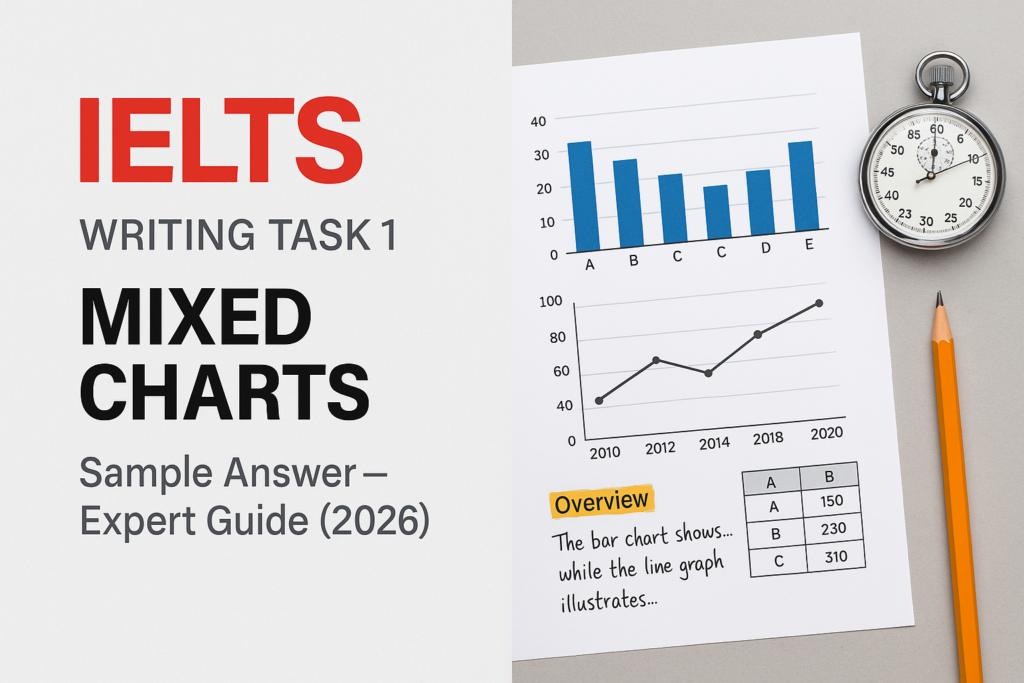
Mixed charts are Academic Writing Task 1 questions that combine two or more visual types. You might see a line graph and a table, a bar chart and a pie chart, or a map with a chart. The visuals usually share a topic, time period, place, or group of categories.
Your job is to summarise the main features and make comparisons where relevant. You do not need to describe every number. In fact, trying to report every number often makes the answer crowded and hard to follow. The examiner wants selection, organisation, and accurate reporting.
- Identify the main trend or biggest contrast in each visual.
- Find the connection between the visuals.
- Write one overview that covers both charts.
- Group details logically instead of describing chart one then chart two mechanically.
- Use accurate data language for numbers, proportions, and change.
IELTS Writing Task 1 Mixed Charts Sample Answer
Here is a sample task: The bar chart shows the percentage of people in three age groups who used online banking in 2015 and 2025. The table shows the average number of monthly branch visits by the same age groups in those years. Summarise the information by selecting and reporting the main features.
Sample answer:
The charts compare online banking use and average monthly branch visits among three age groups in 2015 and 2025. Overall, online banking became more common in every age group, while visits to bank branches fell. Younger adults used online banking the most in both years, but the largest increase was among people aged 55 and over.
In 2015, 68% of 18 to 34-year-olds used online banking, compared with 52% of those aged 35 to 54 and only 27% of people aged 55 and above. By 2025, the figures had risen to 91%, 84%, and 66% respectively. Although the youngest group remained the most frequent users, the gap between the age groups narrowed considerably over the decade.
The table shows the opposite pattern for branch visits. In 2015, the oldest group visited branches most often, at 2.4 times per month, while the youngest group averaged just 1.1 visits. By 2025, all groups visited less frequently. The figures dropped to 0.4 visits for 18 to 34-year-olds, 0.7 for 35 to 54-year-olds, and 1.2 for people aged 55 and over. This suggests that the rise in online banking was linked to a broad decline in face-to-face banking.
Why This Sample Answer Works
The answer works because it does not describe the bar chart in isolation and then forget the table. It connects the two visuals through one clear message: online banking increased while branch visits decreased. That relationship is the main story of the task.
The overview is also strong because it covers both charts. It mentions the general rise in online banking, the fall in branch visits, the strongest group, and the largest change. This gives the examiner a complete map of the answer before the detailed numbers appear.
If you want to practise mixed chart answers under real test timing, access unlimited IELTS mock tests and check whether your overview stays clear when the visuals look crowded.
How To Analyse Mixed Charts Before Writing
Spend two or three minutes reading both visuals before you write. Do not start with the first number you see. First, ask what the two visuals have in common. They may show the same groups, the same years, the same country, or the same topic from two different angles.
Next, find the biggest movement or contrast in each chart. In the sample task, online banking rises for all groups, while branch visits fall for all groups. That relationship is more important than any single figure. Once you know the main relationship, the answer becomes easier to organise.
Finally, choose details that prove the overview. You do not need every figure. Select the highest, lowest, largest increase, largest decrease, and any important comparison between groups. This keeps the answer focused and prevents number dumping.
How To Write A Strong Introduction
The introduction should paraphrase the task in one sentence. For mixed charts, mention both visuals and the topic they share. You can write, “The charts compare…” or “The bar chart and table show…” depending on what you see.
Avoid trying to create clever synonyms for every word. If the task says “online banking”, it is fine to repeat “online banking”. Accuracy matters more than forced variety. A simple introduction gives you more time for the overview and body paragraphs.
Do not include your opinion. IELTS Writing Task 1 is a reporting task, not an argument. You should not explain why people changed their behaviour unless the chart itself gives that information. In the sample answer, the final sentence says the figures suggest a link, but it stays close to the data.
How To Write The Overview For Mixed Charts
The overview should describe the main features across all visuals. A weak mixed chart overview only says, “Overall, there were many changes.” A stronger overview states the direction of change, the leading group, and the relationship between the charts.
For example, in the sample task, a strong overview says that online banking increased in all age groups, branch visits decreased, younger adults used online banking most, and older adults had the largest increase. That is enough. You do not need exact numbers in the overview.
If there are two unrelated visuals, write one sentence for each. If the visuals are clearly connected, explain the connection. The examiner should be able to understand the main story even before reading your body paragraphs.
How To Organise The Body Paragraphs
Most mixed chart answers work well with two body paragraphs. One paragraph can describe the first major pattern, and the second can describe the related pattern. In the sample answer, the first body paragraph focuses on online banking use, while the second focuses on branch visits and links back to the first chart.
Another option is to organise by group. For example, if the task compares men and women across two visuals, one paragraph could cover men and the other could cover women. Choose the structure that makes the comparison easiest to follow.
For more Task 1 practice, the IELTS Writing Task 1 sample answers guide can help you compare different chart types and notice how organisation changes from task to task.
Vocabulary For Mixed Chart Answers
Mixed chart vocabulary should be precise but not dramatic. Use words such as increased, decreased, rose, fell, remained, accounted for, averaged, compared with, respectively, and whereas. These words help you report data clearly.
Be careful with verbs for different data types. Percentages can rise or fall. Numbers of visits can average a certain amount. Categories can account for a proportion. If you use the wrong verb, the sentence may still be understandable, but it sounds less controlled.
Use “respectively” only when the order is clear. For example, “The figures rose to 91%, 84%, and 66% respectively” works because the age groups were listed in the previous sentence. If the order is not clear, repeat the groups instead.
Common Mistakes In Mixed Charts
The first common mistake is writing two separate mini-reports. Candidates describe the bar chart fully, then describe the table fully, but they never connect them. Mixed chart tasks usually reward comparison across the visuals.
The second mistake is reporting too many figures. A strong answer selects numbers that support the main features. If you include every figure, your answer becomes mechanical and the overview may disappear inside the detail.
The third mistake is adding reasons that are not shown. If the chart does not explain why online banking increased, do not invent causes such as better apps or lower fees. You can describe a likely relationship between the visuals, but stay cautious and data-based.
If Writing Task 1 is holding back your score, compare IELTS preparation plans and choose support that includes feedback on overview, grouping, grammar, and data accuracy.
Grammar Patterns That Help Mixed Chart Answers
Mixed charts often need comparison grammar. Useful patterns include “while”, “whereas”, “compared with”, “in contrast”, and “the figure for”. For example, “Online banking increased in all age groups, whereas branch visits declined.” This sentence connects both visuals cleanly.
You also need tense control. If all data is in the past, use past tense. If the chart includes a future projection, use future or projected language such as “is expected to”, “is forecast to”, or “is projected to”. If there is no future data, do not invent it.
Use complex sentences carefully. A long sentence with three comparisons can become confusing. It is better to write shorter, accurate sentences than to force complicated grammar and lose control.
A Step-By-Step Practice Method
Start by printing or opening a mixed chart task and writing only the overview. Do this for five tasks before writing a full answer. This trains you to find the main story quickly. If the overview is weak, the full answer will usually be weak too.
Next, practise grouping details. For each task, decide whether the body paragraphs should be organised by chart, by group, by time period, or by trend. Write a one-line plan before writing the answer. This small step prevents messy paragraphs.
Finally, write full answers under a 20-minute limit. After writing, check whether you included an introduction, overview, two body paragraphs, selected data, and at least one comparison across the visuals. For broader Task 1 strategy, review IELTS Writing Task 1 tips and strategies.
Final Checklist Before You Submit
Before you finish a mixed chart answer, check that your overview covers both visuals. Then check that every body paragraph has a clear purpose. If one paragraph is only a list of numbers, rewrite the topic sentence so the examiner can see the pattern.
Also check your data accuracy. A small wrong number may not destroy the answer, but repeated inaccurate figures can damage Task Achievement. Make sure percentages, years, age groups, and categories match the visuals.
Mixed charts look difficult because there is more information on the page. The skill is not to write more. The skill is to choose better. Find the shared story, select the strongest numbers, and write a report that is easy to follow.
Ready to find out your IELTS band score?
Take the IELTS Express Pre-Test for just $4.99 and get your personalised band prediction with a 14-day improvement plan.
FAQ: IELTS Writing Task 1 Mixed Charts Sample Answer
What are mixed charts in IELTS Writing Task 1?
Mixed charts are tasks that combine two or more visual types, such as a bar chart and a table. You must summarise the main features and compare the visuals where relevant.
Should I describe each chart separately?
Not always. You can describe each chart in a separate paragraph if that is the clearest structure, but you should still connect the visuals in the overview or comparisons.
How many figures should I include in a mixed chart answer?
Include enough figures to support the main trends and comparisons. You do not need every number. Select the highest, lowest, largest changes, and important contrasts.
Do mixed charts need one overview or two?
Usually, one overview is best. It should cover the main features across both visuals. If the visuals are very different, you can include one broad sentence for each visual.
How can I improve mixed chart answers quickly?
Practise writing overviews first, then practise grouping details. Most weak mixed chart answers fail because the writer cannot identify the main relationship between the visuals.