If you need an IELTS Writing Task 1 Process Diagram sample answer, the main skill is not creative writing. You need to describe a sequence clearly, group the stages logically, and use accurate process language. Before you keep practising without knowing your current level, take the IELTS Express Pre-Test to get a quick band prediction and a focused 14-day improvement plan.
Process diagrams can feel easier than charts because there are no numbers. That can be misleading. Many candidates lose marks because they miss the overview, describe every small arrow separately, or use grammar that makes the sequence unclear. A strong answer is calm, selective, and easy to follow from the first stage to the final result.
What Is An IELTS Writing Task 1 Process Diagram?
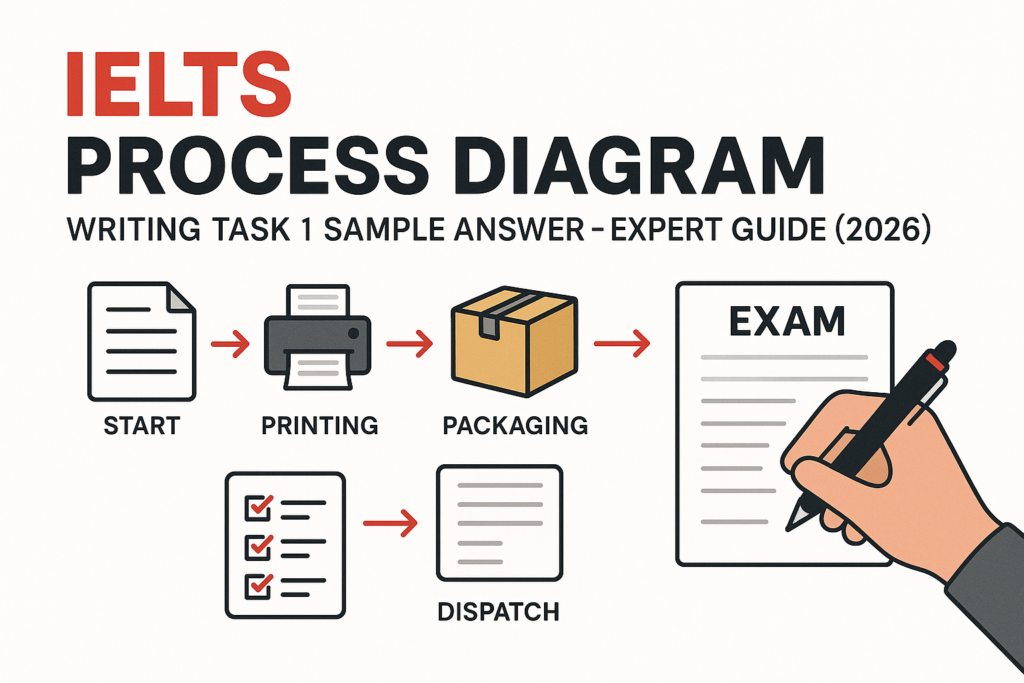
A process diagram shows how something is made, how something works, or how a natural cycle develops. In IELTS Academic Writing Task 1, you must summarise the information in at least 150 words. Your job is to report the main stages, not explain extra reasons or add background knowledge.
Process tasks often include arrows, labels, machines, materials, inputs, outputs, or repeated stages. The process may be linear, where one stage follows another, or cyclical, where the final stage connects back to the beginning. Your answer must make that movement clear.
- Identify the starting point and final point.
- Count the main stages, not every tiny label.
- Write a clear overview of the whole process.
- Group related stages into two body paragraphs.
- Use passive verbs when the actor is not important.
IELTS Writing Task 1 Process Diagram Sample Answer
Here is a sample task: The diagram shows the process used to produce recycled paper from used office paper. Summarise the information by selecting and reporting the main features.
Sample answer:
The diagram illustrates how recycled paper is produced from used office paper. Overall, the process has six main stages, beginning with the collection of waste paper and ending with the production of new paper sheets. The paper is cleaned, mixed with water, filtered, pressed, and dried before it is ready for reuse.
At the first stage, used office paper is collected and sorted to remove unsuitable materials such as plastic, staples, or heavily contaminated sheets. The selected paper is then cut or shredded into smaller pieces. After this, water is added to the shredded paper, and the mixture is stirred until it forms a soft pulp.
In the next stage, the pulp is passed through screens so that small pieces of dirt, ink, or remaining solid material can be removed. The cleaned pulp is then spread across a flat surface and pressed to remove extra water. Finally, the thin layer of pulp is dried and rolled or cut into new sheets of recycled paper.
Why This Sample Answer Works
The answer works because it gives the reader a full route through the process. It begins with a paraphrase of the task, then gives an overview that names the beginning, ending, and main movement. The body paragraphs describe the stages in order without adding invented details.
Notice that the answer does not try to use difficult vocabulary. Words such as collected, sorted, shredded, mixed, filtered, pressed, and dried are simple but accurate. In Task 1, accurate verbs usually matter more than rare words.
If you want to practise this kind of answer under time pressure, access unlimited IELTS mock tests and check whether your overview and body paragraph structure stay clear when the timer is running.
How To Write The Introduction
The introduction should be short. You only need to paraphrase the task statement. If the task says the diagram shows how recycled paper is produced, you can write that the diagram illustrates the process of producing recycled paper from used office paper.
Do not spend too long changing every word. Many candidates damage accuracy by forcing strange synonyms. The goal is a clean opening sentence that tells the reader what the diagram is about.
A safe introduction pattern is: “The diagram illustrates how…” or “The diagram shows the stages involved in…” This is enough. Save your time and energy for the overview and the sequence details.
How To Write A Strong Process Overview
The overview is one of the most important parts of a process diagram answer. It should describe the whole process in broad terms. You can mention the number of main stages, the starting point, the ending point, and whether the process is linear or cyclical.
For the recycled paper example, the overview says that the process has six main stages, begins with collection, and ends with new paper sheets. That gives the examiner a clear picture before the body paragraphs begin.
A weak overview says, “Overall, there are many steps.” That is too empty. A stronger overview tells the reader what kind of movement happens. For example: “Overall, raw materials are first prepared and cleaned before being shaped and dried into the final product.”
How To Organise Body Paragraphs
Most process diagram answers work well with two body paragraphs. The first body paragraph can describe the early preparation stages. The second can describe the later processing and final product. This structure keeps the answer balanced.
Do not make one very long paragraph that lists every stage. IELTS examiners need to see clear organisation. Paragraphing helps the reader follow the sequence and shows that you can group information logically.
If the process has eight or nine stages, group them by function. For example, one paragraph might cover collection and preparation, while the next covers heating, cooling, packaging, or delivery. For more Task 1 practice, the IELTS Writing Task 1 sample answers page can help you compare different report structures.
Useful Vocabulary For Process Diagrams
Good process vocabulary is practical. You need verbs for movement, change, preparation, and completion. Do not force advanced language into the answer if a simple verb is clearer.
- Starting: begins with, starts when, at the first stage, initially.
- Sequence: after this, next, then, subsequently, following this.
- Processing: is collected, is heated, is mixed, is filtered, is pressed.
- Change: is converted into, is transformed into, becomes, forms.
- Ending: finally, at the final stage, the finished product, ready for use.
Passive grammar is common because process diagrams often focus on what happens to materials, not who does the action. For example, “the paper is shredded” is usually better than “workers shred the paper” if the diagram does not show workers.
Grammar For IELTS Process Answers
Use the present simple for most process diagrams. If the diagram shows a general process, write “the material is heated”, “water is added”, and “the product is packaged”. Do not use past tense unless the diagram clearly describes a past process.
Use passive forms when the actor is not important: “the mixture is filtered”, “the liquid is poured”, and “the sheets are dried”. Use active forms when the subject naturally performs an action, such as “the water flows into a tank” or “the cycle begins again”.
Be careful with articles and plurals. Write “a machine”, “the mixture”, “several stages”, and “new sheets”. Small grammar errors can accumulate, especially in a short Task 1 answer.
Common Mistakes In Process Diagram Answers
The first common mistake is missing the overview. Without an overview, the answer may be limited even if the details are accurate. Always include a broad summary after the introduction.
The second mistake is inventing information. If the diagram does not show time, temperature, cost, purpose, or reasons, do not add them. Task 1 rewards accurate reporting, not imagination.
The third mistake is writing a list of arrows. A process answer should read like a report. Use linking words, but do not begin every sentence with “then”. If every sentence has the same pattern, the writing sounds mechanical.
If process answers keep pulling your Writing score down, compare IELTS preparation plans and choose support that includes feedback on real Task 1 reports.
A Simple Planning Method
Spend two or three minutes planning before you write. First, find the start and end. Second, count the main stages. Third, decide where to divide the body paragraphs. Fourth, choose two or three useful verbs that match the process.
For the recycled paper example, the plan is simple: collect and sort paper, shred and mix it, filter the pulp, press it, then dry and cut it. The first body paragraph can cover collection to pulping. The second can cover filtering to final sheets.
Planning prevents repetition. It also stops you from writing details in a random order. A clear plan often makes the difference between a rushed Band 6 answer and a more controlled Band 7-style report.
Band 7 Habits For Process Diagram Tasks
A Band 7-style process answer is clear, complete, and well organised. It does not need dramatic language. It needs an accurate overview, logical paragraphs, and controlled grammar.
Use a mix of sentence forms. Some sentences can be short and direct. Others can combine two stages: “After the paper has been shredded, it is mixed with water to form pulp.” This shows range without making the answer difficult to read.
Also check whether your answer has enough detail. A very short answer may miss important stages. A very long answer may include too much minor detail. Aim for a focused report that covers the full process in about 160 to 190 words.
Final Checklist Before You Write
Before you start writing, make sure you know the type of process, the start, the finish, and the main stages. Write the introduction quickly, then spend real attention on the overview. The overview is where many scores are won or lost.
During writing, describe stages in order and group them sensibly. After writing, check tense, passive forms, articles, and whether you have added any information that the diagram does not show. Process diagrams reward clear reporting. Keep the answer simple, accurate, and complete.
Ready to find out your IELTS band score?
Take the IELTS Express Pre-Test for just $4.99 and get your personalised band prediction with a 14-day improvement plan.
FAQ: IELTS Writing Task 1 Process Diagram Sample Answer
How many paragraphs should a process diagram answer have?
Most strong answers have four paragraphs: an introduction, an overview, and two body paragraphs. This keeps the sequence clear and easy to follow.
What tense should I use for a process diagram?
Use the present simple for a general process. For example, write “the material is heated” or “water is added” unless the task clearly shows a past process.
Do I need passive voice in IELTS process diagrams?
Yes, passive voice is often useful because the diagram usually shows what happens to materials. Use forms such as “is mixed”, “is filtered”, and “is dried”.
Can I add reasons for each stage?
No. Only describe what the diagram shows. Do not add reasons, opinions, or background information unless they are clearly included in the diagram.
How long should my Task 1 process answer be?
You must write at least 150 words. A practical target is usually 160 to 190 words, as long as the answer includes all main stages and a clear overview.