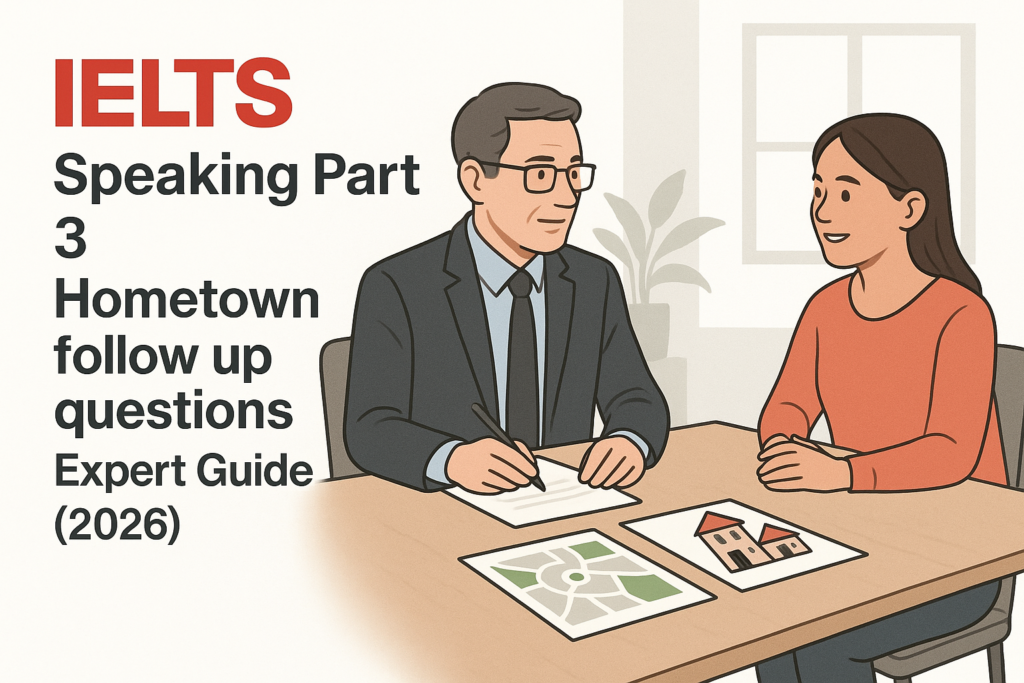
If you are practising IELTS Speaking Part 3 Hometown follow up questions, the hard part is usually not understanding the topic. Most candidates can talk about where they live. The harder part is giving answers that sound thoughtful, organised, and flexible when the examiner moves from personal questions into broader discussion. Before you rely only on memorised answers, take the IELTS Express Pre-Test to check whether your current speaking level is close to the score you need.
Hometown questions are common because they let the examiner test everyday vocabulary, opinion language, comparison, explanation, and examples. In Part 1, you may describe your own town in a simple way. In Part 3, the examiner expects a wider answer. You may need to discuss how cities change, why people leave rural areas, whether local communities are weaker now, or how governments should improve public spaces.
What IELTS Speaking Part 3 hometown questions are really testing
Part 3 is a discussion. The examiner is listening for your ability to explain ideas beyond your own life. You do not need expert knowledge about urban planning, economics, or local government. You need a clear answer, enough development, and language that shows you can compare ideas and justify opinions.
A strong answer usually has three parts. First, give a direct opinion. Next, explain the reason behind that opinion. Then add an example, contrast, or consequence. This gives your answer shape without making it sound memorised.
- Answer the question directly before adding detail.
- Move from personal experience to a wider social idea.
- Use examples from towns, suburbs, cities, or rural areas.
- Keep speaking naturally instead of trying to sound academic in every sentence.
If you want a wider overview of the speaking section, the IELTS Speaking Test complete guide is a useful place to connect Part 3 with Part 1 and Part 2.
How to answer IELTS Speaking Part 3 Hometown follow up questions
The safest approach is to treat each question as a small discussion rather than a memory test. You can start with a simple position, then build from there. For example, if the examiner asks whether your hometown has changed, do not only say “yes, it has changed a lot”. Explain what changed, why it changed, and whether the result is positive or negative.
Here is a practical answer frame:
- Point: give your main idea in one sentence.
- Reason: explain why you think that.
- Example: add a real or realistic example.
- Result: mention the effect on people or daily life.
You do not need to use this structure mechanically every time. It is simply a way to stop short answers from becoming too thin. In the test, a developed answer of four to six sentences is often better than a long answer that wanders away from the question.
Common hometown follow-up questions and model answers
Below are realistic IELTS Speaking Part 3 hometown questions with model answers. Use them to study answer structure, not to memorise every sentence.
How has your hometown changed in recent years?
My hometown has changed mainly because it has become more developed and busier. There are more shops, apartment buildings, and transport options than before, which makes daily life more convenient for many people. At the same time, it feels less quiet than it used to, and some older neighbourhoods have lost a bit of their character. So I would say the changes are useful, but not all of them are completely positive.
Why do some people prefer to stay in their hometown?
Many people stay in their hometown because it gives them a sense of comfort and connection. They may have family nearby, know the local area well, and feel more secure in a familiar environment. This is especially true for people who value community life more than career opportunities in a bigger city. For them, staying is not a lack of ambition. It can be a practical and emotional choice.
Why do young people often leave their hometown?
Young people often leave because they want better study or work opportunities. Smaller towns may have fewer universities, fewer professional jobs, and less variety in lifestyle. Moving to a larger city can give them more options and a chance to become independent. However, some people later return when they want a slower pace of life or closer family support.
Are cities better places to live than small towns?
It depends on a person’s priorities. Cities are usually better for work, education, public transport, and entertainment. Small towns are often better for space, quietness, and community. Personally, I think cities suit people who are building a career, while smaller towns may suit people who want a more stable and less stressful lifestyle.
If you want to practise these answers under timed conditions, use unlimited IELTS mock tests so you can hear whether your answers stay organised when the questions change.
Useful vocabulary for hometown discussion
Hometown vocabulary should be flexible. You do not need rare words. You need words that help you describe places, change, community, and quality of life clearly.
- local community: the people who live in the same area.
- public facilities: places such as parks, libraries, hospitals, and transport services.
- urban development: growth in buildings, roads, shops, and services.
- rural area: countryside or small-town regions outside large cities.
- quality of life: how comfortable, healthy, and satisfying daily life is.
- sense of belonging: the feeling that you are connected to a place or group.
Try to use vocabulary in complete ideas. Saying “urban development” is not enough by itself. A stronger sentence would be: “Urban development has made my hometown more convenient, but it has also made housing more expensive.”
How to extend a short answer naturally
Many candidates lose confidence in Part 3 because their first answer is too short. The solution is not to speak faster or add memorised phrases. It is to add one useful layer at a time.
If your answer is thin, add a comparison. You can compare the past and present, cities and towns, young people and older people, or your country and another country. Comparisons work well because they naturally create more language without sounding forced.
- Compare old and new parts of your hometown.
- Compare living in a city with living in a small town.
- Explain how different age groups see the same place.
- Mention both advantages and disadvantages before giving your view.
This is also where many candidates improve from Band 6 to Band 7. The answer becomes less like a list and more like a small argument. If you need more work on structure across the speaking test, see the IELTS Speaking Part 3 tips and strategies guide.
Common mistakes with hometown follow-up questions
The first mistake is staying too personal. In Part 3, the examiner may start with your hometown, but the question often points to a wider issue. If you only describe your own street, school, or family, the answer may not show enough discussion ability.
The second mistake is giving extreme opinions. For example, saying that cities are always better or that small towns are always boring sounds too simple. A stronger answer usually recognises both sides and then gives a clear judgement.
The third mistake is overusing memorised linking phrases. Expressions such as “from my perspective” and “to a certain extent” are fine when they fit, but they cannot replace real development. The examiner is more interested in how well your ideas connect than in how many formal phrases you can remember.
- Do not answer every question only from personal experience.
- Do not make claims that are too absolute.
- Do not use complex words you cannot control.
- Do not ignore the second half of the examiner’s question.
Practice set for IELTS Speaking Part 3 hometown questions
Use these questions for speaking practice. Record your answers if possible, then check whether each one has a clear opinion, reason, and example.
- What makes a hometown a good place to live?
- Do people in your country prefer living in big cities or small towns?
- How can governments improve life in small towns?
- Why are some cities becoming too crowded?
- Should young people be encouraged to stay in their hometown?
- How important are parks and public spaces in a town?
- Do you think local traditions are weaker than in the past?
When practising, do not aim for a perfect speech. Aim for a clear answer that can survive a follow-up question. If the examiner asks “why?” or “can you give an example?”, you should be able to continue without starting again.
Ready to find out your IELTS band score?
Take the IELTS Express Pre-Test for just $4.99 and get your personalised band prediction with a 14-day improvement plan.
FAQ: IELTS Speaking Part 3 hometown follow up questions
How long should I answer IELTS Speaking Part 3 hometown questions?
Most strong answers are about four to six sentences. That is usually enough to give an opinion, explain it, and add an example. If the examiner wants more detail, they will ask another follow-up question.
Can I talk about my real hometown in Part 3?
Yes, but do not stay only with personal details. Use your hometown as an example, then connect it to a wider idea about cities, towns, community, transport, housing, or quality of life.
Do I need advanced vocabulary for hometown questions?
You need accurate vocabulary more than advanced vocabulary. Words such as community, facilities, development, transport, housing, and quality of life are useful because they fit many hometown questions naturally.
What if I do not know much about my hometown?
You can still answer by speaking generally. IELTS does not test local history. It tests your ability to express and develop ideas in English. Use realistic examples and keep your answer clear.
Are hometown questions common in IELTS Speaking Part 3?
Yes, they are common because they connect easily to broader topics such as urbanisation, lifestyle, work, study, public services, and community change. Preparing this topic can help with many related questions.
How to use this topic in your preparation
Hometown questions are useful because they are familiar, but they can still reveal weak speaking habits. If your answers stay too personal, practise moving from your own experience to a wider point. If your answers are too short, add a reason, example, or comparison. If your vocabulary feels limited, build a small set of flexible place-related phrases and use them in full sentences.
The goal is not to memorise a perfect hometown speech. The goal is to become comfortable discussing ordinary places in a more thoughtful way. That is what IELTS Speaking Part 3 rewards: clear thinking, flexible language, and answers that keep developing after the first sentence.