If you are asking How Many Times Can You Take Ielts, the short answer is that there is no fixed lifetime cap on full IELTS tests. If you do not get the score you need, IELTS says you can resit the full test as soon as you feel ready. That sounds simple, but it creates a second question that matters more in real life: how many retakes make strategic sense before you are just paying for the same mistakes again.
Before you book another attempt, take the IELTS Express Pre-Test to get a clearer picture of your current level. A proper baseline is much more useful than guessing from memory after a stressful exam day.
As of May 26, 2026, the official IELTS guidance says you can resit the test whenever you feel ready, while IELTS One Skill Retake has a separate rule: you can only use it once per original full test and it must be completed within 60 days of that test. This guide explains both rules in plain English, when a retake is sensible, and how to avoid turning repeated bookings into an expensive loop.
Is there a limit on how many times you can take IELTS?
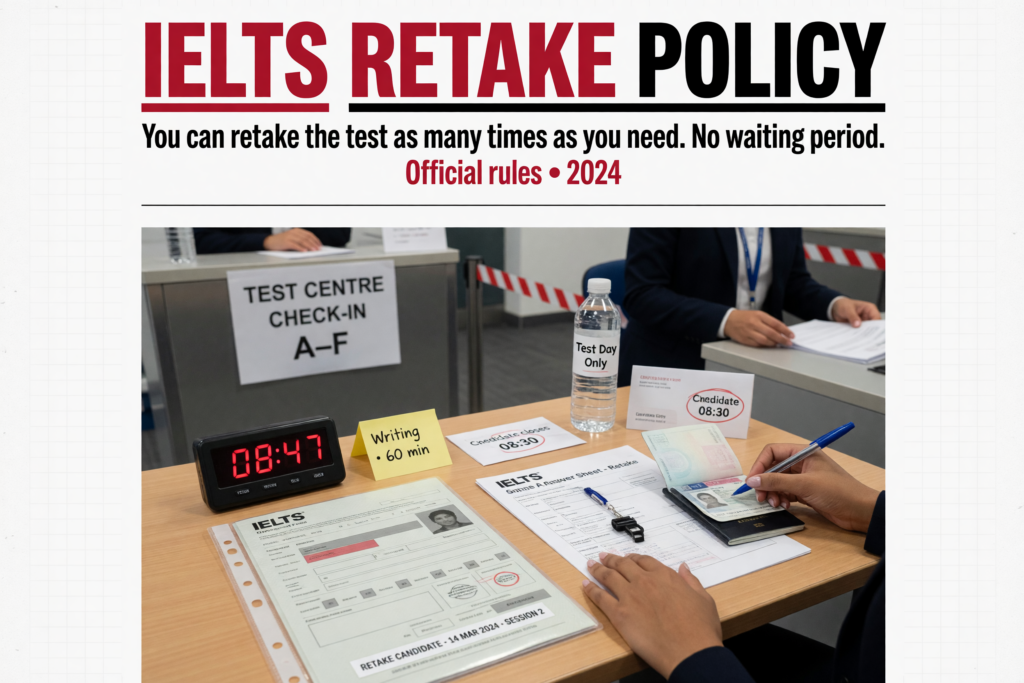
For the full IELTS test, there is no official rule saying you only get a certain number of attempts. IELTS states that if you did not receive the score you wanted, you can apply to resit the test as soon as you feel ready. In practice, that means you can book another full IELTS test again and again, provided test dates are available and you keep paying the fee.
That does not mean unlimited retakes are always a good idea. A policy without a cap is not the same as a smart preparation plan. Many candidates take the test multiple times because they assume one more attempt will magically solve the problem, when the real issue is a weak writing structure, poor listening concentration, or an unrealistic target date.
- There is no published lifetime cap for full IELTS retakes.
- You can usually book another full test once a slot is available.
- You still need to pay the fee each time you sit the test.
- Your best strategy depends on why the previous score missed the target.
What the official IELTS policy says about full retakes
The current IELTS guidance is straightforward. On the official IELTS results page, the organisation says that if you did not receive the score you were hoping for, you can apply to resit your test as soon as you feel ready. That wording matters because it does not promise that retaking quickly is wise. It only confirms that the system does not force a long waiting period between full attempts.
This is useful for candidates with real deadlines. If you need a score for migration, university entry, registration, or work, you do not have to wait months for a second chance. However, you still need enough time to correct the score barrier that caused the first result. If the weak section has not changed, the fast retake often produces a very similar outcome.
If you are comparing providers, dates, and formats before another booking, the IELTS test format guide helps you see how timing and delivery options affect the decision.
How IELTS One Skill Retake changes the answer
This is where the answer becomes more nuanced. IELTS One Skill Retake is not the same as a normal full retake. The official IELTS One Skill Retake page says you can only retake one skill once per original full test, and you must sit that retake within 60 days of the original exam. In other words, One Skill Retake is limited even though full IELTS retakes are not.
That difference is important. If you missed your target because only one section fell short and your organisation accepts One Skill Retake, this can be a faster and cheaper path than repeating all four skills. If you need to improve more than one section, or if your institution does not accept One Skill Retake, then a full retake is usually the cleaner option.
In Australia, IDP IELTS Australia also says One Skill Retake is accepted by governments, universities, employers, and professional organisations worldwide, including the Australian Department of Home Affairs, but candidates should still verify acceptance with the exact organisation they are applying to. That final check matters more than general marketing claims.
- Full IELTS retakes: effectively unlimited.
- One Skill Retake: only once per original full test.
- One Skill Retake must be taken within 60 days of the original test.
- It is only useful if your target institution or authority accepts it.
When a quick retake makes sense
A quick retake can work if the first score was already close to your target and the reason for the miss is narrow and obvious. For example, maybe you needed 7.0 in every skill and scored 7.5, 7.0, 7.0, and 6.5. That is very different from a profile where two or three sections are unstable. In the first case, a short, targeted preparation block may be enough.
A fast retake also makes sense when you know the previous result was dragged down by something specific such as timing errors, a bad speaking performance, or one writing task that went off track. Candidates in that position often benefit from structured review and a limited reset period rather than a long break.
If you are trying to diagnose whether your score is genuinely close or only feels close, working through unlimited IELTS mock tests with proper review gives you much better evidence than relying on instinct.
When repeated IELTS attempts are a bad strategy
Retaking the exam over and over becomes a bad strategy when your score pattern is not changing. If you keep getting roughly the same result, that is evidence. It usually means one of three things: your underlying English level needs more time, your exam technique is inconsistent, or your study method is too vague to create measurable improvement.
Another warning sign is emotional retaking. Some candidates book again immediately because they feel frustrated, embarrassed, or pressured by a deadline. That reaction is understandable, but it often produces a second attempt before the first one has been analysed properly. Paying another test fee is not the same as fixing the score barrier.
A more disciplined approach is to ask three blunt questions before every new booking:
- What exactly prevented the target score last time?
- What has changed since that attempt?
- What evidence shows the weaker skill is now stronger?
If those answers are fuzzy, you probably do not need another test yet. You need a better correction plan.
How many times do candidates usually need to take IELTS?
There is no universal number because candidates sit IELTS for different reasons and start from very different English levels. Some test takers get the result they need on the first attempt. Others need two or three attempts because the target is strict, especially when a visa, registration body, or university demands section minimums rather than only an overall band score.
The practical issue is not what other candidates do. The practical issue is how stable your score profile is. A person chasing 7.0 in every skill may need more attempts than someone who only needs an overall 6.5. Likewise, a candidate with strong Reading and Listening but weak Writing can stay stuck for multiple sittings if the writing problem is not repaired properly.
This is why planning around section minimums matters so much. If one skill is repeatedly blocking the whole outcome, the smarter move is often to build around that bottleneck instead of treating all four skills as equal. The IELTS Band Score Framework is helpful if you need a clearer way to think about that problem.
Costs, deadlines, and booking pressure after multiple retakes
Every extra IELTS attempt costs money, time, and mental bandwidth. Even when the official policy allows unlimited full resits, your deadline may not. University rounds close. Visa processes move. Professional registration files sit waiting for a score that has not yet arrived. That means the real cost of repeated attempts is often bigger than the booking fee itself.
One Skill Retake can reduce that pressure if only one component is below target and the receiving organisation accepts it. In Australia, IDP says One Skill Retake results are typically released within 3 to 5 days. That can be useful when a narrow score miss would otherwise force you through another full test cycle.
On the other hand, if you keep missing by a full band or more in the same skill, the cheaper path is often stronger preparation first. Spending a little more time improving can be far less expensive than funding a string of rushed exam attempts.
Ready to find out your IELTS band score?
Take the IELTS Express Pre-Test for just $4.99 and get your personalised band prediction with a 14-day improvement plan.
How to decide whether to book again now or wait
The best decision usually comes from evidence, not urgency. If your last result was close, your weak section is clearly identified, and your recent practice shows stable improvement, booking again may be reasonable. If your score profile is messy or your practice quality is inconsistent, waiting a little longer is usually the better call.
A useful way to think about the choice is to separate retaking from preparing. Retaking is a transaction. Preparing is the part that changes the outcome. Too many candidates focus on the transaction because it feels concrete. The real leverage is in the preparation block between attempts.
If you want a broader view of structured support options before another booking, the IELTS preparation plans page lays out the available pathways clearly.
FAQ: How Many Times Can You Take Ielts
Can you take IELTS unlimited times?
For the full IELTS test, the official policy does not set a fixed lifetime cap. IELTS says you can resit the test as soon as you feel ready. In practice, that means you can keep booking full tests if places are available and you pay the fee each time.
How many times can you take IELTS One Skill Retake?
As of May 26, 2026, the official IELTS One Skill Retake page says you can only complete one retake for each original full IELTS test. It also has to be taken within 60 days of that original test.
Should I retake IELTS immediately after a bad score?
Only if the score miss was narrow and you know exactly what went wrong. If the same weak section has been blocking you repeatedly, a rushed retake often leads to the same result and extra cost.
Is One Skill Retake accepted everywhere?
No. Acceptance is broad, but it is not automatic everywhere. IELTS and IDP both recommend checking directly with the university, visa authority, employer, or registration body you are applying to before relying on One Skill Retake.
Final takeaway
If you searched for How Many Times Can You Take Ielts, the clear answer is this: full IELTS retakes do not have a published cap, so you can resit as soon as you feel ready. The main exception is IELTS One Skill Retake, which is limited to one retake per original full test and must be used within 60 days.
The smarter question is not how many times you are allowed to book. It is how many attempts make sense before the next one stops being a plan and starts being repetition. If you treat each retake as a decision backed by evidence, you give yourself a much better chance of reaching the score you need without wasting money or time.