If you are asking How Long Are Ielts Scores Valid, the short answer is simple: IELTS results are generally valid for two years from your test date. That is the standard validity window used by IELTS and the rule most universities, employers, professional bodies, and migration pathways expect you to work with. The reason this matters is practical. A score that looks comfortably recent today can become unusable very quickly if your visa file, course application, or registration process drifts past the validity window.
Before you guess whether your current score is still strong enough for your next step, take the IELTS Express Pre-Test. It gives you a realistic baseline if your old result is close to expiry and you need to decide whether a retake is likely to be manageable or whether you need a more structured preparation plan.
In this guide, you will see how the two-year rule works, when the countdown starts, what it means for migration and study applications, what happens with One Skill Retake, and how to avoid being caught by expiry at the worst possible moment. The rule itself is not complicated. The problem is that many candidates leave the timing check too late and only discover the issue when they are ready to submit documents.
What the official IELTS validity period is
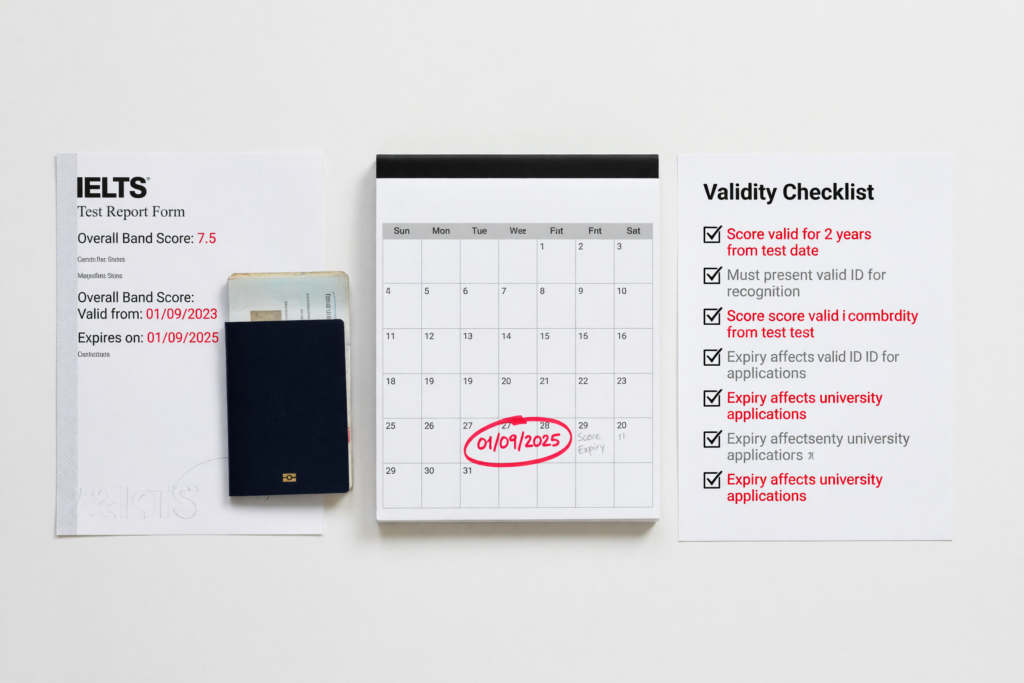
The standard IELTS validity period is two years from the original test date. Official British Council and IELTS guidance continues to describe the Test Report Form as valid for two years, and that is the default assumption used by most score users. In plain terms, if you sat the test on 25 May 2026, most organisations will treat the result as valid until 25 May 2028, not from the day you downloaded the result and not from the day a university opened your file.
This rule exists because language ability can change over time. A result that was accurate two years ago may no longer reflect your current English level. IELTS therefore uses a recency rule rather than treating the score as permanent. That does not mean every organisation checks it in exactly the same way, but it does mean the two-year window is the safe planning assumption unless the institution explicitly says otherwise in writing.
- The usual rule is two years from the test date
- The countdown does not restart when you print or send the TRF
- Academic and General Training scores both follow the same standard validity window
- You should always verify the receiving organisation’s current policy before submission
When the two-year countdown actually starts
This is where candidates make avoidable mistakes. The validity period starts from the date you sat the test, not from the day the result became available online and not from the date printed on an email. If you took the test on paper and waited 13 days for the result, those 13 days are already part of the two-year clock. If you took IELTS on computer and received the result faster, the same principle applies.
That matters because candidates often think, “I got my score in June, so it should be valid until June in two years.” If the test date was actually in late May, that assumption can cost you a full application cycle. A safer habit is to calculate the expiry window from the test date immediately and note it in your calendar. If you are also deciding whether to book again, it helps to compare the expiry deadline against current IELTS test dates in Australia so you do not leave yourself with a very narrow retake window.
Do universities, visa authorities, and professional bodies all use the same rule?
In most cases, they work from the same two-year IELTS validity period, but the operational detail can still differ. A university may require your score to be valid on the day you submit the application. A migration authority or professional registration body may care about validity on the day the file is assessed. Another organisation may ask for a score that remains valid up to the start date of a course or the final stage of a document review.
This is why “my score is still under two years old today” is not always enough. What matters is whether it will still be under two years old at the point the receiving organisation checks it. If your timeline is tight, treat the expiry date as a hard risk factor rather than a background detail. A score that expires halfway through a delayed application can create extra cost, fresh testing, and preventable stress.
If your current result is close to the line and you are unsure whether another attempt is worth it, using unlimited IELTS mock tests can help you make the decision with better evidence. That is far better than assuming you can repeat your old score without checking whether your Writing, Speaking, or timing control is still where it needs to be.
How IELTS score validity affects migration planning
For migration pathways, score validity is often more important than candidates expect because the test result is tied to broader timing pressure. You may be coordinating English results with skills assessments, visa invitations, employment documents, partner evidence, or occupation-specific registration rules. In that situation, the IELTS score is not just one document. It is one document that can delay everything else if it expires at the wrong time.
A common mistake is treating IELTS as an early box to tick and then letting too much time pass while the rest of the file develops. That can be especially risky if your target pathway depends on section minimums or a higher point threshold. In practice, some candidates are better off waiting slightly longer to sit the test so the score remains fresh through the main decision window. Others should sit earlier because they may need room for a retake. The right choice depends on the rest of the application timeline, not just on the IELTS rule in isolation.
If you are planning around a high-stakes submission date, build in margin. Do not aim to have your score expire a few days after your expected filing date and hope there are no delays. Administrative drift is normal. The safe strategy is to leave enough buffer that the score still looks comfortably current if processing slows down.
What happens if your IELTS score expires
Once the score passes the normal two-year validity window, most organisations will no longer accept it as current proof of English proficiency. At that point, the practical answer is usually simple: you need to sit IELTS again or provide another accepted English test result that fits the organisation’s rules. There is no general mechanism that magically refreshes an expired IELTS score just because your English is still strong.
This is why expiry should be treated as a planning issue, not a surprise event. If you are six to twelve weeks from the deadline and your result is already close to two years old, you should assume the score may become a problem and check the policy now. Waiting for an application rejection or a late request for updated evidence is a poor strategy because it compresses your options.
- Expired scores are usually not accepted for new applications
- You may need a full retake if the old score no longer falls inside the validity window
- Retesting late can create pressure on booking dates and preparation time
- Checking early gives you more control over timing and score recovery
Does One Skill Retake extend the validity period?
Usually, no. British Council guidance for IELTS One Skill Retake states that the result remains valid for two years from the original test date. That detail matters because some candidates assume a retake creates a brand-new two-year window. It generally does not. You receive a new report showing the updated section result, but the validity still tracks back to the original exam date.
That makes One Skill Retake useful in some situations and useless in others. If your original score is still comfortably within the two-year window and you only need one section improved, it can be a smart move. But if your original test date is already close to expiry, One Skill Retake may not buy you enough usable time. In that case, a full fresh exam can be the safer route. If this issue is relevant to your case, our IELTS One Skill Retake Policy Australia guide gives more detail on when the option helps and when it does not.
How early should you retake IELTS before your score expires?
The best answer depends on why you need the score, but a sensible rule is not to leave the retake decision until the final few weeks. If your application timeline is active, you ideally want a fresh valid score before expiry becomes urgent. That gives you room for an unexpected weaker result, a delayed booking, or a second attempt if one skill slips below target.
For many candidates, the safest planning window is to reassess the score at least two to four months before expiry. That does not mean everyone must retake at that point. It means that by then you should know whether the score will still be accepted at the moment you need it and whether your current English level is stable enough to protect the result if you sit the test again. If you are unsure about cost, intensity, or the amount of support you need, you can also see our IELTS preparation plans before choosing between self-study, mock testing, or a more structured course.
Ready to find out your IELTS band score?
Take the IELTS Express Pre-Test for just $4.99 and get your personalised band prediction with a 14-day improvement plan.
FAQ: How Long Are Ielts Scores Valid
Are IELTS scores valid for two years from the result date or the test date?
IELTS scores are generally valid for two years from the test date. That is the key date you should use when calculating whether the score will still be accepted.
Can I use an IELTS score that expires during my application process?
Sometimes that creates a problem because the receiving organisation may require the score to still be valid when they assess the application, not only when you first submit it. You need to check the exact policy of the institution or authority handling your case.
Does IELTS One Skill Retake give me a new two-year validity period?
Usually no. Current British Council guidance says the result remains valid for two years from the original test date, not from the One Skill Retake date.
What should I do if my IELTS result is close to expiring?
Check the receiving organisation’s policy immediately, compare the timing against your application milestones, and decide early whether you need a fresh test. Leaving the decision too late usually reduces your options and increases pressure.