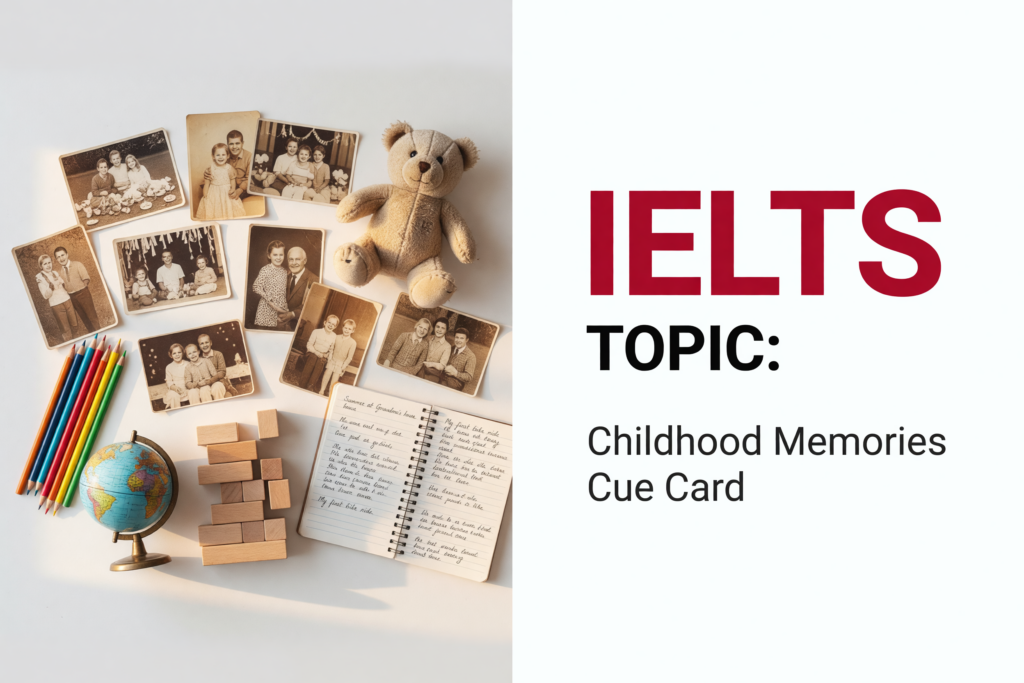
If you are searching for an IELTS Speaking Part 2 Childhood Memories cue card sample, you probably want more than a polished script to memorise. You want a response you can understand, adapt, and deliver naturally when the examiner is sitting in front of you. Childhood memories are a common cue card topic, but that does not make them easy. Before you keep guessing whether speaking is the section holding your band score back, take the IELTS Express Pre-Test to see how close you already are to your target.
Many candidates freeze on this topic because childhood feels distant. They worry that their memories are too ordinary or that they cannot think of enough detail to speak for two minutes. The truth is that the examiner is not scoring how interesting your childhood was. They are scoring how well you organise your answer, extend your ideas, and speak fluently under pressure. A simple, well-structured memory will usually score higher than a dramatic story told with poor control.
This guide gives you a practical structure, a full sample answer, flexible language you can adapt, and the common mistakes that keep candidates stuck. The goal is to help you sound natural, organised, and confident without memorising a script that collapses in the real test.
Why childhood memories cue cards feel harder than they are
Childhood memories seem like an easy topic because everyone has them. The difficulty is that the topic is too broad. Candidates often spend the first minute searching for a good memory, then speak too fast once they find one, and run out of detail before the two minutes are up.
Another problem is overthinking the content. Some candidates believe they need a remarkable story — a dramatic holiday, a special achievement, or a life-changing event. In practice, ordinary memories work better because they are easier to describe naturally. A story about helping your grandmother cook, playing in the street with friends, or learning to ride a bicycle can be just as effective as a more dramatic event if you organise it well.
The examiner is listening for fluency and coherence, vocabulary range, grammar accuracy, and pronunciation. They are not judging whether your childhood was interesting. They are judging whether you can keep one idea moving clearly for about two minutes.
- Ordinary memories are often safer than dramatic ones
- Specific detail matters more than impressive content
- The examiner scores language, not life story quality
- A clear structure prevents you from freezing mid-answer
What the examiner is listening for in Part 2
An IELTS Speaking Part 2 Childhood Memories cue card sample is testing your ability to organise and extend a spoken response. The examiner wants to hear whether you can take a single topic and develop it with relevant detail from start to finish.
That means your answer needs a clear beginning, a developed middle, and a natural ending. If you jump between unrelated memories, switch topics halfway through, or stop speaking after forty seconds, the examiner will notice even if your grammar and vocabulary are otherwise strong.
Think of the cue card as a short personal story. You are not listing facts about your childhood. You are showing that you can shape a memory into a complete answer with a purpose.
A safe four-part structure for any childhood memory
Most candidates become more stable when they stop improvising and use a repeatable pattern. Here is a simple structure that works for almost any childhood memory:
First, name the memory clearly. Second, explain when and where it happened. Third, add one or two specific details, actions, or feelings. Fourth, finish with why the memory still matters to you now.
This structure works because it creates movement. Instead of staying at the level of “I had a happy childhood,” your answer becomes a small story with a clear direction. For example, you might talk about visiting your grandparents every weekend, helping your grandmother prepare lunch, and learning to make a simple dish that you still remember today.
- Start by naming the memory and your connection to it
- Set the scene: when, where, and who was there
- Add a specific action, habit, or sensory detail
- Finish with why the memory still means something to you
If you want to test whether your Part 2 answers stay consistent beyond your favourite topics, access unlimited IELTS mock tests and compare how stable your speaking remains under real timing pressure.
IELTS Speaking Part 2 Childhood Memories cue card sample answer
Here is a natural sample you can learn from without copying sentence by sentence:
“I would like to talk about a memory from my primary school days that I still think about fairly often. Every Saturday morning, my mother used to take me to a small public library near our home. It was not a large building, but it had a quiet reading room on the second floor with big windows that let in a lot of natural light.
What I remember most is the routine we had. We would arrive early, choose a few books together, and then sit in the reading room for about an hour. I used to pick storybooks with a lot of pictures, and my mother would read the first few pages with me before I tried to read the rest on my own. I liked the feeling of having a whole morning dedicated to reading, without any pressure to finish quickly.
One particular day stands out. I found a book about animals in different countries, and I spent the whole hour looking at the pictures and trying to remember the names of the animals. When we left, my mother bought me a small notebook so I could write down the ones I liked. I still remember the excitement of having my own notebook for the first time.
Overall, that memory matters to me because it was the first time I really enjoyed learning something on my own. It taught me that reading could be fun, not just something I had to do for school. Even now, I still visit libraries whenever I travel, and I think that habit started on those Saturday mornings.”
This answer works because it is specific, easy to follow, and personal without sounding rehearsed. It moves from a general background to a particular day, then to a clear reflection. That pattern is much safer than trying to sound impressive from the first sentence.
How to build your own answer without memorising
The best way to use a sample is to borrow its logic, not its exact words. If you memorise the whole answer, you may sound smooth for thirty seconds and then panic when the real cue card changes slightly. If you learn the structure instead, you stay flexible.
Start by preparing a few safe idea areas you can use for almost any childhood memory:
- A place you visited regularly with family
- A hobby or activity you enjoyed at school
- A person who taught you something useful
- A simple event that became part of your routine
- An object or gift that still reminds you of that time
That is enough material for most candidates to speak naturally for close to two minutes. You do not need a dramatic story. A small but clear memory is usually better than a big event you cannot explain properly.
If you want a more detailed look at how Part 2 is structured and scored, see our IELTS Speaking Part 2/3 Framework guide for a complete breakdown.
Useful language for childhood topics that still sounds natural
Strong candidates prepare flexible phrases they can control rather than long expressions they would never use in normal speech. With childhood memories, useful language usually sits around routine, family, places, feelings, and habits.
- “I would like to talk about…”
- “What I remember most is…”
- “It used to happen every…”
- “One particular day stands out because…”
- “It taught me how to…”
- “Even now, I still…”
Be careful with vocabulary that sounds forced. If you do not normally say “nostalgic recollections” or “formative years” in conversation, you do not need those phrases to score well. Clear language with good control is far safer than awkward language that sounds memorised.
For more practical speaking techniques, have a look at our IELTS Speaking Part 2 Tips and Strategies guide.
Common mistakes in childhood memories answers
The most common problem is staying too general. Candidates say they had a happy childhood, mention a few activities, and then repeat the same point in different words. Another mistake is trying to describe too many memories in one answer, which usually makes the response less coherent.
Timing is another issue. Some people spend too long explaining basic background and have no room left for a personal example. Others rush through a memorised script and sound detached from their own words. A better plan is to choose one memory, one clear line of development, and one detail that helps the answer feel real.
- Do not describe every memory you can think of
- Do not fill time with textbook definitions of childhood
- Do not speak too fast just to sound fluent
- Do not memorise full sentences you cannot adapt
How to practise this cue card for a real score gain
Repeating one model answer ten times is not the smartest way to improve. It may make one answer sound smooth, but it does not make you flexible. A better method is to prepare three versions of the topic. One can be about a place. One can be about a person. One can be about an activity or routine.
Then record yourself and listen for three things. First, are there long pauses where you are searching for ideas? Second, does each sentence connect naturally to the one before it? Third, does the answer end with a clear final thought instead of just stopping? When those three areas improve, your Part 2 performance usually becomes more reliable.
If you are close to booking your exam and want a clearer idea of the support that fits your timeline, see our IELTS preparation plans and compare the level of feedback that matches your target band score.
Ready to find out your IELTS band score?
Take the IELTS Express Pre-Test for just $4.99 and get your personalised band prediction with a 14-day improvement plan.
FAQ: IELTS Speaking Part 2 Childhood Memories cue card sample
Do I need a dramatic childhood story to score well?
No. Ordinary memories work perfectly if you organise them well. The examiner scores your language and structure, not the drama of your life story. A clear description of a simple routine often scores higher than a complicated story told with poor control.
Should I memorise a childhood memories sample answer?
No. It is safer to learn a structure and a few flexible phrases. Memorised answers often become obvious when the real question changes angle or wording. The examiner can usually tell when a response is rehearsed rather than natural.
What if I cannot remember much about my childhood?
You do not need detailed memories. Choose something simple — a place you visited, a game you played, or a family routine — and build your answer around one specific detail. IELTS Speaking rewards clear communication more than perfect autobiography.
How long should my Part 2 answer be?
You should aim to speak for close to two minutes. You do not need perfect timing, but you do need enough relevant development to show fluency and coherence. A well-structured answer usually reaches the right length naturally.
Can a simple answer still score Band 7 or higher?
Yes. A simple answer with clear structure, specific detail, and natural language is usually safer than a complicated answer full of memorised vocabulary you cannot control. Many Band 7+ responses are built on ordinary topics told with strong organisation.
Make the answer sound like you
The best IELTS Speaking Part 2 Childhood Memories cue card sample is the one that gives you a reliable structure and enough flexibility to think in real time. Name the memory clearly, set the scene, add one specific detail, and finish with a calm personal reflection. That is already strong enough for a far better answer than most candidates produce when they rely on guesswork.
You do not need to sound like a storyteller or a public speaker. You only need to sound organised, specific, and real. Once that becomes your habit, childhood memories stops being a risky topic and turns into another chance to collect marks safely.