If you are searching for IELTS Speaking Part 2 Sports cue card sample, you probably do not want a polished answer that sounds clever on paper but collapses in the real test. You want something safer: a response you can understand, remember, and adapt when the examiner is in front of you. Before you keep guessing whether speaking is the section limiting your result, take the IELTS Express Pre-Test to see how close you already are to your target band.
Sports is a common IELTS Speaking topic because it is broad enough for almost everyone to discuss. That does not make it easy. Many candidates know the topic, but they still struggle to speak for two minutes without repeating simple ideas. They say they like football, running, or swimming, then run out of detail. A stronger answer is not about advanced vocabulary. It is about clear structure, specific examples, and a pace that feels natural.
This guide gives you a practical way to handle the topic. You will see what the cue card is really testing, how to organise your answer, a full sample response, and the mistakes that usually keep candidates stuck. The goal is simple: help you sound more fluent without memorising a script that falls apart under pressure.
Why sports cue cards catch candidates out
At first glance, sport looks like a friendly topic. Many people watch it, played it at school, or at least know the names of common sports. The problem is that familiarity can make candidates lazy. They start speaking too early, rely on vague comments, and forget that the examiner is scoring development, not just comfort with the theme.
A weak answer usually sounds like this: “I like basketball because it is exciting and healthy.” That is not wrong, but it is thin. There is no clear story, no reason the answer matters, and no detail that helps the examiner hear fluency or range. A better answer explains who you played with, when the sport mattered to you, why it stayed memorable, and what it says about your habits or personality.
- Familiar topics still need structure
- Simple ideas need specific examples
- One clear story is safer than several half-developed points
- Natural detail often scores better than forced “advanced” language
What the examiner is really listening for in Part 2
An IELTS Speaking Part 2 Sports cue card sample is not a test of expert sports knowledge. The examiner is listening for fluency and coherence, vocabulary, grammar control, and pronunciation. In other words, they want to hear whether you can keep one idea moving clearly for about two minutes.
That means your answer should feel organised from start to finish. You need a clear opening, a sensible middle, and a natural closing thought. If your response jumps between different sports or switches direction halfway through, the examiner may hear uncertainty even if your English is otherwise good.
It helps to think of the cue card as a short spoken story. You are not listing facts about tennis, cricket, or swimming. You are showing that you can take a familiar topic and shape it into a complete answer with a beginning, development, and a personal reflection.
A safe structure for any sports cue card
Most candidates become more stable when they stop improvising from zero and use a repeatable four-part structure. First, name the sport clearly. Second, explain when it became important to you. Third, add one or two specific details or memories. Fourth, finish with why the sport still matters to you now.
This structure works because it creates movement. Instead of staying at the level of “I enjoy sport because it is healthy”, you build a response that sounds lived-in and real. For example, you might say that badminton became part of your school routine, helped you spend time with friends, and taught you how to stay calm in competition.
- Start by naming the sport and your connection to it
- Explain when or where it became meaningful
- Add a specific example, habit, or memory
- Finish with what the sport still means to you today
If you want to test whether your Part 2 answers stay strong beyond your favourite topics, access unlimited IELTS mock tests and compare how stable your speaking remains under real timing pressure.
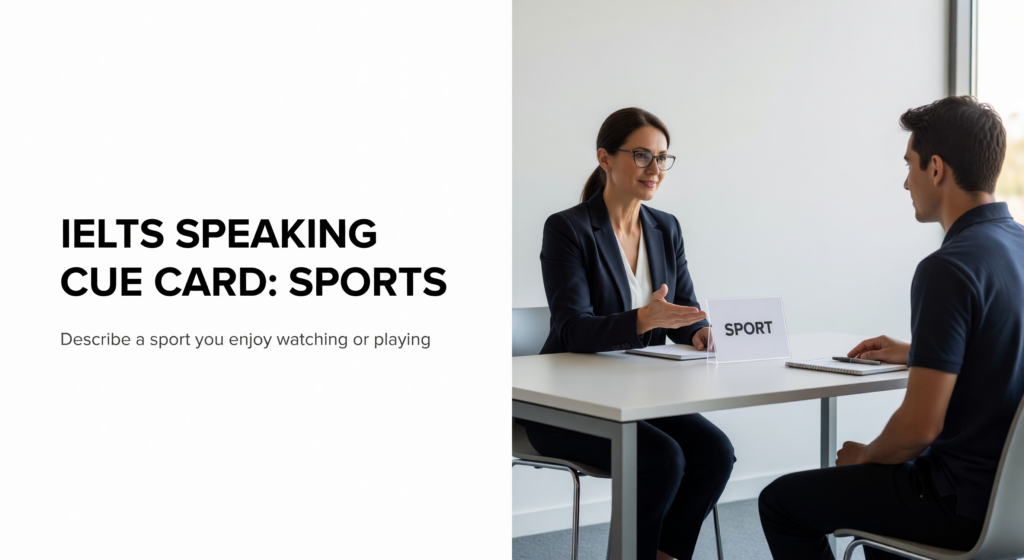
IELTS Speaking Part 2 Sports cue card sample answer
Here is a natural sample you can learn from without copying sentence by sentence:
“I would like to talk about badminton, which is probably the sport I have enjoyed most for the longest time. I first started playing it seriously when I was in secondary school, because it was one of the easiest sports to organise with friends after class. We did not need a large field or expensive equipment, so it quickly became part of our weekly routine.
What I liked about badminton was that it looked simple at first, but it actually required a lot of concentration and quick movement. I enjoyed the fact that every game felt fast and competitive, even when we were only playing for fun. It also gave me a break from study, so I always felt mentally lighter after playing.
One memory that still stands out is a school tournament where I played doubles with one of my close friends. We were not the strongest team, but we communicated well and stayed calm during the final points of each match. I remember feeling proud not because we won easily, but because we kept improving as the day went on.
Overall, badminton is the sport that has stayed with me because it is social, practical, and enjoyable without being too complicated. Even now, I still think of it as one of the best ways to stay active and clear my mind.”
This answer works because it is specific, personal, and easy to follow. It moves from general background to the reason the sport matters, then to a memory, and finally to a clear judgement. That pattern is much safer than trying to sound impressive from the first sentence.
How to build your own answer without memorising
The best way to use a sample is to borrow its logic, not its exact wording. If you memorise the whole answer, you may sound smooth for thirty seconds and then panic when the real cue card changes slightly. If you learn the structure instead, you stay flexible.
Start by preparing a few safe idea areas you can use for almost any sport:
- How you first encountered the sport
- Who you usually played or watched it with
- Why it matched your personality or lifestyle
- One event, match, or personal memory connected to it
- What effect it had on your health, routine, or confidence
That is enough material for most candidates to speak naturally for close to two minutes. You do not need a dramatic story. A small but clear memory is usually better than a big story you cannot explain properly.
Useful language for sports topics that still sounds natural
Strong candidates prepare flexible phrases they can control rather than long “high-level” expressions they would never use in normal speech. With sports topics, useful language usually sits around habit, enjoyment, competition, routine, and memory.
- “I first got into it when…”
- “What I enjoy most is…”
- “It became part of my routine because…”
- “One moment I still remember is…”
- “It taught me how to…”
- “Compared with other sports, this one feels…”
Be careful with vocabulary that sounds forced. If you do not normally say “athletic performance” or “physical endurance” in conversation, you do not need those phrases to score well. Clear language with good control is far safer than awkward language that sounds memorised.
Common mistakes in sports answers
The most common problem is staying too general. Candidates say they like football because it is popular, or swimming because it is healthy, then they repeat the same point in different words. Another problem is trying to describe several sports in one answer, which usually makes the response less coherent.
Timing can also go wrong. Some people spend too long explaining basic background and have no room left for a personal example. Others rush through a memorised script and sound detached from their own words. A better plan is to choose one sport, one clear line of development, and one memory that helps the answer feel real.
- Do not describe every sport you have ever tried
- Do not fill time with textbook definitions
- Do not speak too fast just to sound fluent
- Do not memorise full sentences you cannot adapt
How to practise this cue card for a real score gain
Repeating one model answer ten times is not the smartest way to improve. It may make one answer sound smooth, but it does not make you flexible. A better method is to prepare three versions of the topic. One can be about a sport you played. One can be about a sport you watched. One can be about a sport that influenced your school life, friendships, or health routine.
Then record yourself and listen for three things. First, are there long pauses where you are searching for ideas? Second, does each sentence connect naturally to the one before it? Third, does the answer end with a clear final thought instead of just stopping? When those three areas improve, your Part 2 performance usually becomes more reliable.
If you are close to booking your exam and want a clearer idea of the support that fits your timeline, see our IELTS preparation plans and compare the level of feedback that matches your target band score.
How to stay calm if the sport is not your favourite topic
Some candidates worry because they are not interested in sport at all. That is not fatal. IELTS does not require passion. It requires communication. You can still give a strong answer by choosing a sport you did at school, watched with family, or simply respected even if you did not play it often.
The safest move is to keep the answer close to real life. If you once joined volleyball at school for one term, that is enough. If your family watched cricket together on weekends, that is enough too. Real but ordinary material usually sounds more believable than an invented story that becomes difficult to maintain after the first few sentences.
Ready to find out your IELTS band score?
Take the IELTS Express Pre-Test for just $4.99 and get your personalised band prediction with a 14-day improvement plan.
FAQ: IELTS Speaking Part 2 Sports cue card sample
Do I need to talk about a sport I play regularly?
No. You can talk about a sport you played in the past, watched often, or remember clearly from school or family life. What matters most is that you can explain it naturally and add enough detail.
Should I memorise a sports cue card sample answer?
No. It is safer to learn a structure and a few flexible phrases. Memorised answers often become obvious when the real question changes angle or wording.
What if I know very little about sport?
You do not need expert knowledge. Choose a simple sport and connect it to a routine, memory, or personal reason. IELTS Speaking rewards clear communication more than specialist content.
How long should my Part 2 answer be?
You should aim to speak for close to two minutes. You do not need perfect timing, but you do need enough relevant development to show fluency and coherence.
Can a simple answer still score well?
Yes. A simple answer with clear structure, specific detail, and natural language is usually safer than a complicated answer full of memorised vocabulary you cannot control.
Make the answer sound like you
The best IELTS Speaking Part 2 Sports cue card sample is the one that gives you a reliable structure and enough breathing room to think. Name the sport clearly, explain why it matters, add one memory, and finish with a calm final judgement. That is already strong enough for a far better answer than most candidates produce when they rely on guesswork.
You do not need to sound like a commentator or a professional athlete. You only need to sound organised, specific, and real. Once that becomes your habit, sports stops being a risky topic and turns into another chance to collect marks safely.