If you are trying to decide Ielts Online Vs Paper Based Which To Choose, you are asking a smart question before booking the test, not after paying for the wrong format. The best IELTS version is not the one people online call easier. It is the one that helps you perform more calmly and more accurately under real exam pressure. Before you book, take the IELTS Express Pre-Test to check whether your current level is already close to the band score you need.
Many candidates focus only on convenience. They like the idea of typing faster or finishing sooner, so they assume the computer option must be better. Others trust paper because it feels more familiar and less risky. Both reactions are understandable, but neither is enough on its own. A better decision comes from looking at your reading habits, writing speed, concentration style, and how you usually handle time pressure.
What the IELTS online vs paper based choice really affects
The core test content is broadly the same. You still face the same four skills, the same scoring system, and the same need for accuracy. What changes is the delivery format. That format can quietly influence how well you read, plan, type, highlight, review answers, and stay settled across the test session.
In practice, the choice affects your performance system more than the syllabus itself. A candidate with strong typing speed and comfortable screen-reading habits may gain a real advantage from computer delivery. A candidate who thinks better with printed pages, handwritten notes, and visible annotations may perform more reliably on paper.
- The test format can change how you manage time
- It can affect reading comfort and concentration
- It can influence how clearly you plan Writing answers
- The better option is the one you can repeat under pressure
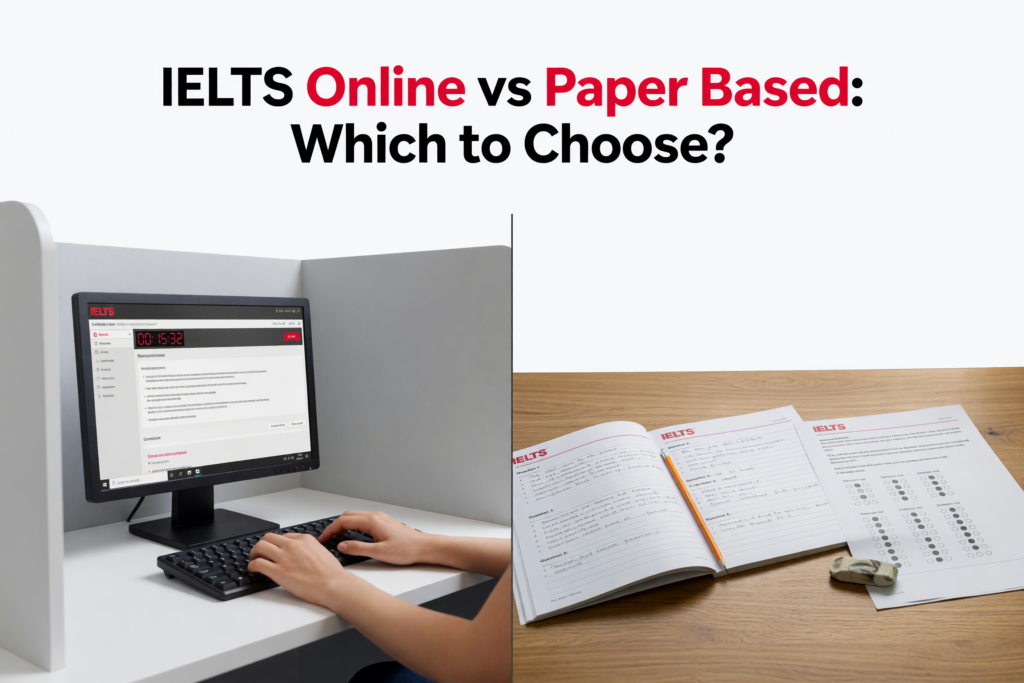
How computer-based IELTS usually feels on test day
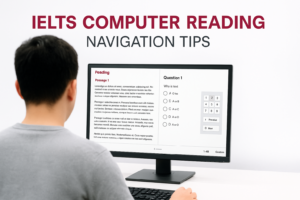
Computer-based IELTS often appeals to candidates who are used to working on screens. Typing can feel faster than handwriting, especially in Writing Task 2 where longer answers are needed. Editing is also easier because you can move quickly through the text, add words, and correct mistakes without making the page messy.
There are practical benefits beyond typing. The timer is visible on screen, answers are usually easier to read back, and some candidates feel more in control when they can navigate quickly between questions. If your goal includes improving consistency across repeated practice, access unlimited IELTS mock tests and compare whether your scores stay stronger in a digital setting.
Even so, the computer format is not automatically easier. Some candidates read more slowly on screens, feel more eye strain, or panic when scrolling through long Reading passages. Others type quickly but make more careless grammar errors because the keyboard encourages speed over control.
How paper-based IELTS usually feels on test day
Paper-based IELTS still suits many candidates because it feels concrete and stable. You can underline key words, circle distractors, sketch quick plans in the margin, and see a fuller visual map of the text at one time. For people who think clearly on paper, that physical layout can reduce mental friction.
Paper also helps candidates who do not enjoy long periods of screen reading. If you tend to lose focus when scrolling or you remember information better when you annotate a printed page, paper can be a safer choice. The downside is that handwriting speed and legibility matter more. If your written answers become harder to read under pressure, that benefit can disappear quickly.
Another practical issue is editing. On paper, changes are slower and sometimes untidy. That is not a disaster, but it means candidates who revise heavily may lose time compared with the computer format.
Ielts Online Vs Paper Based Which To Choose for Reading and Listening
Reading and Listening often decide the format question more than candidates expect. In Reading, some people scan faster on paper because they can jump between paragraphs physically and mark the text with less effort. Others prefer the search-and-focus feeling of the screen because the layout looks cleaner and the text feels easier to control.
Listening creates a different concern. On paper, some candidates like writing quick notes by hand before transferring or checking answers. On computer, answer entry is direct, which can feel efficient but also less forgiving if typing errors or spelling slips happen under time pressure. The real question is not which method sounds modern. It is which method lets you keep accuracy when your attention dips for a few seconds.
- Choose paper if annotation clearly improves your Reading control
- Choose computer if screen focus and direct answer entry feel faster for you
- Do not assume your everyday computer use means test performance will also improve
- Always compare accuracy, not only comfort
Writing is where the format difference becomes most obvious
For many candidates, Writing is the deciding factor. Computer-based IELTS is often stronger for people who type comfortably because they can draft, edit, and restructure their essays with less friction. That matters in Task 2, where clarity and paragraph control often improve when you can revise quickly.
Paper-based IELTS can still be the better choice if handwriting helps you think. Some candidates plan more naturally with pen and paper, and their sentences feel more controlled when they write by hand. However, that only works if your handwriting stays readable and your pace stays strong through both writing tasks.
A useful way to judge this is simple. Write one full Task 1 and Task 2 set by hand under timed conditions, then do another by typing. Compare not only word count, but also grammar accuracy, paragraph organisation, and how much time you had left for checking. If you need more structured support around that comparison, see our IELTS preparation plans and choose the support level that matches your timeline.
When computer-based IELTS is usually the better option
Computer delivery is often a better fit if you already type quickly without losing accuracy. It also suits candidates who use screens for work or study every day and do not feel drained by long digital reading sessions. If editing on a keyboard makes your writing cleaner and more organised, that is a meaningful advantage.
You may also prefer the computer format if you like clear on-screen timers, neat answer presentation, and a test environment that feels more streamlined. Some candidates simply feel less stressed when they do not have to worry about messy handwriting or crossing out whole lines.
- Your typing speed is clearly better than your handwriting speed
- You read long texts on screen without losing focus
- You revise essays a lot during practice
- Your spelling and keyboard accuracy stay reliable under time pressure
When paper-based IELTS is usually the safer option
Paper is often safer for candidates who process information visually on printed pages. If highlighting, underlining, and handwritten planning improve your control, that matters. The paper version can also be better if screens make you tired or if scrolling interrupts your sense of where information sits inside a passage.
You may also want paper if your computer habits are ordinary rather than strong. Many people use computers every day, but that does not mean they type well enough for timed IELTS writing. If your typing is slow, error-prone, or stressful, computer delivery can create a hidden disadvantage that you do not need.
- You annotate heavily when reading
- You plan essays better with a pen
- Screen reading lowers your concentration
- Your handwriting is fast and easy to read
Common mistakes people make when choosing between the two
The first mistake is copying someone else’s preference. A friend may love computer-based IELTS, but that tells you very little about your own reading comfort, typing discipline, or test nerves. The second mistake is choosing based on convenience alone, such as more available dates or a centre that is closer to home, without checking whether the format actually suits your performance style.
Another mistake is doing only one casual practice session before deciding. One untimed attempt is not enough. You need to compare the formats under realistic timing, with proper breaks, and with honest review afterwards. If your goal is a band score that affects migration, study, or professional registration, guessing here is expensive.
- Do not assume newer technology means easier marks
- Do not assume paper is safer just because it feels traditional
- Do not judge from comfort alone without score evidence
- Do not ignore Writing speed and Reading accuracy when comparing
A simple way to decide before you book
The best decision method is practical. First, confirm which delivery options are accepted for your pathway and available at your preferred test centre. Second, complete at least one serious practice comparison between screen and paper conditions. Third, review which format gives you better control, not just faster completion.
Look for repeatable signs. Did one format produce fewer careless mistakes? Did you feel calmer in Reading? Was your Writing more organised? Did you finish with enough time to check answers properly? That evidence is far more useful than general advice from forums or social media.
Before the FAQ, use this checkpoint if you want a quick reality check on your current level before choosing a format and booking a test date:
Ready to find out your IELTS band score?
Take the IELTS Express Pre-Test for just $4.99 and get your personalised band prediction with a 14-day improvement plan.
FAQ: Ielts Online Vs Paper Based Which To Choose
Is computer-based IELTS easier than paper-based IELTS?
Not automatically. It can feel easier if you type quickly, read well on screens, and revise your writing efficiently. If screens reduce your focus or your typing is weak, paper may be the better option.
Does paper-based IELTS give higher scores?
No. The scoring system is the same. What changes is how well the format matches your habits, which can affect your real performance on test day.
Which format is better for IELTS Writing?
Computer-based IELTS is often better for candidates who type quickly and edit a lot. Paper-based IELTS can still be better if handwriting helps you think clearly and you can write fast enough under timed conditions.
Is Reading harder on computer than on paper?
For some candidates, yes. Screen reading, scrolling, and eye strain can reduce control. For others, the cleaner digital layout feels easier. The best way to know is to test both formats under realistic timing.
How should I choose if I feel comfortable with both?
Choose the one that gives you more reliable accuracy, calmer timing, and better Writing control across more than one practice attempt. Reliability matters more than novelty.
Choose the format that protects your score, not your ego
The real answer to Ielts Online Vs Paper Based Which To Choose is not about trend, technology, or what other candidates say felt easier. It is about which format lets you stay accurate, organised, and calm from the first section to the last.
If typing improves your writing and screens do not reduce your focus, computer-based IELTS may be the better fit. If printed pages help you read more clearly and handwritten planning keeps your thinking sharp, paper may protect your score better. Test both properly, trust the evidence, and book the version you can repeat with confidence.