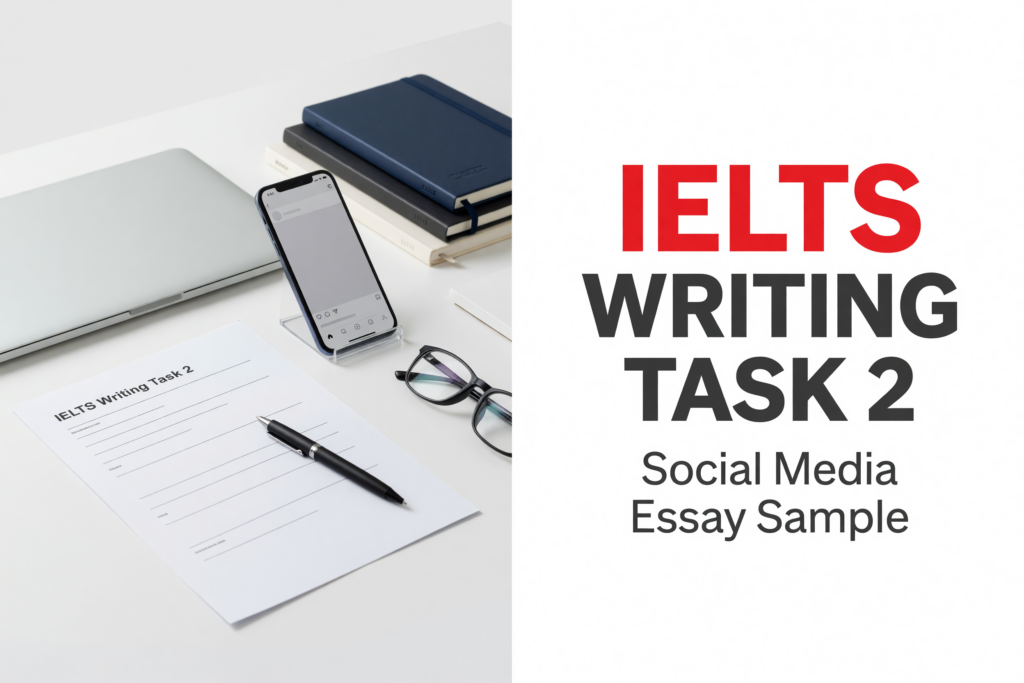
If you are looking for an IELTS Writing Task 2 Social Media essay sample, you probably want more than a model answer that sounds polished but teaches you nothing. Most candidates need a sample they can actually learn from under test pressure. Before you assume your writing is already close to your target band, take the IELTS Express Pre-Test to see where your current Writing level really sits.
Social media is a very common IELTS topic because it connects to communication, mental health, education, privacy, and modern lifestyle. That makes it useful, but it also makes it risky. Candidates often write vague opinions about whether social media is good or bad instead of answering the exact question. A stronger essay stays focused, builds one clear argument at a time, and uses examples that feel realistic rather than dramatic.
What examiners look for in a social media Task 2 essay
An essay about social media is marked in the same way as any other Task 2 response. Examiners still assess task response, coherence and cohesion, lexical resource, and grammatical range and accuracy. In practical terms, they want to see whether you answered the question clearly, organised your ideas in a logical way, used vocabulary precisely, and controlled grammar well enough for the meaning to stay clear.
The topic itself does not earn marks. Your handling of the topic does. That is why a simple but well-developed argument will usually score better than a broad essay full of half-explained claims. Social media questions often tempt candidates to mention addiction, fake news, cyberbullying, marketing, friendships, and politics all in one response. That usually weakens the essay because none of the points get proper development.
- Answer the exact question, not the whole topic of social media
- Give each paragraph one clear purpose
- Use examples that support your point directly
- Prefer clear language over forced academic wording
Why social media questions can be harder than they first appear
Many candidates feel confident with this topic because they use social media every day. That confidence can be misleading. Familiarity with the topic is not the same as control in the essay. Under exam pressure, candidates often start writing from personal feeling instead of structure. They produce statements such as social media has changed our lives or young people spend too much time online, but they do not explain how those ideas answer the actual prompt.
A stronger approach is to narrow the issue early. Is the question about communication quality, education, mental health, public opinion, or privacy? Is it asking for an opinion, both views, advantages and disadvantages, or a problem-solution response? Once you identify that structure, the essay becomes much easier to control. If you want a stronger framework before practising this topic, the IELTS Writing Task 2 band score strategy guide is a useful companion.
A sample question you can practise with
Here is a realistic IELTS-style question on this theme:
Some people think that social media has improved communication between people, while others believe it has damaged real human interaction. Discuss both views and give your own opinion.
This is a discuss both views essay with an opinion. That means you need to explain both sides fairly and still make your own position clear. For this sample, the position will be that social media has made communication faster and wider, but it has also weakened the quality of some face-to-face interaction when people rely on it too heavily.
IELTS Writing Task 2 Social Media essay sample
Sample essay:
Social media has become one of the main ways people communicate in modern life. While some people argue that it has improved communication by making it faster and more convenient, others believe it has harmed genuine human interaction. In my opinion, social media has created valuable communication opportunities, but it can damage the quality of relationships when it replaces direct personal contact too often.
On the one hand, social media has clearly improved communication in several important ways. First, it allows people to stay in contact across long distances at very low cost. Friends and family members who live in different cities or countries can share updates, photos, and messages instantly, which helps them maintain regular contact. Second, social media gives users quick access to information, support networks, and public discussion. For example, students can join study groups, professionals can build career connections, and local communities can organise events more efficiently. In this sense, social media has made communication more accessible and immediate than in the past.
On the other hand, many people believe that social media has reduced the quality of real human interaction. One reason is that online communication is often shorter, less thoughtful, and more distracted than face-to-face conversation. People may react quickly to posts without listening carefully or considering other views. In addition, some users spend so much time online that they neglect deeper relationships in everyday life. For instance, it is now common to see groups of friends sitting together while each person focuses on a phone screen rather than speaking properly. This suggests that although communication has become easier, it has not always become better.
In my view, social media is beneficial when it supports real relationships rather than replacing them. It is a useful tool for staying connected, sharing ideas, and building communities, but it becomes harmful when people depend on it as their main form of social contact. Therefore, I believe social media has improved communication in terms of speed and reach, but it has also created habits that can weaken meaningful human interaction.
In conclusion, social media has both strengthened and weakened communication in different ways. It helps people connect quickly and widely, yet it can also reduce the depth of personal interaction when used without balance. Overall, its impact is positive only when people use it to support, rather than replace, direct communication.
Why this sample is around Band 7 level
This sample works because the writer answers both parts of the task clearly and maintains a consistent opinion from the introduction to the conclusion. The first body paragraph explains how social media improves communication, and the second explains how it can damage interaction. Nothing feels confused about the direction of the essay.
The support is also specific without becoming too complicated. The sample mentions long-distance contact, study groups, professional connections, and distracted face-to-face situations. These examples are easy to understand and clearly linked to the argument. That matters because IELTS examiners reward development, not just opinion. A simple idea explained properly is usually more effective than a dramatic idea that is left vague.
- The opinion is easy to identify from the start
- Each body paragraph has one clear role
- The examples feel believable and relevant
- The conclusion closes the discussion without changing direction
The language is also controlled. It does not try too hard to sound advanced. That is often what a real Band 7 essay looks like. It is clear, organised, and steady under pressure. If you want to compare your current level with that kind of standard, you can access unlimited IELTS mock tests and test how your writing performs in timed conditions.
Useful vocabulary and sentence patterns for this topic
You do not need to memorise the whole sample. A better strategy is to notice the language patterns that organise the argument. Social media essays often need comparison, balance, and cause-and-effect language, so a small set of useful phrases can help you stay clear.
- While some people argue that …, others believe that …
- It allows people to stay in contact across long distances
- It has reduced the quality of real human interaction
- It is beneficial when it supports real relationships rather than replacing them
- Its impact is positive only when used with balance
These expressions are useful because they do real work in the essay. They compare views, show nuance, and guide the reader through the discussion. That is much better than trying to force impressive vocabulary into every sentence.
Common mistakes in social media essays
One common mistake is writing a very emotional response instead of an academic one. Candidates sometimes use social media topics as a place to complain about modern life rather than answer the question carefully. Another mistake is drifting too far into general discussion about technology, teenagers, or society without connecting those points back to communication.
Candidates also lose marks when they make claims that are too absolute. For example, saying that social media has completely destroyed relationships or that it is always beneficial sounds simplistic. IELTS usually rewards measured judgement. A balanced claim is easier to defend and explain. For topic-specific practice, the IELTS Writing Task 2 sample answers page can help you compare how stronger responses stay controlled across different questions.
- Answering the broad topic instead of the exact question
- Using extreme claims that are hard to support
- Listing several problems without developing any of them properly
- Forcing memorised technology vocabulary into the wrong context
How to plan your own social media essay in under five minutes
In the exam, a short planning stage can protect you from a weak structure later. You do not need a full sentence-by-sentence plan. You only need a clear map. For a social media discuss-both-views question, that usually means deciding what each side believes, what your own opinion is, and which examples you can explain quickly.
- Underline the task words and the topic focus
- Decide your opinion before writing the introduction
- Give paragraph one one side of the debate and paragraph two the other
- Choose everyday examples you can explain clearly
- Leave time at the end to check repetition and grammar
This process matters because many weak essays are not weak because of poor ideas. They are weak because the ideas arrive in the wrong order. If you need more structured support with planning, feedback, and score improvement, see our IELTS preparation plans and compare the option that fits your study timeline.
How to make your opinion clear without repeating yourself
Many candidates worry that they must keep writing I believe or in my opinion in every paragraph. That usually makes the essay sound mechanical. A better method is to make your position clear in the introduction, support it through the logic of your body paragraphs, and restate it naturally in the conclusion.
In this sample, the opinion is that social media is useful but only when it does not replace direct communication too heavily. The first body paragraph acknowledges its benefits honestly, while the second shows the limits and risks. That balance allows the final opinion to feel reasonable rather than forced. This is especially important in Task 2 because examiners want a position that is clear and consistent, not loud and repetitive.
Use this essay sample to build flexibility, not memorisation
The best use of an IELTS Writing Task 2 Social Media essay sample is not to memorise it. It is to understand how the argument is built. Notice how the introduction frames both sides of the debate, how each body paragraph stays focused, and how the conclusion returns to the same central judgement. That is what you want to reproduce with a new question on test day.
If you can repeat that method with a different social media prompt, you are learning something genuinely useful. Before the FAQ, use this practical checkpoint if you want a clearer picture of your current band level:
Ready to find out your IELTS band score?
Take the IELTS Express Pre-Test for just $4.99 and get your personalised band prediction with a 14-day improvement plan.
FAQ: IELTS Writing Task 2 Social Media essay sample
Is this IELTS Writing Task 2 Social Media essay sample good enough for Band 8?
It is closer to a solid Band 7 model. A Band 8 response would usually show slightly sharper development, more flexible vocabulary, and tighter control of complex grammar.
Should I memorise a social media essay before the IELTS test?
No. It is better to learn the structure, useful sentence patterns, and way of developing ideas. Memorised essays often sound unnatural when the real question changes angle.
What kinds of examples are safe to use in a social media Task 2 essay?
Use simple, believable examples such as family communication, student study groups, professional networking, or face-to-face distraction. The safest example is the one you can explain clearly.
Do I need advanced vocabulary to write about social media well?
No. You need precise and controlled vocabulary, not flashy vocabulary. Clear language about communication, relationships, influence, and behaviour is usually enough.
How should I practise after reading a sample like this?
Write your own answer to a different social media prompt under timed conditions, then compare your structure, clarity, and paragraph control with the sample.
Study the structure, then write your own version
Social media is a common topic, but the scoring logic stays simple. Read the question carefully, narrow the issue early, and give each paragraph one clear task. When you do that, even a familiar topic becomes much easier to control.
If you can apply that method consistently, your writing becomes more reliable under exam conditions. That is the real lesson from a strong sample essay. Clear structure, practical examples, and language you can control will take you further than trying to sound overly clever.