If you are asking IELTS vs PTE which is easier, you are probably not looking for a polite answer like “it depends” and nothing else. You want to know which test is more manageable for your English level, your study habits, and your score goal. That is the right question. Before you commit to one exam, take the IELTS Express Pre-Test to see whether IELTS already suits your current level better than you think.
The truth is that neither test is easier for everyone. IELTS and PTE measure similar English skills, but they feel very different on test day. IELTS often suits people who communicate naturally and want more human-style speaking tasks. PTE often suits people who are comfortable with fast computer workflows and highly structured response patterns. The easier exam is usually the one that matches your strengths with the least friction.
What makes one English test feel easier than another
When people compare IELTS and PTE, they often talk as if one exam is simply easy and the other is simply hard. That is not how it works in real life. A test feels easier when the task types match the way you already process English. It also feels easier when the scoring system rewards the habits you already have.
For example, some candidates speak well in conversation but dislike talking into a microphone with no human reaction. Others type quickly, like clear templates, and prefer computer-based marking because it feels more predictable. The better match usually creates lower stress, better timing, and fewer avoidable errors.
- Your stronger skill may be natural speaking, fast typing, careful listening, or pattern recognition
- Your weaker skill may be handwriting speed, accent confidence, spelling control, or time management
- The easier test is often the one that exposes your weaknesses less aggressively
IELTS vs PTE which is easier for overall test format
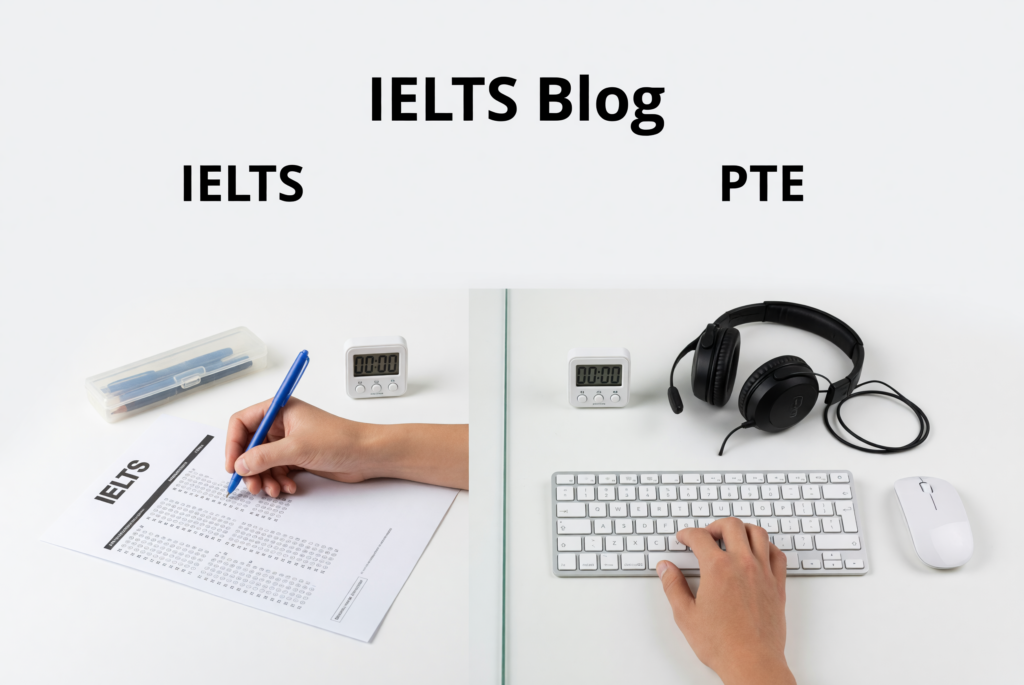
IELTS has a more traditional exam feel. You move through Listening, Reading, and Writing in a fixed way, and the Speaking test is either face-to-face or via video call with a human examiner, depending on the test centre setup. The structure is familiar to many candidates, especially those who have already done school or university exams in English.
PTE is fully computer-based. You sit at a computer, wear a headset, and move through integrated tasks that can combine reading, listening, speaking, and writing. Many candidates like the speed and consistency of that format. Many others find it mentally crowded because the test moves quickly and the interface demands fast decisions.
If you want a stronger foundation before choosing, the IELTS test format guide helps you understand exactly what IELTS will ask from you.
Speaking: where the easier choice often becomes obvious
For many people, the speaking section decides the whole question. IELTS Speaking feels more natural to candidates who can hold a conversation, repair a sentence smoothly, and respond well to a real person. Even when they make small mistakes, they may still sound clear and confident because the interaction is human.
PTE Speaking feels easier for candidates who are comfortable speaking into a microphone under strict timing. The responses are often short, fast, and heavily shaped by the computer format. That can be good if you like structure. It can be bad if your fluency depends on natural eye contact, feedback, or a few seconds of thinking space.
In plain terms:
- IELTS often feels easier for conversational speakers
- PTE often feels easier for candidates who like fast, repeatable speaking templates
- If microphone pressure makes you rush or freeze, PTE may feel harder than expected
- If face-to-face speaking makes you nervous, IELTS may feel harder than PTE
Listening and reading: speed versus stability
IELTS Listening and Reading can feel more stable because the task flow is easier to follow. You know which section you are in, what kind of information you need, and how the paper is organised. That does not make IELTS easy, but it does make the pressure easier to manage for many candidates.
PTE often feels faster and more compressed. Because some tasks are integrated, you may need to listen, read, and respond under tighter timing with less recovery room. Candidates who process information quickly sometimes enjoy that. Candidates who need a little more space to settle into each task often find IELTS easier.
This is especially important if you lose marks when the test feels crowded. A stable rhythm is not a small comfort. It can protect your score. If you are building IELTS-specific reading and listening habits, access unlimited IELTS mock tests and see how your accuracy holds up under timed conditions.
Writing: IELTS usually rewards clearer argument, PTE rewards tighter control
IELTS Writing often suits candidates who can build an argument, explain a point, and organise ideas in paragraphs. Even if your grammar is not perfect, strong structure and clear development can still carry the response. That is one reason many candidates feel IELTS is fairer in writing.
PTE Writing can feel easier if you are good at controlled templates and concise written responses. However, it can also feel less forgiving if your typing speed is weak or if you rely on a more natural writing rhythm. Some candidates prefer the shorter writing load in PTE. Others do better in IELTS because they can think more fully on the page.
If your strength is explaining and developing ideas, IELTS may feel easier. If your strength is short-form precision and efficient typing, PTE may feel easier.
Scoring style matters more than most candidates realise
This is where the easier test can flip completely. IELTS gives you band scores and uses human judgement in important areas such as Speaking and Writing. That can help candidates whose English sounds natural even when it is not perfectly mechanical. Human examiners can hear communication quality, not just output shape.
PTE uses computer scoring across the test. Some candidates love that because it feels objective. Others struggle because the scoring rewards very specific response behaviour. If your pronunciation is understandable but unusual, or if your timing and microphone control are inconsistent, PTE can become frustrating quite quickly.
Neither approach is automatically better. The easier one is the one that rewards the way your English already appears under pressure.
IELTS vs PTE which is easier for migration and study goals
Sometimes the best choice is not only about difficulty. It is also about what you need the score for, how soon you need it, and how reliable your performance is likely to be. If your goal is Australian migration, university entry, or professional registration, both tests may be accepted in many contexts, but you still need to check the exact requirement first.
After that, the question becomes practical. Which test gives you the safer path to the score you need? A candidate who is already close to the IELTS target may waste time switching to PTE just because they heard it was easier online. A candidate who is highly computer-comfortable and struggling with IELTS Speaking may find the switch worthwhile.
If you are comparing options seriously, do not choose based on internet mythology. Choose based on sample performance, accepted score requirements, and how repeatable your result looks over two or three practice sessions.
Who usually finds IELTS easier
IELTS often feels easier for candidates with these profiles:
- They speak more naturally in conversation than into a microphone
- They can organise longer answers without relying on rigid templates
- They prefer a steadier exam rhythm with clearer section boundaries
- They want human judgement in Speaking and Writing
- They are already familiar with essay-style academic tasks
IELTS can also be the better choice if you want a preparation path with a lot of public guidance, mock material, and section-specific strategy. If that sounds like you, it is worth reviewing the IELTS preparation complete guide before making a final decision.
Who usually finds PTE easier
PTE often feels easier for candidates with a different profile:
- They type quickly and accurately
- They like computer-based tasks and fixed response routines
- They are comfortable with fast pacing and integrated task design
- They prefer machine-scored consistency over human interaction
- They can stay calm when speaking into a microphone with strict timing
PTE can be a good fit for highly structured learners. But if your English becomes less natural when you force it into a template, that advantage may disappear.
The simplest way to decide without wasting months
The safest way to answer IELTS vs PTE which is easier is to stop treating it like a theory question. Test both formats lightly, then compare your real performance. Do one honest IELTS practice set and one honest PTE-style sample session. Notice more than the score. Notice the stress, the timing, the fatigue, and where your mistakes actually come from.
Ask yourself:
- Which test felt more natural from start to finish?
- Which speaking format helped me sound more like myself?
- Which writing format let me show my real English more clearly?
- Which test made me lose marks through format pressure rather than English weakness?
If you are still unsure, choose the exam where improvement feels more trainable. That usually matters more than the first raw score.
Do not chase the “easy” test if it is the wrong fit
A lot of candidates burn time by switching tests for the wrong reason. They hear that PTE is easier, move over, then discover that microphone pressure ruins their speaking. Or they assume IELTS is simpler, then struggle with face-to-face speaking and longer written argument. The problem is not laziness. It is mismatch.
The smarter question is not “Which test is easier for everyone?” It is “Which test is easier for me to repeat well on a real exam day?” That is the version that protects your money, your timeline, and your confidence.
Before the FAQ, use this checkpoint if IELTS is still on your shortlist:
Ready to find out your IELTS band score?
Take the IELTS Express Pre-Test for just $4.99 and get your personalised band prediction with a 14-day improvement plan.
FAQ: IELTS vs PTE which is easier
Is PTE easier than IELTS for most people?
No. PTE is easier for some candidates, especially those who are fast on computers and comfortable with headset speaking. IELTS is easier for others, especially those who prefer more natural conversation and clearer section flow.
Is IELTS Speaking easier than PTE Speaking?
It often is for candidates who speak better with a real person. If you rely on natural interaction and dislike microphone pressure, IELTS Speaking usually feels easier.
Which test gives faster score improvement?
The faster-improving test is usually the one that fits your current habits better. If the format matches your strengths, your score often becomes more stable with less wasted effort.
Should I switch from IELTS to PTE if I am stuck?
Only if your problem is truly a format mismatch rather than weak English. Switching can help, but it can also reset your preparation if the new format exposes different weaknesses.
How can I decide between IELTS and PTE quickly?
Compare one honest practice attempt in each format, check the score requirements for your goal, and choose the test that feels more repeatable under pressure.
Choose the test that gives you the safest score path
So, IELTS vs PTE, which is easier? The blunt answer is this: IELTS is easier for some people, PTE is easier for others, and the wrong test can feel much harder than either one should. Look at your speaking comfort, typing speed, timing control, and how naturally you perform in each format.
If IELTS already matches your strengths, do not abandon it because of online hype. If PTE clearly fits your habits better, switching may be sensible. The goal is not to win a debate about which exam is easier in theory. The goal is to choose the exam that gives you the safest, most repeatable route to the score you actually need.