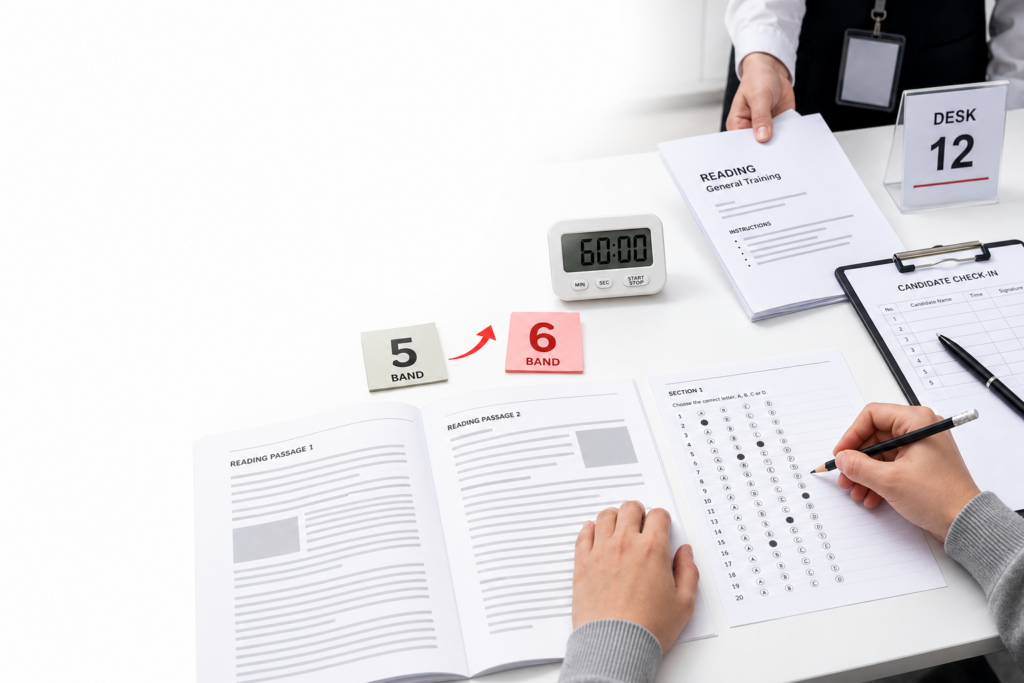
If you want to improve IELTS Reading General from band 5 to 6, you do not need a miracle technique. You usually need better control of the basics: matching the answer to the text, handling time pressure without panic, and avoiding the small mistakes that keep your raw score stuck. Before you keep guessing whether Reading is the section holding you back, take the IELTS Express Pre-Test to get a clearer picture of your current band and the habits that still need work.
Band 5 readers often understand part of the passage but lose marks through rushed decisions, weak scanning, or confusion when the wording changes. Band 6 is more stable. It usually means you can follow the overall meaning, find evidence more reliably, and protect the easier questions instead of leaking marks throughout the paper. That jump is realistic. It comes from cleaner process, not from sounding smarter.
What Band 5 and Band 6 usually look like in IELTS Reading General
At Band 5, many candidates can catch keywords, but they do not always track the exact meaning around those words. They may choose an answer because one familiar term appears in the text, even when the sentence as a whole says something slightly different. They also tend to lose rhythm after one difficult item and then rush the next few questions.
Band 6 is different because the reading process is steadier. You do not need perfect comprehension of every line. You need enough control to separate the main point from the distractors and enough discipline to keep moving through the paper without turning one mistake into three more.
- Band 5 readers often rely too heavily on isolated keywords
- Band 6 readers check meaning, not just word matching
- Band 5 readers lose time when they get stuck
- Band 6 readers recover faster and protect the next answer
Why candidates get stuck at Band 5 in General Reading
General Reading feels easier than Academic Reading on the surface because the topics are more familiar. The trap is that familiar language makes candidates overconfident. They read quickly, assume they understood enough, and answer before confirming the exact evidence. That habit costs marks in True False Not Given, matching tasks, and any question where the wording is paraphrased.
Another common issue is weak passage management. Candidates spend too long reading every line carefully in Section 1, then arrive at later sections already short on time. Others do the opposite: they rush everything and miss clear answers that were actually easy to find. If your overall system still feels messy, the IELTS Reading General tips and strategies guide is a useful wider reference because it explains how the section is built and where many marks disappear.
IELTS Reading General improve from band 5 to 6 by checking evidence properly
The fastest route upward is usually better evidence control. That means refusing to lock an answer in until you can point to the line, phrase, or sentence that supports it. At Band 5, candidates often answer from memory of the passage or from a quick impression. At Band 6, answers start to come from clearer proof.
This matters most when IELTS uses paraphrasing. The question sheet may use one phrase while the passage uses a different one with the same meaning. If you only hunt for identical words, you can miss the answer or choose the wrong one. A stronger habit is to ask, “What idea am I actually looking for?” and then match the meaning carefully.
- Find the relevant part before choosing the answer
- Read one or two sentences around it instead of one isolated line
- Check for contrast words such as however, but, although, and instead
- Reject partial matches when the full meaning does not fit
This one change helps because many Band 5 mistakes are not language failures. They are decision failures. You understood enough to find the area, but not enough to slow down and test the answer properly.
How to improve scanning and skimming without becoming careless
People often hear that they need to scan faster, then turn scanning into random eye movement. Good scanning is not about looking everywhere quickly. It is about looking for the right thing. Before you search the passage, identify whether you are hunting for a name, date, number, opinion, instruction, or reason. That makes your attention narrower and more useful.
Skimming also helps when it is done with purpose. You are not trying to memorise every detail on the first read. You are trying to understand what each paragraph is doing. Is it giving instructions, comparing options, describing a process, or presenting a complaint? That simple awareness makes later questions easier to locate.
A practical way to train this is to write a three-word label next to each paragraph during practice. For example: “refund rules”, “job duties”, or “library changes”. That turns the passage into a map. You do not need to reread the whole text every time because you already know roughly where each idea lives.
Question types that usually separate Band 5 from Band 6
Not every question type causes equal damage. Many candidates around Band 5 lose the most marks in True False Not Given, matching headings or information, and multiple choice. These tasks punish quick assumptions. They ask you to compare the wording carefully and notice whether the text fully supports the idea, partly supports it, or does not mention it clearly enough.
In True False Not Given, the biggest problem is treating “Not Given” as the same thing as false. It is not. False means the text clearly contradicts the statement. Not Given means the text does not provide enough information to confirm or contradict it. That distinction alone can lift scores when candidates finally train it properly.
- True False Not Given: compare the statement with the text line by line
- Matching headings: focus on the main point of the paragraph, not one interesting detail
- Multiple choice: eliminate wrong options for exact reasons
- Sentence completion: watch grammar and word limits carefully
If you want more timed practice once you know your weak pattern, it helps to access unlimited IELTS mock tests and review the same question type across several papers rather than doing endless mixed practice without diagnosis.
Timing habits that make the jump to Band 6 easier
Band 5 readers often treat timing as a general panic problem. In reality, timing is usually a collection of smaller habits. You might spend too long on one stubborn question. You might reread a paragraph three times because you did not identify its purpose early enough. You might finish Section 1 comfortably but arrive at Section 3 with too little time for the harder questions.
A better timing method starts with limits. If a question is resisting you, give it one clear second attempt, mark your best answer, and move on. Do not let one uncertain item swallow three easier ones later. That is a very common Band 5 pattern.
It also helps to think in sections rather than one long 60-minute block. Section 1 should feel efficient, not leisurely. Section 2 still needs control. Section 3 often deserves your freshest concentration because the texts are longer and the traps are more subtle. Time management becomes easier when you expect those shifts instead of reacting too late.
How to review practice so your score actually moves
Many candidates do a practice test, check the answer key, feel disappointed, and then start another test the next day. That feels productive, but it is weak training. If you want to improve IELTS Reading General from band 5 to 6, review is where the score change usually happens.
After each practice set, classify every wrong answer. Did you miss it because of a paraphrase? Did you read too fast? Did you confuse False with Not Given? Did you ignore the word limit? Did you panic and guess? Those labels matter because they show you what to fix. Without them, every bad result just feels like “my Reading is not good enough”.
A simple review routine works well:
- Step 1: redo wrong questions slowly without the time pressure
- Step 2: underline the exact evidence for the correct answer
- Step 3: write one short reason your original answer failed
- Step 4: group similar mistakes together and look for a pattern
That is also the point where many candidates realise they need a proper study structure rather than scattered drills. If that sounds familiar, see the IELTS preparation plans to compare support options that fit your timeline and target score.
A realistic 2-week plan to lift General Reading from Band 5 to 6
You do not need months of perfect study to move one band if the problem is mainly process. In two focused weeks, many candidates can improve by tightening a few repeated behaviours. The goal is not to do as many full tests as possible. The goal is to build steadier answer control.
A practical 2-week structure could look like this:
- Days 1 to 3: one timed section each day, followed by detailed error review
- Days 4 to 6: targeted work on your weakest question type plus short mixed drills
- Day 7: one full Reading paper under proper timing
- Days 8 to 10: paragraph mapping, scanning drills, and paraphrase review
- Days 11 to 13: two more timed section sets with strict recovery rules
- Day 14: one full paper and a final review of repeated mistakes
This is not glamorous, but it works because it closes the loop between test, diagnosis, and correction. Before the FAQ, use this as your practical checkpoint:
Ready to find out your IELTS band score?
Take the IELTS Express Pre-Test for just $4.99 and get your personalised band prediction with a 14-day improvement plan.
FAQ: IELTS Reading General improve from band 5 to 6
How long does it take to improve IELTS Reading General from band 5 to 6?
It depends on the cause of your mistakes, but many candidates can make that jump within a few weeks when they fix evidence checking, timing control, and weak question-type habits rather than only doing more random tests.
What is the most common reason candidates stay at Band 5?
The most common reason is not checking meaning carefully enough. Many Band 5 readers answer from keywords, assumptions, or panic instead of matching the exact idea in the passage.
Should I read every passage fully before answering the questions?
Not always. A quick purposeful skim is often enough at the start. You want a map of the text first, then you can return to the relevant section for each answer and read that part more carefully.
Which question type should I practise first if I want Band 6?
Start with the type that repeatedly costs you marks. For many candidates, that is True False Not Given or matching information because both punish loose reading and weak evidence control.
Can vocabulary alone raise my General Reading band?
Vocabulary helps, but it is rarely the only answer. Most Band 5 to 6 improvement comes from better answer discipline, stronger paraphrase awareness, and cleaner time management.
Build a steadier reading process
If you want to improve IELTS Reading General from band 5 to 6, stop looking for one magic shortcut. The real gain usually comes from steadier habits: read for meaning, check evidence properly, manage time with more discipline, and review your mistakes like they are clues rather than proof that you are bad at Reading.
That shift matters because Band 6 is usually not a distant level. It is often one layer of control above where you already are. Clean up the repeated leaks, and the score starts to look much more reachable.