If you are looking for IELTS Reading General tips and strategies, you probably want something more useful than a generic reminder to “read faster.” Most General Training candidates do not lose marks because they are lazy or incapable. They lose marks because they use the wrong process: they read too slowly at the start, spend too long on one confusing question, or treat every section as if it requires the same approach. Before you keep guessing whether your current reading level is safe enough, take the IELTS Express Pre-Test to get a clearer picture of your band score and the sections that still need work.
The good news is that IELTS Reading General responds well to strategy. You do not need miracle speed-reading tricks. You need a practical way to move through everyday texts, workplace notices, and longer passages without leaking time or accuracy. The strongest candidates are not always the fastest readers. They are usually the people who manage the paper calmly, spot answer patterns, and avoid wasting energy on low-value mistakes.
What IELTS Reading General is actually testing
General Training Reading is often misunderstood. Some candidates assume it is easy because it is “general,” while others panic because they imagine they must understand every word perfectly. Neither view helps. The test is really measuring whether you can find relevant information, understand meaning in context, follow instructions carefully, and answer different question types under time pressure.
The texts are usually more practical than Academic Reading, but that does not mean the exam is forgiving. You may need to move quickly between advertisements, notices, workplace policies, forms, short factual texts, and one longer reading passage. That shift in text type is exactly why strategy matters. A method that works for a noticeboard text may be clumsy in a longer article.
If you need the broader score and format context, this IELTS test format guide is a useful companion before your next full practice session.
Why many candidates underperform in General Reading
A lot of candidates are close to their target band but still underperform because they make process errors. One common problem is reading every line of the first section too carefully because it feels manageable. That creates false confidence while quietly stealing time from the harder later sections. Another problem is obsession with one difficult question. A candidate may spend two minutes trying to rescue one answer and then rush through three easier ones that were worth the same number of marks.
There is also a mindset issue. Some people believe reading is fixed, so they practise by simply doing more papers and hoping the score will rise on its own. In reality, score improvements usually come from better decisions: knowing when to skim, when to scan, when to read closely, and when to move on. Once you treat the paper like a system instead of a mystery, the whole section becomes more manageable.
A practical timing strategy for the full 60 minutes
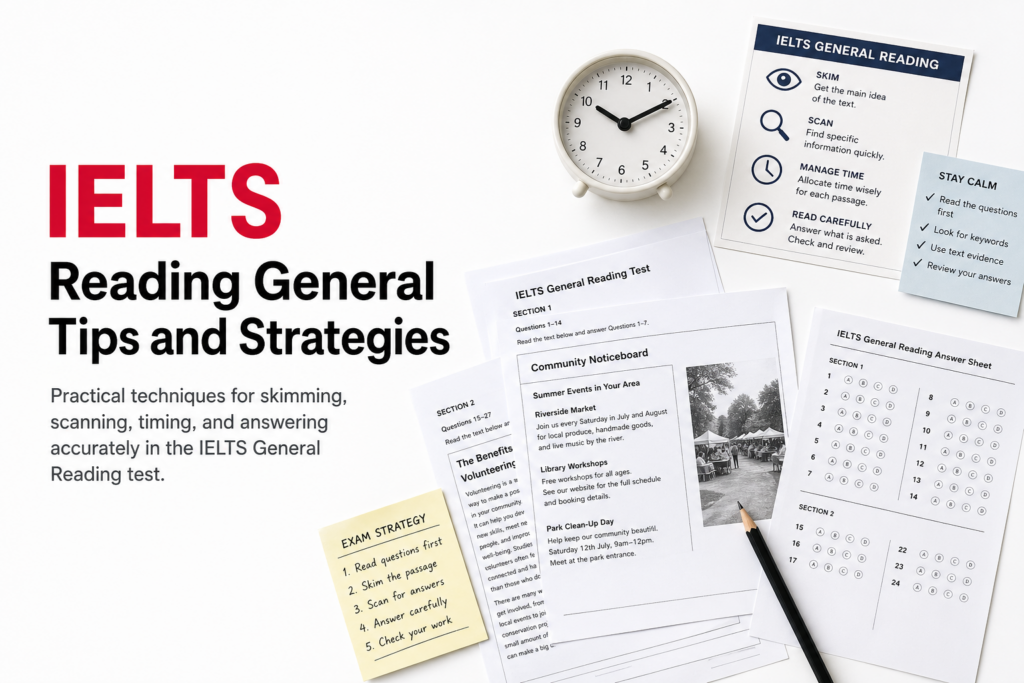
One of the most useful IELTS Reading General tips and strategies is to stop treating the 60 minutes as one long blur. Break the test into sections and give yourself a realistic timing plan. A strong starting point is about 15 minutes for Section 1, 20 minutes for Section 2, and 25 minutes for Section 3. The exact split may vary slightly, but the later sections normally deserve more time because the texts and questions become more demanding.
- Section 1: around 15 minutes
- Section 2: around 20 minutes
- Section 3: around 25 minutes
This split matters because many candidates accidentally reverse it. They feel comfortable early, slow down too much, and then discover they have created a crisis for themselves at the end. Good timing is not about rushing. It is about protecting enough time for the part of the paper that usually decides the score.
If you want a cleaner way to test whether this timing plan works for you, it helps to access unlimited IELTS mock tests and compare how your marks hold up across several papers.
How to approach Section 1 without wasting time
Section 1 often includes short practical texts such as advertisements, notices, timetables, or basic instructions. These can feel easy, which is exactly why candidates become careless. In this section, your job is to collect marks efficiently. Read the question first, identify the key information you need, then search the text with purpose.
Do not turn a short notice into a literature project. You are not trying to admire the writing. You are trying to locate a fee, a date, a condition, a requirement, or a simple factual detail. Because the texts are shorter, the danger is not usually complexity. The danger is over-reading, misreading one small detail, or ignoring a limit such as “NO MORE THAN TWO WORDS.”
A good habit here is to pay special attention to names, numbers, days, and eligibility conditions. These are often where easy marks disappear through haste or sloppy copying rather than real comprehension failure.
How to manage Section 2 with better control
Section 2 often introduces workplace or everyday functional texts that require a bit more comparison and logic. This is where candidates can lose their rhythm if they stay too passive. Instead of reading every text in full before looking at the questions, build a quick map of what each text is about and then return to the relevant part when needed.
You should also expect paraphrasing. The question may not repeat the exact wording in the text. A rule in the passage might be described more directly in the question, or a formal phrase in the text might appear as simpler language in the task. Training yourself to recognise meaning rather than only repeated vocabulary is one of the most important IELTS Reading General tips and strategies for medium-difficulty questions.
When Section 2 feels messy, pause for a second and check whether the real problem is confusion or simply weak navigation. Often the answer is in the text, but you are searching without a clear map. That is a process problem, not a talent problem.
How to survive Section 3 when the longer passage feels dense
Section 3 is where timing and discipline really matter. The longer text often looks more intimidating, and candidates start reading in two unhealthy ways: either too slowly because they are scared to miss something, or too quickly because they feel behind. Neither approach is reliable.
A better method is to begin with a short structural skim. Read the title, look at the opening of each paragraph, and notice how the topic develops. Then use the questions to guide deeper reading. That way, you are not wandering through the passage blind. You already have a rough map of where ideas are likely to be located.
If your Reading score still feels unstable across test sections, this IELTS Reading practice guide can help you strengthen the bigger picture as well as your section-by-section method.
Skimming and scanning are useful, but only when used properly
People talk about skimming and scanning so often that the advice has become slightly cursed. Candidates hear those words and assume they should race their eyes over everything and hope the answer magically appears. That is not strategy. That is panic wearing technical vocabulary.
Skimming means getting the overall shape of a text quickly. You use it to understand the topic, structure, and paragraph flow. Scanning means searching for a specific detail such as a date, price, rule, location, or name. Both skills matter, but they solve different problems.
The trick is knowing when to switch from one to the other. If you scan before you understand the text structure at all, you may keep landing in the wrong area. If you skim forever and never narrow your search, you waste time. Strong readers move between these modes deliberately instead of treating them like magic tricks.
Question order can either save you or sabotage you
Another of the most valuable IELTS Reading General tips and strategies is learning which question types usually follow the text order and which ones can send you searching everywhere. Tasks like true, false, not given, sentence completion, note completion, and short answer questions often move through the text in sequence. That can make them more efficient to tackle first because each answer helps pull you forward.
By contrast, matching headings and some matching information tasks can be more time-heavy because they require a broader understanding of several paragraphs. That does not mean you should always leave them until the end, but you do need to treat them with respect. If one matching task is swallowing your minutes, you may need to mark uncertain answers, move forward, and protect the rest of the section.
The test is not rewarding stubbornness. It is rewarding answer control. A candidate who lets one awkward question consume the paper is usually being diligent in the wrong direction.
How to avoid the classic true false not given trap
Many candidates lose marks on true, false, not given style questions because they answer based on topic similarity rather than exact meaning. If the text mentions the same subject, they assume the statement must be true or false. But the real issue is whether the specific claim in the question is confirmed, contradicted, or simply not stated.
For example, a passage may discuss online training in general, while the question claims that all staff preferred online training to face-to-face training. Those are not the same idea. The topic overlaps, but the strong wording in the question may not be supported at all.
When you face this question type, slow down just enough to compare the exact meaning. Pay attention to words like all, only, always, mainly, or required. Small shifts in strength can completely change the answer. This is where accuracy beats speed.
How to handle unknown vocabulary without freezing
Unfamiliar words do matter sometimes, but candidates often give them too much power. One unknown word is not a good reason to mentally leave the test. In many cases, you can still answer the question through context, surrounding detail, and logical structure.
Instead of stopping completely, ask yourself three things. First, is this word actually necessary for the answer? Second, does the sentence around it reveal a contrast, cause, example, or definition? Third, can I continue searching for a clearer part of the text before returning?
The truth is that General Training Reading usually rewards calm problem-solving more than vocabulary perfection. If you can stay functional when one phrase looks unfamiliar, you protect both your timing and your confidence.
Common mistakes that quietly drag down good scores
Some mistakes look small but cost a surprising number of marks over a full test. One is ignoring word limits. Another is changing an answer without clear evidence just because a later option looks tempting. A third is copying from the passage inaccurately, especially with plurals, spelling, or articles. Candidates often blame comprehension when the real issue was answer-form accuracy.
Another common mistake is emotional overreaction. One confusing paragraph appears, panic arrives, and the next four questions are answered badly because the candidate is still mentally fighting the earlier problem. Good strategy includes emotional recovery. You do not need to love the section. You need to reset quickly and keep collecting marks.
If your overall study plan still feels random, you can see our IELTS preparation plans and follow a more structured approach instead of patching weaknesses one by one.
A simple review method that makes practice tests more useful
Practice becomes much more powerful when you review it properly. After finishing a test, do not only count how many answers were wrong. Label the cause of each miss. Was it timing, vocabulary, question type confusion, or a careless copying error? That quick diagnosis turns one practice paper into a useful lesson instead of a vague disappointment.
Then go back and find the proof line for each answer. Ask yourself what clue you missed. Did the text paraphrase the question in a way you did not notice? Did you misunderstand a contrast word such as however or instead? Did you spend too long earlier and rush the later section?
This review habit matters because score improvement usually comes from repeated pattern correction, not from endlessly doing fresh papers and hoping experience alone will save you.
A seven-day plan to improve IELTS Reading General
If you want to turn these IELTS Reading General tips and strategies into real progress, use a simple one-week cycle. On Day 1, complete one full timed reading test. On Day 2, review every wrong answer and label the cause. On Day 3, repeat one difficult section with a stricter timing target. On Day 4, practise one weak question type such as matching or true/false/not given. On Day 5, do a shorter timed set and focus on answer accuracy. On Day 6, review vocabulary and paraphrases from the week’s texts. On Day 7, complete another full section or full paper and compare your timing decisions with Day 1.
This kind of plan works because it connects testing with repair. You are not just proving that a weakness exists. You are attacking it while the pattern is still fresh. That is how practice starts producing better scores instead of just producing more completed worksheets.
Ready to find out your IELTS band score?
Take the IELTS Express Pre-Test for just $4.99 and get your personalised band prediction with a 14-day improvement plan.
FAQ: IELTS Reading General tips and strategies
What is the best timing strategy for IELTS Reading General?
A practical starting point is about 15 minutes for Section 1, 20 minutes for Section 2, and 25 minutes for Section 3. This gives more time to the harder later section without letting the early easy marks consume the whole paper.
Should I read the whole text before answering the questions?
Not always. A short skim for structure is useful, but full slow reading often wastes time. It is usually better to build a quick map of the text and then search more precisely with the questions in mind.
How can I improve my IELTS Reading General score quickly?
The fastest safe improvement usually comes from better timing, stronger question-type control, and more honest review of mistakes. Many candidates improve once they stop repeating the same errors in every practice paper.
What should I do if I see vocabulary I do not understand?
Do not freeze. First decide whether the word is actually necessary for the answer. Then use surrounding context, sentence logic, and other clues in the text to stay moving. One unknown word rarely means the whole answer is impossible.
Are skimming and scanning enough to get a high score?
They help, but only when used properly. Skimming helps you understand structure, while scanning helps you locate details. High scores usually come from combining these tools with accurate reading and smart time decisions.
Your next step
Strong IELTS Reading General tips and strategies are not about looking clever. They are about giving yourself a repeatable method you can trust under pressure. Use a realistic timing plan, choose question order carefully, avoid low-value battles, and review mistakes honestly after every practice session.
Once your process becomes calmer and more deliberate, the score usually stops feeling random. And that is when General Reading starts becoming a section you can manage instead of a section you just survive.