If you struggle with IELTS Reading Academic time management, the problem is usually not only reading speed. Most candidates lose time because they read in the wrong order, spend too long on one difficult question, or panic when a passage feels dense. The result is predictable: the first passage feels manageable, the second becomes rushed, and the third turns into a time disaster.
The good news is that time management in IELTS Reading is trainable. You do not need superhero concentration or extreme speed-reading tricks. You need a repeatable system for how long to spend, when to move on, and how to stop one hard question from stealing marks from the rest of the paper. Before you keep guessing whether Reading is already safe enough, take the IELTS Express Pre-Test to get a clearer picture of your current band and your biggest risk areas.
Why IELTS Reading Academic time management feels so hard
Academic Reading is difficult because the clock is working against your natural instincts. In normal life, if a text is confusing, you slow down and re-read. In the test, that habit can quietly destroy your score. You only have 60 minutes for three passages and 40 questions, and there is no extra transfer time at the end.
Many candidates also waste time trying to understand every sentence perfectly. That is not how the exam works. IELTS Reading is not rewarding full literary appreciation. It is rewarding your ability to find relevant information, follow argument flow, and answer question types accurately under pressure.
If your broader Reading strategy also needs work, this IELTS Reading Academic practice test guide is a useful companion for full-test review.
The biggest time traps in Academic Reading
One major trap is over-investing in the first passage because it feels safer. Candidates think they are building confidence, but they often spend 23 or 24 minutes there and leave themselves too little time for the harder passages later. Another trap is obsessing over one question that seems almost solvable. That question can cost you three or four easier marks elsewhere.
A third problem is passive reading. Some people read an entire passage slowly before looking at the questions in detail. Others bounce randomly between questions and paragraphs without any clear map. Both approaches burn time because they create unnecessary re-reading.
Vocabulary panic is another quiet killer. When candidates hit an unfamiliar word, they freeze and assume they cannot continue. In reality, most answers come from structure, paraphrase, and local meaning, not from knowing every academic term.
A realistic timing plan for all 60 minutes
The cleanest IELTS Reading Academic time management plan is to treat the test like three separate jobs. Passage 1 should usually take about 15 to 17 minutes, Passage 2 about 18 to 20 minutes, and Passage 3 about 23 to 25 minutes. That allows difficulty to rise without stealing too much time from the end.
A practical split looks like this:
- Passage 1: 15 to 17 minutes
- Passage 2: 18 to 20 minutes
- Passage 3: 23 to 25 minutes
- Emergency buffer: 2 to 3 minutes inside the total, not added at the end
This is not a law, but it is a strong default. If Passage 1 is taking longer than 17 minutes, you are already borrowing time from the rest of the paper. Candidates who improve fastest usually start wearing a mental stopwatch. They know roughly where they should be, and they move on before the damage spreads.
If you want more score-focused Reading support, this IELTS Reading Academic band score guide helps connect timing strategy to actual mark outcomes.
How to start each passage without wasting time
You do not need to read every passage from beginning to end in deep detail before touching the questions. A faster method is to spend one or two minutes getting the shape of the passage. Read the title, skim the first sentence of each paragraph, notice names, dates, or repeated themes, and identify the general topic flow.
That short orientation creates a map in your head. Then, when a question asks about a specific idea, you are not hunting blindly. You already know where the likely paragraph lives. This is especially useful for matching headings, sentence completion, and summary completion tasks.
The goal of the first skim is not full understanding. The goal is control. Once you understand the structure, the passage becomes easier to search efficiently.
Question order matters more than most candidates think
One of the smartest IELTS Reading Academic time management decisions is choosing the right question order. Many question sets follow the text order, especially true, false, not given; yes, no, not given; short answer; sentence completion; and note completion. These are often worth doing early because the answers appear progressively through the passage.
Other tasks, such as matching headings or matching information, can be more time-hungry. They often require a wider view of multiple paragraphs, so if you tackle them badly, they can absorb huge amounts of time. That does not mean you should always leave them until last, but you should recognise that they need stronger scanning discipline.
A good rule is this: start with the question types that move you through the passage in order, build momentum, then return to broader matching tasks if needed. If you also need help avoiding common technical errors, this IELTS Reading Academic common mistakes guide is worth reviewing.
When to skip and when to stay
This is where many scores are won or lost. If you have spent more than about 75 to 90 seconds on one question and you are not close, you should usually mark it, make your best strategic guess if needed, and move on. Staying longer feels emotionally satisfying because it feels like effort, but it is often bad exam economics.
Skipping is not failure. Skipping is control. The test is giving you 40 marks, not a prize for stubbornness. A candidate who leaves one ugly question and collects six cleaner marks later will beat the candidate who wrestles one answer into submission and runs out of time elsewhere.
This mindset is especially important in Passage 3, where the language is denser and the traps are sharper. Calm triage beats perfectionism every time.
How to read faster without pretending to be a speed reader
You do not need to become dramatically faster at reading every line. What you need is faster selective reading. That means learning to slow down only when the question demands precision and staying lighter when you are locating relevant parts of the passage.
Here are the habits that help most:
- Track keywords and paraphrases: look for meaning shifts, not identical words
- Read around the answer zone: one or two lines before and after often matter
- Stop re-reading whole paragraphs: return only to the local section you need
- Notice signpost words: however, instead, in contrast, therefore, and similarly often guide the answer
- Use question wording as a search tool: nouns, names, dates, and technical terms help you land faster
If your real issue is repetition under exam pressure, access unlimited IELTS mock tests and practise timing with real passage sets rather than isolated drills.
Passage-by-passage strategy that actually works
Passage 1 should feel controlled, not leisurely. Your job is to bank marks efficiently. Keep moving, avoid over-reading, and do not let easy confidence become slow confidence.
Passage 2 often looks manageable but becomes tricky through paraphrase and structure. This is where you need discipline. Keep checking the clock and do not let one matching task consume the entire middle of the paper.
Passage 3 is where weaker timing habits are exposed. The language is often more abstract, and the questions can require tighter attention to argument and nuance. Go in expecting resistance. That expectation alone helps you stay calmer when it feels harder. If Passage 3 feels messy, that does not mean you are failing. It usually means you must use stricter time decisions.
Common timing mistakes that cost good candidates marks
The first mistake is reading too carefully too early. The second is changing answers repeatedly without new evidence. The third is failing to notice instructions such as word limits. A candidate may actually find the right idea and still lose the mark by writing too many words.
Another frequent issue is letting confidence collapse after one bad section. Once candidates feel behind, they often rush everything and make avoidable mistakes. A better response is to reset quickly: check the time, accept the loss, and attack the next questions cleanly.
It also helps to remember that not every passage needs to feel comfortable for a strong score. You do not need to feel brilliant. You need to keep collecting marks.
A one-week IELTS Reading Academic time management drill
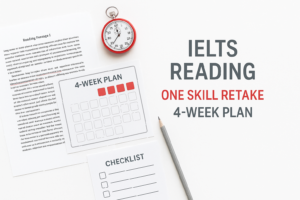
If you want fast improvement, train timing directly instead of hoping it will fix itself. A simple seven-day drill can help:
- Day 1: complete one full Reading test and record how long each passage took
- Day 2: review where you over-spent time and which question types caused it
- Day 3: practise one passage only, with a strict 17-minute cap
- Day 4: practise matching headings or matching information under time pressure
- Day 5: complete another full test using the 17-20-23 split
- Day 6: review wrong answers and label them as timing, vocabulary, or logic errors
- Day 7: repeat one difficult passage and focus on calmer skip-or-stay decisions
This kind of drill works because it turns timing into a visible behaviour, not a vague hope. Once you see where the minutes are leaking, you can fix them much faster.
If you want structured help beyond self-study, you can see our IELTS preparation plans and choose support that matches your timeline and target band.
Ready to find out your IELTS band score?
Take the IELTS Express Pre-Test for just $4.99 and get your personalised band prediction with a 14-day improvement plan.
Frequently Asked Questions
How much time should I spend on each IELTS Academic Reading passage?
A practical default is about 15 to 17 minutes for Passage 1, 18 to 20 minutes for Passage 2, and 23 to 25 minutes for Passage 3. The exact split can vary slightly, but harder passages should receive more time, not less.
Is IELTS Reading Academic time management mainly about reading faster?
No. Reading speed helps, but most candidates gain more by improving question order, scanning discipline, and skip-or-stay decisions. Better control usually matters more than raw speed.
Should I read the whole passage before answering questions?
Usually not in deep detail. A short skim for structure is useful, but full slow reading often wastes time. It is more efficient to build a quick map and then search purposefully using the questions.
What should I do if one question is taking too long?
Mark it, make a strategic move, and continue. Spending too long on one question can cost several easier marks later. Good test management means protecting the rest of the paper.
Can time management alone improve my IELTS Academic Reading band score?
Often, yes – especially if you already understand the passages reasonably well but keep leaving questions unfinished. Better timing can turn existing ability into actual marks.
Your next step for a calmer Reading score
IELTS Reading Academic time management improves when you stop treating the clock as an enemy and start treating it as part of the method. Use a clear passage split, protect yourself from time traps, and move on from low-value battles faster. That is how strong candidates finish the paper with enough control to score well.
The next time you practise, do not only check how many answers you got right. Check where the minutes went. That is often the real breakthrough.