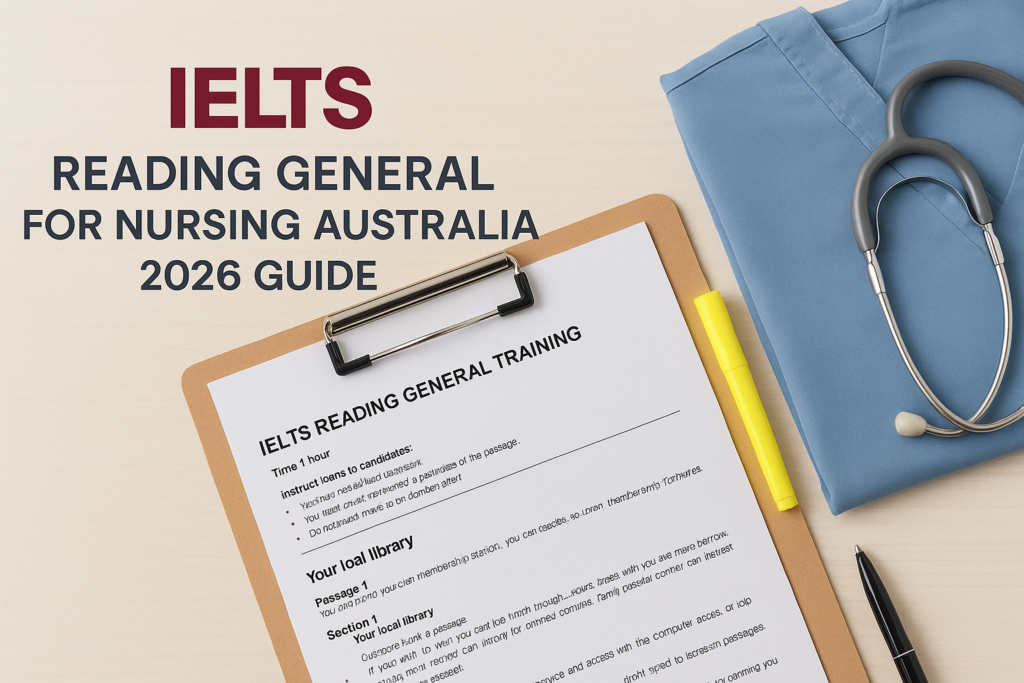
If you are searching for IELTS Reading General for Nursing Australia, you are probably trying to answer a very practical question. Is the General Training reading module enough for your pathway, and if so, how do you score well enough without wasting weeks on the wrong study method? Nurses are often balancing registration research, shift work, family pressure, and a test deadline at the same time. That is why efficiency matters.
Before you spend more money on random practice materials, take the IELTS Express Pre-Test to check your current level and see whether Reading is actually the section putting your result at risk.
What IELTS Reading General for Nursing Australia usually means
When people search for IELTS Reading General for Nursing Australia, they are usually in one of two situations. Either they are confirming whether the General Training test is accepted for their nursing goal, or they already know they need General Training and want a safer way to prepare for the Reading section.
Here is the key point. Your required IELTS version depends on the organisation and pathway you are applying through. Some nursing pathways, registration bodies, employers, or migration routes may ask for Academic IELTS instead. Others may accept General Training in specific circumstances. That is why you should always verify the exact requirement with the official body handling your application before you book the test.
Once the test version is confirmed, preparation becomes simpler. The Reading section in General Training still demands speed, accuracy, and careful attention to detail. It is not an “easy version” of IELTS. Many candidates lose marks because they underestimate it.
How the General Training Reading test is structured
The IELTS General Training Reading test lasts 60 minutes and contains 40 questions. There is no extra transfer time at the end, so the time pressure is real from the first minute. The passages usually move from shorter, everyday texts to longer and more complex workplace or general-interest texts.
For nursing candidates, this matters because the skills being tested match real professional pressure. You need to scan notices quickly, understand instructions, compare details, and avoid careless errors. In Australian nursing settings, that kind of careful reading matters every day.
The three parts usually look like this:
- Section 1: short factual texts such as notices, advertisements, rules, or information sheets
- Section 2: workplace-related texts such as policies, procedures, job information, or training notes
- Section 3: one longer text on a general topic, often with denser ideas and more inference
Many nurses do reasonably well in Sections 1 and 2, then leak marks badly in Section 3 because concentration drops or the reading method falls apart. That pattern is common, and you can fix it.
Which reading skills matter most for nurses
Nurses often assume vocabulary is the main issue. Sometimes it is, but more often the bigger problem is method. Strong General Training Reading scores usually come from a small set of repeatable skills used well under time pressure.
- Skimming: getting the general idea of a text fast before looking for detail
- Scanning: locating names, dates, rules, figures, and key phrases quickly
- Keyword matching: spotting paraphrases rather than hunting for the exact same words
- Instruction control: following word limits and answer form exactly
- Error discipline: checking whether an answer is supported by the text, not by memory or assumption
That last point matters more than many candidates realise. Nurses are trained to act carefully, but in the test room people still rush. They see one familiar word, choose an answer too quickly, and move on. IELTS punishes that habit.
If you want structured timed practice rather than random worksheets, access unlimited IELTS mock tests so you can track how your reading method holds up across full sets, not just isolated questions.
Common question types in IELTS Reading General for Nursing Australia
The question types repeat often. Once you understand what each type is really testing, your score becomes much more stable.
Multiple choice
This type tests more than basic understanding. It checks whether you can separate the correct answer from options that look plausible but do not fully match the text. Candidates often lose marks here because they choose the answer that feels broadly right instead of the one that is precisely supported.
True, False, Not Given
This question type causes trouble because many candidates confuse False and Not Given. False means the text clearly contradicts the statement. Not Given means the statement is not confirmed by the text. If you cannot prove it from the passage, you should not invent it.
Matching headings
Matching headings tests your ability to identify the main idea of a paragraph, not just a repeated word. Nurses who focus too narrowly on keywords often choose the wrong heading because they miss the paragraph’s overall purpose.
Sentence completion and summary completion
These questions reward careful detail tracking. The answer usually depends on exact grammar, word form, and the instruction limit. A right idea written in the wrong form can still lose the mark.
Matching information or features
This is where organised scanning helps. Instead of reading the whole passage again from the top, you need a calm process for locating the right part, checking the wording, and confirming the link.
Why many nursing candidates get stuck below their target
Most reading plateaus come from the same few habits. The first is over-reading. Candidates spend too long trying to understand every line before they answer anything. The second is under-reading. They skim so fast that they miss the evidence needed to choose accurately. The third is panic when a hard passage appears.
For nursing candidates in Australia, the target score can feel emotionally heavy because it is tied to registration plans, job opportunities, and migration timelines. That pressure makes small mistakes feel bigger. Unfortunately, stress also causes more mistakes. Candidates start second-guessing easy answers or wasting time on one stubborn question while easier marks are waiting later in the paper.
A better mindset is calm and evidence-based. Treat each question like evidence work. Find the relevant section, compare meaning carefully, answer, and move on. Calm method beats frantic effort almost every time.
A practical reading method that works under time pressure
You do not need a fancy system. You need a simple one you will actually use on test day. A reliable approach for IELTS Reading General for Nursing Australia looks like this:
- Step 1: read the instructions carefully and note any word limit
- Step 2: skim the passage or section to understand the topic and structure
- Step 3: underline or mentally note keywords in the question
- Step 4: scan for paraphrases, not exact word matches only
- Step 5: confirm the answer from the text before writing it
- Step 6: if one question is eating time, move on and return later
This method sounds basic because it is basic. That is exactly the point. Under pressure, simple systems hold up better. Complicated tricks usually collapse halfway through the test.
If your deadline is close and you want more guided support, see our IELTS preparation plans and choose the level that matches your timeline and target score.
How to prepare if you are working shifts or studying around nursing duties
Many nursing candidates do not have the luxury of three free hours a day. Shift work changes your energy, family responsibilities eat into study time, and admin tasks around registration can swallow the rest. So the preparation plan needs to be realistic.
A strong weekly approach could look like this:
- Three short weekday sessions: 30 to 40 minutes each, focused on one question type at a time
- One full timed reading test: once a week, under strict exam conditions
- One review session: check every wrong answer and write down why it was wrong
- Vocabulary review: collect recurring workplace and general reading words, but keep the list practical
The review session matters most. Too many candidates keep doing more tests without learning from the errors. If you missed a question because you ignored the word limit, rushed a paraphrase, or guessed without proof, that is a systems problem. Fix the system, and the score usually moves.
Score targets, accuracy, and what to do before test day
Your exact target depends on the body or pathway assessing your application, so always check the official requirement first. Once you know the target, translate it into practice accuracy. That is much easier to control than vague hopes like “I just need to do better next time”.
In the final two weeks before the test, focus on three things:
- full timed practice, not endless untimed reading
- error review by question type, so weak patterns become visible
- steady routines, so fatigue and nerves do not wreck your method
Do not spend the last week hunting for miracle tips. At that stage, consistency matters more. A nurse who uses one calm reading process well will usually outperform a candidate who has read fifty blog posts but still changes method every second day.
Ready to find out your IELTS band score?
Take the IELTS Express Pre-Test for just $4.99 and get your personalised band prediction with a 14-day improvement plan.
Frequently Asked Questions
Is IELTS Reading General for Nursing Australia easier than Academic Reading?
It is different, not automatically easy. General Training often uses more practical and workplace-style texts, but the time pressure and need for accuracy are still serious. Many candidates lose marks because they underestimate the test.
Do nurses in Australia always need IELTS General Training?
No. The required IELTS version depends on the registration body, employer, migration pathway, or other official requirement connected to your goal. Always confirm the exact test type with the relevant authority before booking.
What is the best way to improve my General Training Reading score quickly?
The fastest improvement usually comes from timed practice, careful review of wrong answers, and a stable method for skimming, scanning, and checking evidence. Doing more tests without review is usually a waste.
Why do I keep making mistakes in True, False, Not Given?
This usually happens because the difference between False and Not Given is not being checked carefully enough. False means the text says the opposite. Not Given means the text does not confirm the point clearly.
How should I study for IELTS Reading if I work nursing shifts?
Use short focused sessions during the week, one full timed reading test each week, and one serious review session to analyse mistakes. That is usually more realistic and more effective than trying to study for long hours after exhausting shifts.
Your next step
A good result in IELTS Reading General for Nursing Australia usually comes from calm method, not guesswork. Confirm the right test version first, practise under time pressure, and review your errors honestly. That combination is much more reliable than jumping between random tips.
If you want a clearer picture of your current level before you book or rebook the exam, start with the pre-test and then build your study plan around the section that is genuinely holding you back.