If you are searching for the IELTS one skill retake policy Australia candidates need to understand, you probably have one clear problem. Your overall result may be close, but one section still missed the target. That is frustrating because re-sitting the whole exam can feel expensive, tiring, and unnecessary when the real issue is only one skill. IELTS One Skill Retake was built for exactly that situation, but the details matter. Eligibility, timing, test format, and acceptance rules can all affect whether it is the right move.
Before you rush into another booking, it helps to check whether one weak section is really the only thing holding you back. Take the IELTS Express Pre-Test to get a quick band prediction and see whether your gap is isolated or whether a full retake strategy would make more sense.
What IELTS One Skill Retake means in Australia
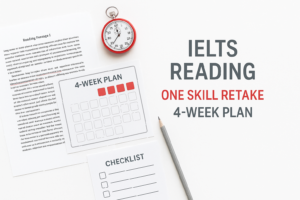
IELTS One Skill Retake lets eligible test takers re-sit just one part of the IELTS test instead of repeating all four skills. That means you can retake Listening, Reading, Writing, or Speaking on its own if one section pulled your result down. The official IELTS guidance says the option applies to IELTS on computer tests at participating centres, and the retake must be completed within 60 days of the original test date.
That is the first point many people miss. This is not a general second chance for every IELTS booking in every format. It depends on where you sat the original test, whether that centre offers One Skill Retake, and whether your first sitting was an IELTS on computer test. If one of those conditions is missing, you are usually looking at a full retake instead.
In practical terms, the IELTS one skill retake policy Australia candidates should follow starts with a simple check, confirm that your original Australian test centre offers the option before you assume you can use it later. If you skip that step, you can waste time planning around a pathway that is not actually available to your booking.
Who can use One Skill Retake, and who cannot
The official IELTS guidance is fairly clear on the broad rules. To use One Skill Retake, you need to have completed a full IELTS on computer test at a centre that offers the service. You can only retake one skill once per original test, and you need to sit that retake within 60 days of the first test date. Results for the retake are usually released within a few days, which is one reason the option appeals to candidates with deadlines.
That said, eligibility and usefulness are not exactly the same thing. You may be technically eligible but still better off with a full retake. For example, if your Writing score missed by 0.5 but your Speaking and Reading were also shaky, a one-skill retake can become a narrow fix for a broader preparation problem. In that case, the policy allows the retake, but your strategy may still be weak.
Another point to treat carefully is acceptance. IELTS says you will receive a new Test Report Form that combines your updated retake score with the other three scores from the original sitting, and you can choose whether to use the original result or the new one. That helps, but it does not mean every university, registration body, or migration pathway will automatically accept One Skill Retake in the same way. Acceptance depends on the organisation you are applying to, so check that before you book.
The 60-day rule is the policy detail that catches people out
If there is one rule worth remembering, it is this one. IELTS One Skill Retake must be taken within 60 days of your original full test. Leave it too late, and the option disappears. Candidates often spend too long deciding whether the retake is worth it, especially after they spend a week feeling annoyed at the result. By the time they make the decision, the window is tighter than they expected.
That is why your next step should be practical, not emotional. As soon as you receive your result, check four things: the section that missed, the exact target you need, whether your centre offers One Skill Retake, and whether your university or authority accepts it. Once those are clear, the timeline becomes much easier to manage.
If your main issue is timing pressure rather than English ability, it may help to rehearse under exam conditions before rebooking. Access unlimited IELTS mock tests and focus only on the section you plan to retake. That is a much smarter use of the 60-day window than vaguely revising everything again.
When One Skill Retake is a smart move
One Skill Retake makes the most sense when three conditions are true. First, only one section missed your target. Second, your other three scores are already strong and stable. Third, the institution or pathway you care about accepts One Skill Retake. When those three pieces line up, the policy can save money, time, and mental energy.
A common example is a candidate who needs 7.0 in each band for study, work, or registration, earns 7.5 or 8.0 in three sections, and gets 6.5 in Writing. That is a classic one-skill retake scenario. Repeating the whole exam may work, but it also creates the risk of one of the previously strong sections dropping. A targeted retake is often the cleaner option.
It can also be a good choice for candidates who usually perform well in one-on-one speaking or timed reading, but had one poor test day in a single area. In that situation, the policy gives you a controlled reset. You are not rebuilding everything. You are fixing one weak link.
If you want a broader view of score planning before you decide, our IELTS band score framework can help you think about section minimums more strategically instead of only reacting to the latest result.
When a full IELTS retake is still the better option
Sometimes the smarter answer is to ignore the convenience of One Skill Retake and book a full sitting instead. That usually happens when more than one section is unstable, when your original scores were all borderline, or when the accepting body does not recognise One Skill Retake for your purpose. In those cases, the policy exists, but it does not solve the real problem.
There is also a preparation issue here. Some candidates use One Skill Retake as a way to avoid facing weak foundations. If your Writing score is low because task response, organisation, and grammar control are all shaky, a quick re-sit may not produce a different outcome. The policy can help a near miss. It does not magically repair an underprepared section.
A full retake may also be safer if your timeline is flexible and you want the best overall score profile possible. Repeating all four sections gives you more room to improve across the board, especially if the original result did not reflect your real level well.
How to check acceptance in Australia before you book
This is the step candidates most want to skip, and it is exactly the step that can save the most trouble. Do not assume that because IELTS offers One Skill Retake in Australia, every Australian university, professional authority, employer, or visa-related pathway will treat it the same way. Some organisations accept it, some may accept it only in certain contexts, and some may still want a full traditional score profile.
The safest approach is simple. Check the live policy of the body you are applying to. If the wording is unclear, ask them directly in writing. That matters for migration-related planning, healthcare registration, university admissions, and any deadline where the wrong test evidence could create a delay. It is better to ask one blunt question early than discover a policy mismatch after you have already paid for the retake.
If you are comparing support options while you plan your next exam move, see our IELTS preparation plans. A targeted plan is often more useful than generic study when you only need one band jump in one section.
A practical plan if you are thinking about One Skill Retake
Good decisions here are usually boring, which is a compliment. The strongest plan is methodical. Get your score report, identify the weak section, confirm acceptance, confirm availability at your centre, and then prepare only for the skill you are re-sitting. Do not spend the whole window reading random forum debates about whether someone else used it successfully in another country or for a different pathway.
A simple plan looks like this:
- Step 1: confirm that your original test was IELTS on computer and sat at a centre that offers One Skill Retake.
- Step 2: check whether your target institution, authority, or pathway accepts the retake format.
- Step 3: book within the 60-day window instead of waiting until the deadline feels uncomfortable.
- Step 4: spend your prep time on the one section that missed, using timed practice and score-focused feedback.
- Step 5: compare your original and new Test Report Forms carefully before submitting anything.
That last step matters because IELTS says you can choose whether to use the original result or the new Test Report Form. If the retake improves the weak section enough, great. If not, at least you know exactly where you stand without guessing.
Ready to find out your IELTS band score?
Take the IELTS Express Pre-Test for just $4.99 and get your personalised band prediction with a 14-day improvement plan.
Frequently Asked Questions
Can I take IELTS One Skill Retake in Australia for any test format?
No. Official IELTS guidance says One Skill Retake is linked to eligible IELTS on computer tests at participating centres. If your original booking was not an IELTS on computer test, you should not assume the retake option will be available.
How long do I have to book and sit One Skill Retake?
You need to complete the retake within 60 days of your original full test date. That window goes faster than most people expect, so it is worth checking your options as soon as your result arrives.
Can I retake more than one section after my original IELTS test?
No. The policy allows one retake of one skill per original test. If more than one section needs work, a full IELTS retake is often the better plan.
Will Australian universities and registration bodies accept One Skill Retake automatically?
Do not assume that. Acceptance depends on the organisation you are applying to. Always check the live policy of the university, employer, regulator, or migration-related authority before you book the retake.
Is One Skill Retake better than a full IELTS retake?
It can be, but only when one section clearly missed and the other three scores are already strong. If your score profile is shaky across multiple sections, a full retake is usually the safer option.