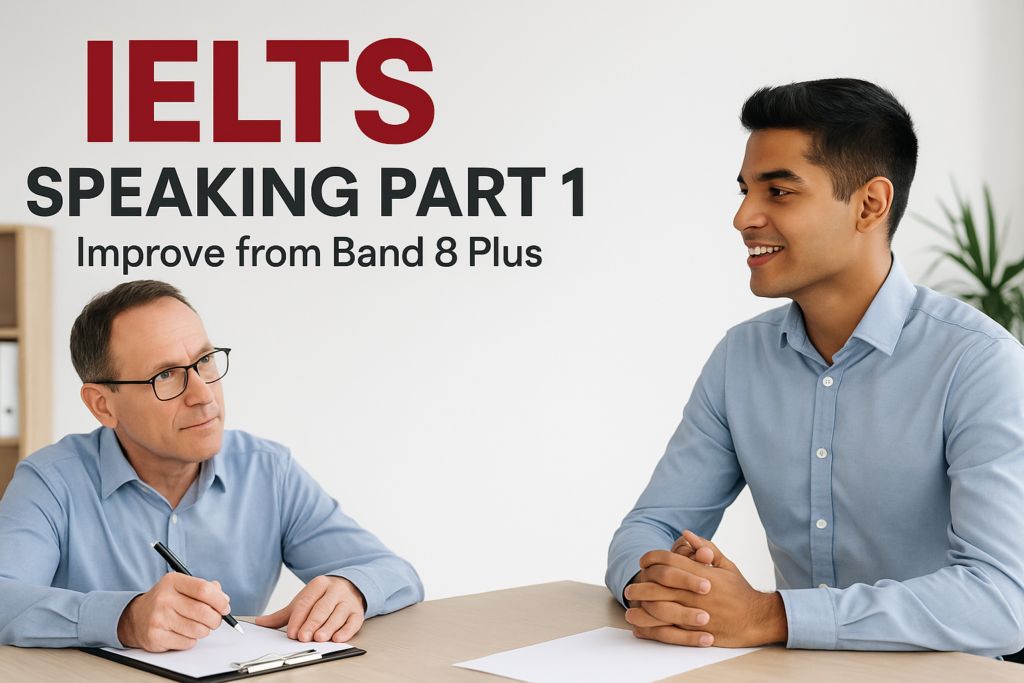
If you are searching for IELTS Speaking Part 1 improve from band 8 plus advice, you are probably not struggling with the basics anymore. You can already answer questions, develop ideas, and avoid obvious silence. The problem is subtler than that. Your answers may still sound a little safe, a little patterned, or a little less precise than truly top-band speaking. At this level, the difference is not more talking. It is finer control.
Before you start changing every speaking habit at once, it helps to check your current level honestly. Take the IELTS Express Pre-Test to see whether Part 1 is really the section stopping you from reaching your target, or whether another skill is creating the bigger drag on your overall result.
What IELTS Speaking Part 1 improve from band 8 plus really means
Band 8 and above in Speaking is not about sounding dramatic, unusually fast, or overloaded with advanced vocabulary. In Part 1, it usually sounds calm, direct, and flexible. The examiner hears answers that are easy to follow, naturally developed, and accurately shaped to the question. There is enough range to sound intelligent, but not so much display that the answer stops sounding human.
That matters because Part 1 is built on familiar topics. You are talking about home, work, routines, food, hobbies, and simple preferences. Since the content is familiar, weak candidates under-answer. Mid-level candidates often memorise patterns. High-level candidates do something harder. They keep the answer natural while still showing precision, control, and small signs of language range.
In other words, improving from an already strong score is not about reinventing your speaking. It is about removing the small habits that keep good English from sounding fully polished under test conditions.
Why strong candidates still get stuck below the very top bands
Many candidates who are close to band 8 make the same mistake. They assume the remaining gap is about more difficult vocabulary. Usually, it is not. More often, the answer sounds slightly rehearsed, too neatly symmetrical, or too cautious. The language is correct, but it does not feel fully alive.
Another common issue is answer shape. A candidate gives a good direct response, adds a reason, then extends the answer with one sentence too many. That extra sentence may not be wrong, but it can flatten the rhythm. The examiner starts hearing repetition rather than flexible thought.
There is also the problem of over-management. High-performing candidates sometimes try so hard to sound fluent that they monitor every word. The result is polished, but a bit tense. A truly strong Part 1 performance usually feels lighter than that. It sounds controlled without sounding managed.
If you want to compare your current speaking against realistic scoring standards, the IELTS Speaking Part 1 band score guide is a useful reference because it shows the difference between answers that are merely strong and answers that feel genuinely high level.
How high-band Part 1 answers sound natural rather than rehearsed
Natural answers usually have three qualities. First, they respond quickly enough to feel conversational. Second, they develop just enough to sound complete. Third, they include language choices that fit the speaker rather than sounding borrowed from a phrase bank.
Imagine the examiner asks, “Do you enjoy cooking?” A rehearsed answer may sound smooth, but overly balanced: “Yes, definitely, because cooking enables me to relax after a demanding day and also allows me to explore different cuisines.” A stronger answer may be simpler: “Yes, quite a lot actually. I usually cook in the evening because it helps me switch off, and I like trying new dishes when I have time.” The second version feels more personal and better timed.
This is why memorised upgrade phrases can backfire at the top end. They do not always sound bad, but they often sound detachable. The examiner hears language that could appear in almost any answer. High-band speaking tends to sound more anchored to the exact question and to the speaker’s real response.
Precision matters more than fancy vocabulary
At this level, precision creates more impact than decoration. The examiner notices whether your words fit the idea cleanly. Saying fairly hectic, a bit repetitive, surprisingly relaxing, or not something I do very often can sound more impressive than forcing in a rare word that does not quite match the point.
That is especially true in Part 1 because the questions are simple by design. If the topic is your hometown, free time, or transport, you do not need specialist vocabulary. You need nuance. You need to show that you can adjust tone and detail with ease. That often comes through in small choices:
- softening language naturally, such as fairly, tend to, or for the most part
- using contrast clearly, such as although, whereas, or that said
- adding brief specificity without overexplaining
- keeping sentence endings clean rather than crowded
If your answers already sound competent, this is where the next gain often comes from. You do not need more impressive English. You need better-fitted English.
How to add range without making the answer heavy
Many advanced candidates know a lot of useful grammar and vocabulary, but Part 1 is not the place to display everything at once. The best answers show range lightly. You might use a condition, a short contrast, a natural past reference, or a habit phrase, but you do it because the idea needs it, not because you are trying to prove something.
For example, if the examiner asks whether you like public transport, a lighter answer might be: “Generally, yes. It is more convenient in the city, although I still prefer driving if I need to get somewhere quickly.” That answer includes contrast and flexibility without feeling engineered.
The danger comes when candidates pile too much into one reply. Long dependent clauses, overly formal linkers, and repeated emphasis words can make the answer sound inflated. A top-band answer usually feels efficient. It has enough complexity to show range, but not so much that the answer loses its conversational rhythm.
That same balance matters in full speaking practice. If you want to test whether your language still holds together under pressure, access unlimited IELTS mock tests and listen closely to the places where your answers become either too careful or too elaborate.
The micro-skills examiners notice in band 8 plus speaking
When candidates think about improvement, they often focus only on vocabulary or fluency. Examiners, however, also hear smaller behaviours that shape the score. These micro-skills are easy to miss because they are not dramatic. Still, they often separate a very good answer from an exceptional one.
- Clean entry into the answer: you begin without unnecessary delay or a long warm-up phrase.
- Stable sentence endings: you finish thoughts clearly rather than trailing off.
- Flexible self-correction: if you adjust a word, it sounds natural and brief, not panicked.
- Appropriate detail: you add enough content to sound complete, then stop.
- Natural stress and emphasis: key words stand out without sounding theatrical.
These details matter because Part 1 moves quickly. The examiner gets many short samples of your speaking in a small amount of time. If each answer sounds settled and appropriately shaped, the overall impression becomes much stronger.
This is also why top-band preparation is often less glamorous than people expect. Instead of hunting for miracle phrases, you spend more time refining rhythm, response size, and language fit.
A practice routine that helps high-level candidates improve further
If you are already around band 7.5 or 8 in speaking, random practice questions are not enough. You need a tighter review loop. A short three-step routine works well.
- Step 1: record ten Part 1 answers. Keep them short and natural. Do not stop and restart every time something feels imperfect.
- Step 2: review for one feature only. On one day, listen for repetition. On another day, listen for overly formal wording. On another day, listen for answers that run too long.
- Step 3: re-answer only the weak questions. Try to improve the same answer with less effort, not more complexity.
This matters because high-level progress often comes from subtraction. You remove stiffness. You remove excess explanation. You remove the phrases that sound learned rather than owned.
It also helps to compare natural spoken English with your test answers. Many candidates discover that their real spoken style is already stronger than their prepared IELTS style. That is useful. It means the goal is not to sound more academic. It is to bring your natural clarity into the exam in a more disciplined way.
Mistakes that often cap candidates below band 8 plus
One common mistake is turning every answer into a mini performance. The candidate sounds capable, but the answer becomes slightly overbuilt. Another is overusing polished connectors such as to be honest, I would say, or from my perspective. These are not wrong, but repeated too often they make the response feel templated.
A third problem is excessive safety. Some candidates keep every answer grammatically tidy by using the same small sentence patterns again and again. This protects accuracy, but it can flatten the sense of range. Other candidates do the opposite. They chase complexity so hard that precision drops.
There is also a subtler issue, emotional flatness. The answer is correct, but it has no natural movement. High-band Part 1 answers often include tiny signals of real attitude, such as mild enthusiasm, hesitation, or comparison. Not exaggerated emotion, just believable personal response. That helps the answer sound lived rather than assembled.
If you need examples of stronger Part 1 response shape, the IELTS Speaking Part 1 sample answers page can help you notice how good responses stay flexible without losing focus.
How to know your Part 1 answers are ready for a top-band score
You are getting close when your answers feel hard to improve by simply adding more language. At that point, the question is no longer, “Can I say more?” It becomes, “Does this sound exact, natural, and appropriately developed?” That is a much better test of top-band readiness.
A strong self-check looks like this:
- the answer begins directly
- the idea develops without rambling
- the wording sounds like something you would really say
- there is some variety in grammar and tone, but it stays light
- the final sentence lands cleanly rather than fading out
If those habits are becoming consistent, your Part 1 score ceiling is probably rising. At that stage, broad speaking ability matters, of course, but exam control matters too. Top-band performance is usually built from many small, repeatable wins rather than one dramatic improvement trick.
If you want a clearer next step beyond self-study, see our IELTS preparation plans and choose a support option that helps you diagnose the last few habits keeping your speaking below your target.
Ready to find out your IELTS band score?
Take the IELTS Express Pre-Test for just $4.99 and get your personalised band prediction with a 14-day improvement plan.
Frequently Asked Questions
What does IELTS Speaking Part 1 improve from band 8 plus usually involve?
Usually, it means refining answers that are already strong. The biggest gains often come from better precision, more natural pacing, and lighter, more flexible language rather than from learning harder vocabulary.
Can memorised phrases help me reach band 8 plus in Part 1?
Not usually. A few natural opener phrases are fine, but heavy reliance on memorised wording can make answers sound detached from the question. At the top end, examiners respond better to language that feels owned and appropriately personal.
How long should a high-band IELTS Speaking Part 1 answer be?
In most cases, two to three sentences is enough. The answer should feel complete, not rushed and not overextended. Strong candidates usually know when the point is made and stop there.
Is advanced vocabulary the key to improving from band 8?
No. Precision is usually more important than difficulty. Well-fitted, natural vocabulary creates a stronger impression than rare words used only to sound impressive.
How can I practise IELTS Speaking Part 1 improve from band 8 plus at home?
Record short Part 1 answers, review one weakness at a time, and re-answer only the questions that sounded stiff, repetitive, or overly managed. Focus on sounding more natural and exact, not on sounding more complicated.