









If you need IELTS for an Australian skilled migration visa, university admission, or professional registration, you’ve likely come across the phrase “7 in each band.” This means you must score at least Band 7 in all four sections — Listening, Reading, Writing, and Speaking — not just achieve a high overall average. A Band 8 in one section cannot compensate for a Band 6 in another. That’s what makes this requirement so demanding, and so misunderstood.
This guide breaks down the IELTS 7 each band minimum strategy into clear, section-by-section preparation steps. Before diving in, it’s worth knowing where you currently stand. The IELTS Express Pre-Test gives you a personalised band prediction across all four skills for just $4.99 — a fast, affordable way to set your baseline before you begin.
Why “7 in Each” Is Harder Than It Looks
Most test takers focus on their overall band score, but “7 in each” requires you to perform consistently across every skill. Consider these realities:
- IELTS Writing is the section where candidates most commonly fall short of Band 7, even when their other skills are strong.
- Listening and Reading are scored out of 40 raw marks each. To get Band 7 in Listening, you typically need around 30 correct answers. In Reading, approximately 30–32 out of 40 are needed.
- Speaking Band 7 requires you to demonstrate fluency, accurate grammar, and a range of vocabulary — all under exam pressure.
- If you sit the test and score 7.0 / 7.0 / 6.5 / 7.0, you fail the requirement — regardless of your overall average.
Understanding this structure allows you to allocate your preparation time where it matters most: your weakest section.
Step 1: Diagnose Your Weakest Section First
The single most effective thing you can do before starting any intensive preparation is identify which section is dragging you below Band 7. Don’t assume — measure it.
A realistic diagnostic involves completing a full-length timed IELTS practice test under real exam conditions. Record your Speaking responses. Write a full Task 1 and Task 2 under strict time limits. Then assess your results honestly.
Common patterns:
- Strong Listening and Reading, weak Writing: Very common among international professionals. Grammar and lexical range in Writing often need focused work.
- Strong Writing, weak Listening: Common among learners from non-audio-heavy study backgrounds. Speed of comprehension is the key barrier.
- Strong Reading, weak Speaking: Often seen in academic learners who read widely but don’t practice speaking under pressure.
Once you know your gap section, you can build a targeted plan rather than a generic one.
Step 2: The IELTS Writing Strategy for Band 7
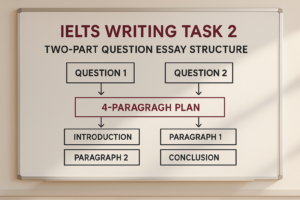
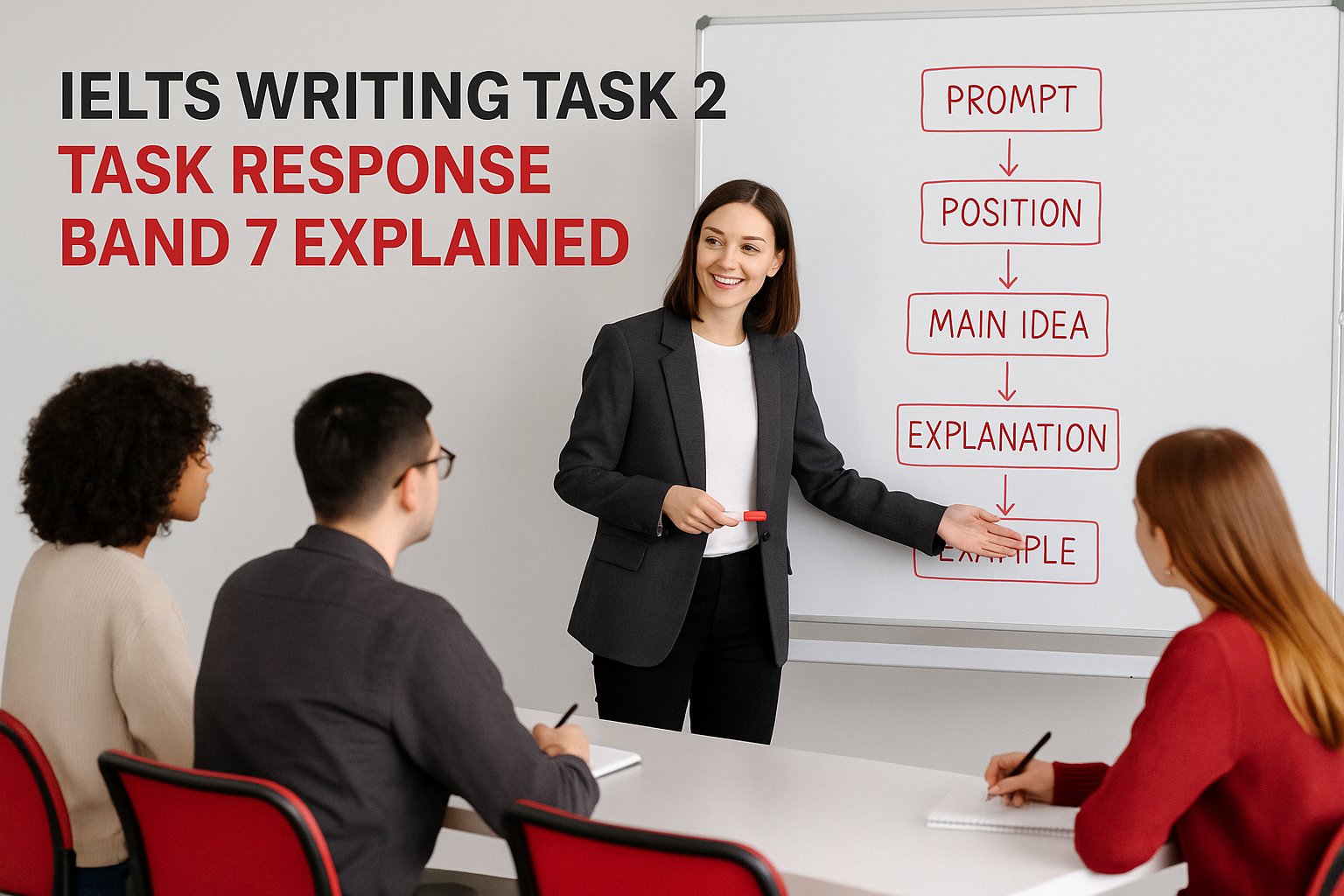
Writing is consistently the section that prevents candidates from hitting “7 in each.” The IELTS Writing band descriptors for Band 7 require you to address all parts of the task, present a clear position, use a range of cohesive devices, and demonstrate flexible, accurate grammar with only occasional errors.
Here’s what separates Band 6 from Band 7 in Writing:
- Task Achievement / Task Response: Band 6 responses often under-develop ideas or drift off-topic. Band 7 responses sustain a clear argument throughout, with well-extended supporting points.
- Coherence and Cohesion: Over-reliance on “firstly / secondly / in conclusion” signals Band 6. Band 7 writers use a natural variety of discourse markers and paragraph transitions.
- Lexical Resource: At Band 7, you need topic-specific vocabulary used accurately — not just common words spelled correctly.
- Grammatical Range and Accuracy: You don’t need perfect grammar to reach Band 7. You need a mix of simple and complex structures used mostly correctly.
The most efficient Writing improvement strategy is to write one Task 2 essay per day, get it assessed against the official band descriptors, and target one improvement area per week. Attempting to fix everything at once leads to slow, unfocused progress. For deeper Writing guidance, the IELTS Writing Task 2 Band Score Strategy covers this framework in full detail.
Step 3: The IELTS Listening Strategy for Band 7
Reaching Band 7 in Listening requires approximately 30 correct answers out of 40. The challenge isn’t just vocabulary — it’s processing spoken English at natural speed while writing answers simultaneously.
The key training priorities for Listening Band 7 are:
- Predict before the audio plays: Use the 30-second reading time before each section to scan the questions, predict the topic, and anticipate answer types (a name, a number, a date, a short phrase).
- Follow the question sequence: IELTS Listening answers always appear in the order they are spoken. Never let one missed answer cause you to lose your place and miss the next three.
- Practise with authentic British and Australian accents: The test commonly features these accents, plus North American. Exposure matters — listen to podcasts, radio, and Australian news daily.
- Focus on Sections 3 and 4: Sections 3 and 4 are the hardest. If you score full marks on Sections 1 and 2 but struggle with 3 and 4, concentrate most of your practice there.
Step 4: The IELTS Reading Strategy for Band 7
Band 7 in Reading requires roughly 30–32 correct answers out of 40. The challenge is time — 60 minutes for three passages and 40 questions is relentless, especially at the Academic level.
The most common reason candidates score below Band 7 in Reading is poor time management, not lack of English ability. Here’s the structure that works:
- Allocate time by passage difficulty: Give yourself 15–18 minutes per passage. If you’re stuck on a question, skip and come back — don’t lose 5 minutes on one answer.
- Read the questions before the passage: Scanning the questions first tells you what information to look for. This is particularly useful for True / False / Not Given and matching questions.
- Understand “Not Given”: This is the question type that most often catches candidates out. “Not Given” means the passage neither confirms nor contradicts the statement — it simply doesn’t address it. Many candidates mark “False” instead because the idea seems wrong.
- Build reading speed with academic texts: Practice daily with academic articles from The Guardian, BBC, or similar publications. Speed and comprehension improve together.
For systematic Reading practice, IELTS Reading Practice: Speed and Accuracy System goes deeper into time-management techniques.
Step 5: The IELTS Speaking Strategy for Band 7
Band 7 in Speaking is achievable — but it requires fluency, clear pronunciation, and grammatical range that you can demonstrate under pressure. The examiners score you on four criteria: Fluency and Coherence, Lexical Resource, Grammatical Range and Accuracy, and Pronunciation.
Key strategies for Speaking Band 7:
- Speak for longer with less hesitation: Band 7 speakers use fillers like “that’s a good point” or “let me think about that for a second” naturally, rather than long silences. Practise speaking continuously for 2 minutes on a random topic every day.
- Avoid scripted-sounding answers: Examiners detect memorised responses immediately and will mark down Fluency. Instead, practise responding naturally to a wide range of topic areas.
- Use a variety of grammar: Include conditionals (“If I had more time, I would…”), passive voice, relative clauses, and a mix of tenses. Variety matters more than perfection.
- Part 2 is your biggest opportunity: You have 1 minute to prepare and 1–2 minutes to speak. Use your preparation time to jot 3–4 key points and a rough structure. This prevents you from running out of things to say after 40 seconds.
Building a 4-Week Plan Around Your Weakest Section
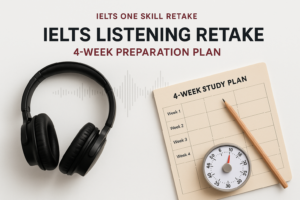
With four sections to prepare and limited time, a structured plan prevents wasted effort. Here’s a proven 4-week framework for candidates targeting “7 in each”:
- Week 1: Full diagnostic test. Identify your weakest section. Begin section-specific daily practice.
- Week 2: Deep-focus on your weakest section (2 hours/day). Maintain the other sections with 30 minutes of practice each.
- Week 3: Full practice tests under exam conditions. Review every error. Re-do weak question types.
- Week 4: Simulate full exam-day conditions. Two complete timed tests. Focus on consistency and confidence, not new learning.
Access to unlimited IELTS mock tests gives you the volume of practice needed to build the consistency this plan requires — the same material, delivered as many times as you need.
Ready to find out where you stand across all four sections?
Take the IELTS Express Pre-Test for just $4.99 and get your personalised band prediction with a 14-day improvement plan.
Frequently Asked Questions
What does “IELTS 7 each band” mean?
It means you must achieve a minimum of Band 7 in every individual section — Listening, Reading, Writing, and Speaking — not just reach a Band 7 overall average. A high score in one section cannot compensate for a low score in another. This requirement applies to many Australian skilled migration visas, some university programs, and certain professional registrations.
Which section is hardest to get Band 7 in?
For most test takers, Writing is the most difficult section to reach Band 7 in. This is because Writing is assessed on multiple subjective criteria simultaneously — Task Response, Coherence and Cohesion, Lexical Resource, and Grammar — and the difference between Band 6 and Band 7 often comes down to argument development and lexical precision, both of which require sustained practice to improve.
How long does it take to improve from Band 6 to Band 7 in each section?
With focused, targeted daily practice, most candidates improve one band in 4–12 weeks depending on the section and their starting point. Writing typically takes longer than Listening or Reading to improve because it requires developing writing habits, not just language knowledge. Candidates who practise daily and get structured feedback improve significantly faster than those who study casually.
Can I sit IELTS multiple times until I reach 7 in each?
Yes. There is no limit to how many times you can sit IELTS. Results are valid for two years from your test date. Many candidates sit two or three times before achieving “7 in each.” The key is to analyse your results from each attempt and target specific improvement areas between sittings rather than simply repeating the test without a changed preparation approach. Check the IELTS retake policy for timing rules and minimum gaps between sittings.
Is IELTS Academic or General Training required for “7 in each”?
It depends on your purpose. Skilled migration visas in Australia (such as the 189, 190, and 491 points-tested visas) typically accept either IELTS Academic or IELTS General Training, but the “7 in each” requirement applies to both versions. University admission usually requires IELTS Academic specifically. Always check the requirements of the specific visa subclass, institution, or professional body you are applying to.