










IELTS Writing Task 2 Culture and Tradition Essay Sample (2026)

Facebook
Email
WhatsApp

Culture and tradition is one of the most frequently tested topics in IELTS Writing Task 2. Whether the question asks about preserving cultural heritage, the impact of globalisation on local customs, or whether governments should fund traditional arts, you need a clear position, organised arguments, and precise academic vocabulary to score Band 7 or above.

This guide walks you through a full Band 7+ essay sample on culture and tradition, breaks down how it was written, and gives you the vocabulary and structure tools to replicate this approach in your own exam. Before you start, take the IELTS Express Pre-Test to find out your current band score — it takes just a few minutes and gives you a personalised improvement plan.

Understanding the Culture and Tradition Topic in IELTS Writing Task 2

Culture and tradition questions appear in both IELTS Academic and General Training. They test your ability to discuss abstract social issues in a balanced, reasoned way. Common question angles include:

  • Should governments spend money to preserve cultural heritage?
  • Is it inevitable that traditional ways of life will disappear due to globalisation?
  • Do young people have a responsibility to maintain cultural traditions?
  • Should foreign cultural influences be restricted to protect local customs?

These questions often ask for your opinion (agree/disagree), a discussion of both views, or a problem-solution response. The key to scoring well is not your personal knowledge of any culture — it is your ability to construct a clear argument with well-developed support.

Example Essay Question

Here is a realistic IELTS-style question you might see in the exam:

“Some people believe that it is important to preserve cultural traditions and practices. Others think that society should move on and focus on progress rather than the past. Discuss both views and give your own opinion.”

This is a discuss-both-views question. A strong response will cover both perspectives fairly, then give a clear personal position — ideally in the introduction and reinforced in the conclusion.

Band 7+ Sample Essay: Culture and Tradition

The following essay responds to the question above and targets Band 7+. Read it carefully before reviewing the analysis.

Essay response:

Cultural traditions form the foundation of a society’s identity, connecting generations through shared rituals, languages, and values. While some argue that preserving these traditions is essential, others contend that clinging to the past can slow social and economic development. In my view, both cultural preservation and progress can coexist, provided society approaches change with deliberate balance.

Those who value cultural preservation argue that traditions provide communities with a sense of belonging and continuity. Practices such as traditional music, festivals, and indigenous languages carry historical knowledge that, once lost, cannot be recovered. In Australia, for example, the revival of Aboriginal languages has demonstrated that cultural restoration strengthens community wellbeing and mental health outcomes. Governments that fund cultural preservation are therefore investing not just in heritage, but in social cohesion.

On the other hand, proponents of progress argue that blindly maintaining old customs can impede equality and economic development. Certain traditional practices — such as those that restrict women’s rights or reinforce social hierarchies — can conflict with modern values of fairness and individual freedom. Societies that cannot adapt risk stagnation, particularly in competitive global economies where innovation and flexibility are rewarded.

In my opinion, the two goals are not mutually exclusive. The most successful societies find ways to honour their heritage while embracing beneficial change. Japan offers a strong model: it has maintained cultural ceremonies, artistic traditions, and social customs alongside becoming a global leader in technology and industry. The key distinction is between preserving traditions that add value and reforming those that cause harm.

In conclusion, while both cultural preservation and progress have genuine merit, I believe a balanced approach — one that celebrates meaningful traditions while remaining open to necessary change — is the most constructive path for modern societies. Governments, communities, and individuals each have a role in deciding what to keep, adapt, and let go.

Word count: approximately 290 words

How to Structure a Culture and Tradition Essay

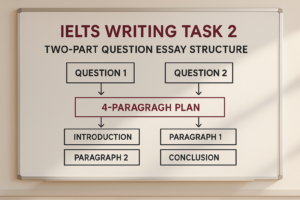
The sample essay above follows a reliable four-paragraph structure for discuss-both-views questions:

  • Introduction: Paraphrase the question, introduce both views briefly, state your opinion clearly.
  • Body Paragraph 1: Discuss the first view (preservation) with a concrete example and clear reasoning.
  • Body Paragraph 2: Discuss the second view (progress/change) with a different example and counterargument.
  • Body Paragraph 3 (or conclusion): Explain your own position and why it offers a nuanced resolution.
  • Conclusion: Summarise and restate opinion without introducing new ideas.

This structure works because it shows the examiner you can handle complexity — you are not just arguing one side, but demonstrating the maturity to weigh competing perspectives. For a deeper look at how to build this kind of argument, see the IELTS Writing Task 2 argument framework guide.

Key Vocabulary for Culture and Tradition Topics

Using precise, varied vocabulary is critical to reaching Band 7 in the Lexical Resource criterion. Here are useful word groups for culture and tradition essays:

Preservation and heritage: cultural heritage, indigenous traditions, intangible assets, oral history, ancestral customs, generational continuity, cultural identity

Change and progress: social evolution, modernisation, globalisation, cultural homogenisation, assimilation, reform, adaptation, innovation

Government and policy: publicly funded institutions, preservation initiatives, cultural subsidies, heritage legislation, national identity programmes

Nuanced opinion phrases: it is not the case that…, the extent to which…, while acknowledging that…, a more measured view would be…, the critical distinction is between…

Avoid generic phrases such as “in today’s world” or “as we all know” — these reduce your score. Instead, open body paragraphs with a position statement, then support it with specific evidence or a developed hypothetical.

Common Mistakes in Culture and Tradition Essays

Even well-prepared candidates lose marks on this topic by falling into predictable traps:

  • Taking an extreme position: Saying all traditions should be preserved, or all traditions are outdated, is too simplistic. Real Band 7+ responses acknowledge nuance.
  • Using vague cultural references: Avoid statements like “many cultures around the world believe…” without specifics. Name a country, a practice, or a real outcome.
  • Confusing the question type: A discuss-both-views question is not an agree/disagree question. You must fairly represent both views before giving your own opinion, even if briefly.
  • Repeating the same vocabulary: Use synonyms across paragraphs. “Preserve” can become “maintain,” “safeguard,” or “sustain.” “Tradition” can become “custom,” “heritage,” or “practice.”
  • Underdeveloped examples: Simply mentioning a country name is not enough. Explain how the example supports your argument — what happened, and why it matters.

If you want to see how your current writing compares to these standards, try one of our unlimited IELTS mock tests — each one includes detailed scoring feedback to help you identify exactly where to improve.

How Examiners Score Culture and Tradition Essays

IELTS Writing Task 2 is marked on four equal criteria, each worth 25% of the task score:

  • Task Response: Did you fully address the question prompt? Did you state and maintain a clear position? The sample essay above earns strong marks here because it discusses both views and gives a reasoned personal opinion throughout.
  • Coherence and Cohesion: Is the essay logically organised? Are ideas connected with appropriate linking words? Notice how the sample essay uses “on the other hand,” “in my opinion,” and “in conclusion” to guide the reader clearly through the argument.
  • Lexical Resource: Did you use a range of precise vocabulary with minimal errors? The essay uses “social cohesion,” “cultural homogenisation,” and “mutually exclusive” — not common words, but used accurately.
  • Grammatical Range and Accuracy: Did you use a range of sentence structures? The essay includes relative clauses, conditional structures, and complex noun phrases alongside simpler sentences for clarity.

A Band 7 response does not need to be perfect — but it must be consistent across all four criteria. One area of weakness (for example, poor task response despite strong vocabulary) will pull the overall score down. For a full breakdown of how bands are calculated, see the IELTS Writing Task 2 band score guide.


Ready to find out your IELTS band score?
Take the IELTS Express Pre-Test for just $4.99 and get your personalised band prediction with a 14-day improvement plan.

Take the Pre-Test Now →


Frequently Asked Questions

What band score is the culture and tradition essay sample above?

The sample essay is written to target Band 7 to 7.5. It demonstrates clear task response, logical organisation, accurate use of complex vocabulary, and varied grammar structures. It falls short of Band 8 primarily because the examples, while accurate, could be more developed with quantitative detail or research-based evidence.

How long should an IELTS Writing Task 2 essay be?

You must write at least 250 words, but most Band 7+ essays are between 270 and 320 words. Going significantly over 350 words risks time management problems and increases the chance of grammar errors. Focus on quality and clarity rather than length.

Can I use personal experience in culture and tradition essays?

IELTS Writing Task 2 expects an academic style, which means personal anecdotes are generally discouraged. Instead, refer to observable examples from countries, research findings, or hypothetical scenarios. You can express a personal opinion using phrases like “in my view” or “I believe,” but support it with reasoned argument, not personal story.

How do I improve my vocabulary for culture and tradition topics?

The most effective approach is to build a topic-specific word bank before the exam. For culture and tradition, learn synonyms for key words (preserve, tradition, heritage, society), study collocations (preserve customs, cultural identity, social cohesion), and practise using them in timed writing tasks. Reviewing model essays — like the one on this page — and noting how precise vocabulary is used in context accelerates this process significantly.

Start your IELTS Journey Today

Try everything for just $1.

Leave a comment

Your email address will not be published. Required fields are marked *

Start your IELTS Journey Today

Try everything for just $1.