










Urbanisation is one of the most common topics in IELTS Writing Task 2, and it appears across both Academic and General Training tests. Whether the question asks about the causes of rapid urban growth, the problems it creates, or solutions governments and individuals can take, the examiner wants to see one thing above all: a clear, well-supported argument presented in formal English.
This guide gives you a full Band 7+ essay sample on urbanisation, a detailed examiner breakdown, and specific strategies to strengthen your own response. If you want to know how close you already are to your target band, take the IELTS Express Pre-Test for just $4.99 and get a personalised band prediction within minutes.
Understanding the Urbanisation Question Type
Before writing a single word, spend 2–3 minutes analysing the task. IELTS Writing Task 2 urbanisation prompts typically fall into three categories:
- Problem–Solution: “Many cities are growing rapidly. What problems does this cause, and what solutions can be suggested?”
- Discuss Both Views + Opinion: “Some people believe urbanisation benefits society, while others think it creates serious issues. Discuss both views and give your own opinion.”
- Advantages and Disadvantages: “What are the advantages and disadvantages of people moving from rural areas to cities?”
Identifying the task type determines your essay structure. A problem–solution essay needs a distinct problems paragraph and a solutions paragraph. A discuss-both-views essay requires balanced coverage of two perspectives plus a clear personal stance. Mixing these up is one of the most common IELTS Writing Task 2 mistakes and can cap your band at 5.5 or 6.
Sample Question: Urbanisation Essay
In many countries, cities are expanding rapidly as more people move from rural areas to urban centres. What problems does this cause, and what measures can be taken to address them?
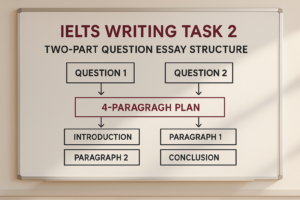
This is a classic problem–solution prompt. The model answer below targets Band 7–7.5 and uses a four-paragraph structure: introduction, problems, solutions, conclusion.
Band 7+ Sample Essay: Full Response
Rapid urbanisation has become a defining feature of modern society, as millions of people relocate from rural communities to cities each year in search of better employment, education, and living standards. While this trend fuels economic growth, it also generates significant social and environmental pressures. This essay will examine the key problems associated with urban expansion and propose realistic solutions that governments and city planners can implement.
The most serious consequence of rapid urban growth is the strain it places on infrastructure and public services. Cities that were not designed to accommodate large populations quickly face overcrowded public transport, inadequate housing, and overstretched healthcare and education systems. In many developing nations, this leads to the expansion of informal settlements or slums, where residents lack access to clean water, sanitation, and electricity. A second major issue is environmental degradation. As urban boundaries extend outward, green spaces and agricultural land are converted into residential and commercial zones. This increases carbon emissions, reduces biodiversity, and intensifies urban heat islands, making cities significantly warmer than surrounding rural areas.
Fortunately, several practical measures can address these challenges. Governments should prioritise investment in urban infrastructure before housing demand outpaces supply. This means expanding public transport networks, building affordable housing, and upgrading water and sewage systems in anticipation of population growth rather than reacting to it after the fact. Singapore and South Korea offer strong models: both nations planned transit corridors and satellite cities in advance, successfully distributing urban populations more evenly. In parallel, zoning laws and green belts can protect natural areas from overdevelopment, preserving ecological balance within and around major cities. Equally important is the need to improve conditions in rural areas. If governments invest in rural employment, digital connectivity, and regional healthcare, fewer people will feel compelled to migrate to already overcrowded cities in the first place.
In conclusion, rapid urbanisation creates serious pressure on infrastructure, housing, and the environment. However, forward-looking investment in urban planning, combined with rural development policies, can mitigate these effects. The key is proactive governance rather than reactive crisis management.
Examiner Analysis: What Makes This Essay Band 7+?
Understanding why this essay scores well is just as useful as reading it. Here is how it performs across the four IELTS marking criteria:
- Task Achievement (Band 7): Both problems (infrastructure strain and environmental degradation) are clearly identified and supported with specific detail. The solutions address each problem directly, and the response fully answers all parts of the question.
- Coherence and Cohesion (Band 7): Each paragraph has a clear central idea. Cohesive devices are used accurately (“while”, “in parallel”, “equally important”) without being repetitive. The progression from problems to solutions is logical.
- Lexical Resource (Band 7–7.5): The essay uses precise, topic-specific vocabulary: “informal settlements”, “urban heat islands”, “zoning laws”, “green belts”, “satellite cities”. Collocations are natural (“forward-looking investment”, “ecological balance”).
- Grammatical Range and Accuracy (Band 7): A mix of simple and complex sentences is used effectively. Passive constructions appear where appropriate (“were not designed”, “are converted”). Minor imperfections, if any, do not impede communication.
If you want to test your writing against this standard and get scored practice under timed conditions, access unlimited IELTS mock tests through Career Wise English.
Key Vocabulary for Urbanisation Essays
Using precise, examiners-approved vocabulary can push a Band 6 response to Band 7. Here are the most effective topic words for urbanisation essays, organised by theme:
- Urban growth: urbanisation, urban sprawl, migration, demographic shift, population density
- Problems: infrastructure strain, housing shortage, traffic congestion, inadequate sanitation, informal settlements, slum dwellings, urban heat island effect
- Solutions: urban planning, zoning regulations, green belt policy, affordable housing schemes, satellite cities, decentralisation, rural development incentives
- Environment: carbon emissions, ecological degradation, biodiversity loss, land conversion, green spaces, deforestation
Incorporate these naturally. Forced vocabulary — where a word is inserted just to seem sophisticated — is a sign examiners recognise immediately. Use each word only when it fits the sentence’s meaning. For a broader look at how vocabulary affects your score, read our guide on IELTS Writing Task 2 band score strategy.
Common Mistakes in Urbanisation Essays
Even well-prepared candidates make predictable errors on this topic. Watch out for the following:
- Listing without explaining: Writing “overcrowding, pollution, and crime” as problems without developing any of them is a Task Achievement weakness. Always explain the mechanism behind each problem.
- Generic solutions: “The government should do something” scores poorly. Examiners want specific, realistic measures — name the type of policy, give an example if possible.
- Off-topic content: If the question asks about problems and solutions, do not spend half the essay discussing the historical causes of urbanisation. Stick to the task.
- Weak conclusion: Your conclusion should summarise the argument, not introduce new ideas. One or two sentences that restate your main points and reiterate your recommendation is all that is needed.
For more patterns to avoid, see our dedicated post on IELTS Writing Task 2 common mistakes.
How to Adapt This Sample to Other Urbanisation Questions
The essay above targets a problem–solution prompt. Here is how to adapt the core content if you encounter a different question format:
- Advantages and Disadvantages: Keep the environmental degradation content as one disadvantage, add economic opportunity and improved services as advantages. Maintain balance — equal depth for both sides.
- Discuss Both Views + Opinion: Present one body paragraph for the view that urbanisation is positive (economic growth, access to services) and one for the negative view (overcrowding, inequality). Then add a third paragraph stating and defending your own position.
- Causes and Effects: Draw from the “reasons for migration” angle (rural poverty, lack of opportunity) as causes, and use infrastructure strain and environmental impact as effects.
Practising the same core content across multiple question types is an efficient study strategy. It builds confidence and reduces the time pressure you feel in the exam room.
Ready to find out your IELTS band score?
Take the IELTS Express Pre-Test for just $4.99 and get your personalised band prediction with a 14-day improvement plan.
Frequently Asked Questions
What band score does this urbanisation essay sample achieve?
The sample essay above is written at a Band 7–7.5 level. It meets the criteria for Task Achievement, Coherence and Cohesion, Lexical Resource, and Grammatical Range and Accuracy at or above the Band 7 threshold. A response of this quality requires clear, specific content rather than general statements, and no major grammatical errors that impede meaning.
Is urbanisation a common IELTS Writing Task 2 topic?
Yes, urbanisation appears regularly in both IELTS Academic and General Training. It is considered a “global issues” topic, and examiners may ask about rapid growth, rural-to-urban migration, housing shortages, infrastructure, or environmental impacts. Having a strong conceptual grasp of the topic — as well as relevant vocabulary — gives you a significant advantage.
How long should an IELTS Writing Task 2 essay be?
You must write a minimum of 250 words, and the recommended range for a strong response is 260–290 words. Writing significantly more (350+ words) rarely improves the band score and can introduce more grammatical errors. Quality and precision matter more than length.
Can I use examples from specific countries in my essay?
Yes, and it is encouraged. Referring to real-world examples — such as Singapore’s planned transit corridors or South Korea’s satellite city strategy — demonstrates knowledge and makes your argument more persuasive. You do not need to cite sources; in IELTS, general knowledge examples are acceptable and enhance your Task Achievement score.
Should I give my own opinion in a problem–solution essay?
Not necessarily. A problem–solution prompt does not ask for your personal view — it asks for problems and solutions. You may express a subtle preference in the conclusion (e.g., “the most effective approach is…”), but avoid making the essay about your personal opinion unless the question explicitly says “give your own opinion.”