









IELTS Writing Task 2 for Migration Australia: Complete Band 7 Guide (2026)

Facebook
Email
WhatsApp

If you are applying for a visa to Australia, there is a good chance that IELTS Writing Task 2 feels like the hardest part. It is an academic essay question, the time pressure is real, and the band score you need for migration is often higher than what most test-takers expect. This guide walks you through everything you need to know about IELTS Writing Task 2 for migration to Australia — the minimum scores, the essay types that come up most often, and the strategies that consistently push scores from Band 6 to Band 7.

Before diving into strategy, it is worth knowing where you actually stand right now. Take the IELTS Express Pre-Test — it takes about 10 minutes and gives you a personalised band prediction so you can plan your preparation around your real starting point.

Why Writing Task 2 Is Critical for Australian Migration

Australian migration visas processed through the Department of Home Affairs require IELTS General Training results. Most skilled migration pathways — including the subclass 189 (Skilled Independent), 190 (Skilled Nominated), and 491 (Skilled Work Regional) — require an overall Band 7, and many require Competent English, which means at least Band 6 in every component.

Writing is often the weakest section for migrants. Reading and Listening can be improved significantly with practice, but Writing requires you to produce organised, coherent arguments under time pressure — a skill that needs targeted development. A low Writing score can drag down your overall band, delay your visa, or require you to sit the test again.

Understanding what Task 2 is actually testing is the first step to fixing it.

What IELTS Writing Task 2 Tests

Task 2 is a 250-word minimum academic essay. You have 40 minutes and are given a prompt asking you to discuss a topic, present and justify an opinion, evaluate evidence, or consider arguments from multiple perspectives. The question is always general enough that no specialist knowledge is needed — but the structure, vocabulary, and argument quality are everything.

The four marking criteria are equal in weight:

  • Task Achievement (TA): Did you answer the question fully and clearly?
  • Coherence and Cohesion (CC): Is your essay logically organised with clear paragraphing?
  • Lexical Resource (LR): Did you use a wide and accurate vocabulary?
  • Grammatical Range and Accuracy (GRA): Did you use varied and correct grammar?

Most Band 6 writers struggle with Task Achievement — they write around the question rather than directly answering it. At Band 7, the argument is clear from paragraph one and every body paragraph supports the central position without going off-topic.

The Most Common Task 2 Question Types for General Training

IELTS General Training Writing Task 2 uses the same question types as Academic, but the topics lean toward social issues, everyday life, and community themes — areas that migration applicants often find easier to relate to.

Here are the main question types you will see:

  • Opinion/Agree or Disagree: “Some people think that… To what extent do you agree or disagree?” — You must take a clear position and defend it throughout the essay.
  • Discussion: “Discuss both views and give your own opinion.” — You present two perspectives, then state which you find more convincing.
  • Problem and Solution: “Why is this a problem? What solutions can you suggest?” — Two separate questions that must both be answered.
  • Advantages and Disadvantages: You assess both sides and may or may not need to give an opinion, depending on the exact wording.
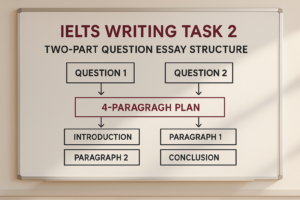
  • Two-Part Question: Rare but possible — two distinct sub-questions that both need clear answers.

For migration applicants, Opinion essays are the most common trap. Test-takers often hedge their position or write a balanced discussion when the question calls for a clear stance. This drops the Task Achievement score immediately.

Band Score Requirements for Australian Migration Visas

Different visa subclasses have different English language requirements. Here is a summary of the most common pathways:

  • Skilled migration visas (189, 190, 491): Competent English = Band 6 in all four skills. Proficient English = Band 7 in all four skills (attracts additional points).
  • Employer Sponsored visas (482, 494): Usually require Competent English (Band 6 minimum per skill).
  • Partner visas (820/801, 309/100): Functional English (Band 4.5 minimum) is the standard, but higher scores may be required for certain circumstances.
  • Permanent Residency pathway: Some streams require Superior English (Band 8 average) for additional points allocation.

For Writing Task 2 specifically, reaching Band 7 is the standard target for skilled migrants. The jump from Band 6 to Band 7 in Writing is achievable within 4–6 weeks of structured practice when you focus on Task Achievement and argument clarity first.

If you are preparing for a skilled visa, it is worth reviewing the IELTS for Migration complete guide to understand exactly which score applies to your specific visa subclass.

How to Structure a Band 7 Task 2 Essay

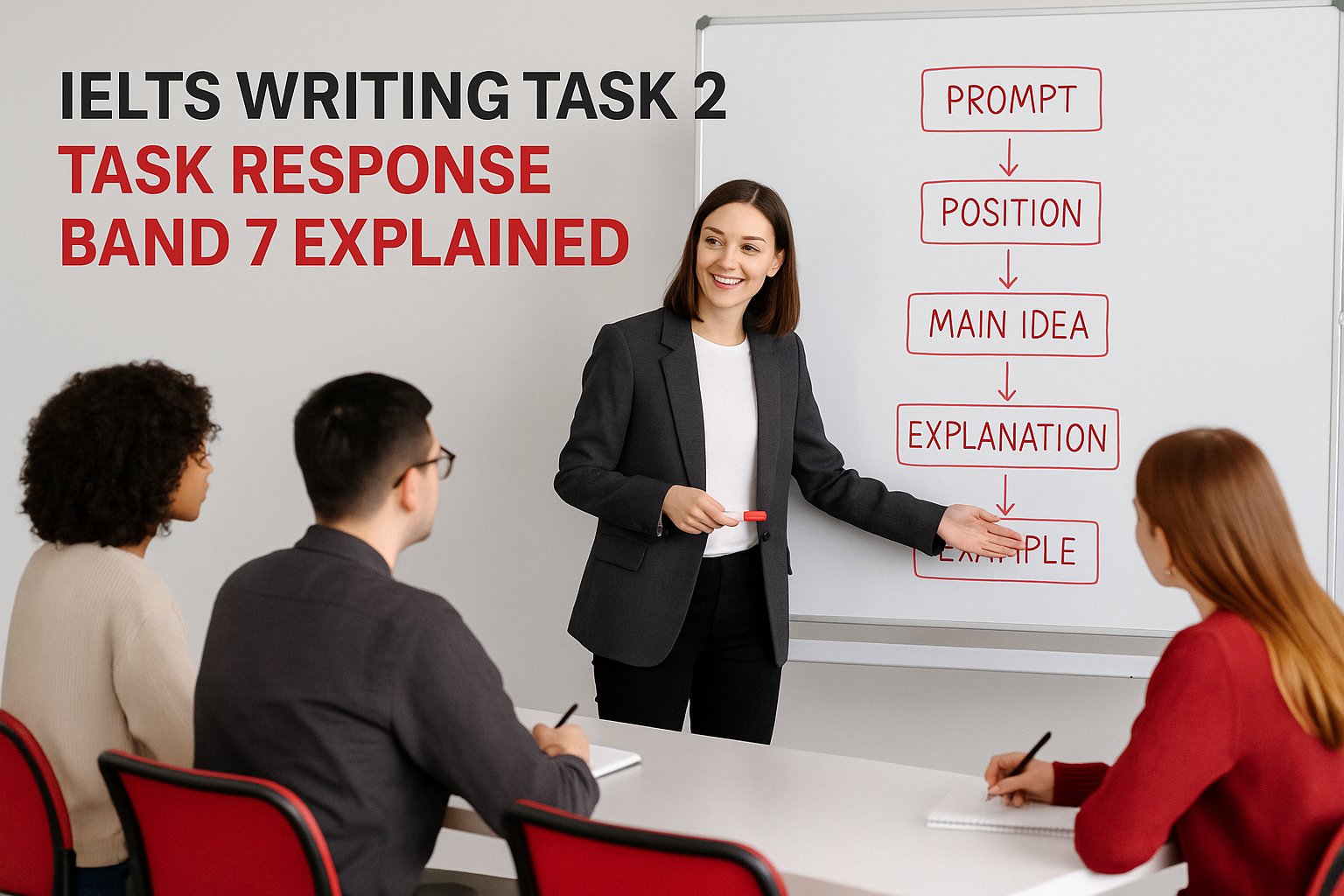
Structure is not creative — it is a formula that works, and using it consistently protects your marks under time pressure. A Band 7 essay follows this pattern:

Introduction (2–3 sentences): Paraphrase the question prompt, then give a clear thesis statement. State your position in the very last sentence of the introduction. Do not save your opinion for the conclusion.

Body Paragraph 1 (5–7 sentences): State your main supporting point. Expand with explanation. Give a specific example or evidence. Link back to the thesis. This is your strongest argument.

Body Paragraph 2 (5–7 sentences): State a second supporting point, or — for discussion essays — present the opposing view before explaining why you find your position more convincing.

Conclusion (2–3 sentences): Restate your thesis in different words. Summarise the key reasons. Do not introduce new ideas here.

One of the most common errors is writing three or four body paragraphs with very short development. Examiners want depth, not breadth. Two fully developed paragraphs score higher than four thin ones.

For a deeper breakdown of Task 2 argument structure, the IELTS Writing Task 2 practical argument framework article covers the exact paragraph logic used in Band 7 and 8 responses.

Vocabulary Strategies That Improve Your Lexical Resource Score

The Lexical Resource criterion rewards range, accuracy, and appropriateness. This does not mean using the longest or most unusual words you know — it means using words precisely and avoiding repetition.

Three tactics that consistently improve LR scores:

1. Topic-specific collocations: Instead of “do an essay”, write “complete the task” or “construct an argument”. IELTS examiners recognise natural collocation as a sign of proficiency. Learn the verbs and adjectives that naturally go with the topic nouns you practice.

2. Synonym variation for key terms: If your essay is about population growth, do not repeat “people” every sentence. Rotate between “residents”, “individuals”, “the population”, “citizens”, and “migrants” where they fit naturally. Forced synonyms (using a thesaurus blindly) actually reduce your score — only use words you understand in context.

3. Hedging language for balanced claims: Band 7 essays use phrases like “this suggests”, “there is evidence to indicate”, “it could be argued that”. These signal academic register and show vocabulary awareness beyond basic sentence patterns.

Grammar Patterns That Separate Band 6 from Band 7

At Band 6, grammar is largely accurate but limited in range. The test-taker uses safe sentence structures and avoids errors by keeping things simple. At Band 7, errors are occasional and the sentence structures are varied — mixing simple, compound, and complex sentences within the same paragraph.

Focus on these patterns to expand your grammatical range:

  • Relative clauses: “The visa applicants who sit the test without adequate preparation often underestimate the Writing component.”
  • Conditional structures: “If candidates focus on Task Achievement first, their overall band score improves faster.”
  • Passive voice for formal register: “This requirement has been introduced to ensure a consistent standard across all applicants.”
  • Participle clauses: “Having completed the pre-test, candidates are better placed to identify their specific weak areas.”

Do not try to use all of these in one essay. Aim for variety within your natural range — one or two complex structures per paragraph is enough for Band 7.

Common Task 2 Mistakes Made by Migration Applicants

Migration applicants often make specific errors that are worth knowing before your test date:

  • Over-general introductions: Starting with “In today’s modern world, many people believe…” wastes words and signals a weak argument. Start with the paraphrased topic instead.
  • Off-topic examples: Using personal migration stories as essay examples. Task 2 requires general evidence and reasoning — not personal testimony.
  • Ignoring both parts of the question: For Problem/Solution and Discussion essays, both parts must be answered. Spending 80% of your essay on one part drops Task Achievement.
  • Writing under 250 words: This is an automatic Task Achievement penalty. Aim for 260–280 words to stay safe without over-writing.
  • Weak conclusions: Ending with “In conclusion, both sides have valid points” when the question asked for your opinion is a Task Achievement failure. Restate your position clearly.

Ready to find out your IELTS band score?
Take the IELTS Express Pre-Test for just $4.99 and get your personalised band prediction with a 14-day improvement plan.

Take the Pre-Test Now →


How to Practice Task 2 Effectively Before Your Migration Test

Practice without feedback is slow. Here is a structured approach for migration applicants with a fixed test date:

Weeks 1–2: Focus on structure and Task Achievement. Write one essay per day using timed conditions (40 minutes). After writing, compare your introduction and conclusion against the question — did you fully answer what was asked?

Weeks 3–4: Focus on Lexical Resource and Grammatical Range. Review your essays for repeated words and safe grammar patterns. Replace five words per essay with a more precise or varied alternative.

Weeks 5–6: Full timed practice under test conditions. Use unlimited IELTS mock tests to simulate the real test experience, including the time pressure of completing Task 1 before Task 2.

Tracking your mock test scores over time shows you whether your Writing score is genuinely improving or plateauing — and where to adjust your focus.

Frequently Asked Questions

What band score do I need in Writing for an Australian skilled migration visa?

Most skilled migration visas require Competent English, which is a minimum Band 6 in every IELTS component including Writing. To qualify for Proficient English — which attracts additional points in the SkillSelect system — you need Band 7 in all components. Check the specific requirements for your visa subclass on the Department of Home Affairs website.

Is IELTS General Training harder than Academic for Writing Task 2?

The two versions of Task 2 use the same question types, marking criteria, and band score descriptors. The topics in General Training tend to reflect everyday social themes, while Academic topics are slightly more formal. Neither is considered harder — the marking standard is equivalent across both.

How long should my IELTS Task 2 essay be for migration?

The minimum is 250 words and there is no official maximum. Most high-scoring essays fall between 260 and 320 words. Writing significantly more than 320 words often introduces more errors and can harm your Coherence score if the extra content repeats ideas. Aim for quality within the 260–290 word range.

Can I use personal examples in my Task 2 essay?

IELTS Task 2 is an academic writing task. While you can refer to general experience or widely known examples, heavily personal examples (“When I applied for my visa…”) are not appropriate for this register. Use evidence-style framing: “In countries with high migration rates, it has been observed that…” rather than first-person personal testimony.

What is the fastest way to improve my IELTS Writing Task 2 score?

For most Band 6 writers preparing for migration, Task Achievement is the quickest win. Read the question carefully, identify exactly what it is asking, and make sure every paragraph directly supports your thesis. Structural improvements produce faster score gains than vocabulary expansion because Task Achievement and Coherence together account for 50% of the Writing mark.

How is IELTS Writing Task 2 scored differently from Task 1?

Task 2 carries twice the weight of Task 1 in the overall Writing band score. This means your Task 2 result has a much larger impact on your final Writing band. If you are running short on time during the test, prioritise finishing Task 2 over Task 1 — the marks at stake are higher.

Start your IELTS Journey Today

Try everything for just $1.

Leave a comment

Your email address will not be published. Required fields are marked *

Start your IELTS Journey Today

Try everything for just $1.