If you’ve ever stared at your IELTS results slip wondering how your raw marks turned into a band score, you’re not alone. The IELTS scoring system has its own logic — and once you understand how bands are calculated, you can start using that knowledge to hit your target. This guide breaks down exactly how the IELTS score calculator works, what the numbers mean, and how to use this system to your advantage.
Before diving in, if you’re not sure where you currently stand, the fastest way to find out is to take the IELTS Express Pre-Test — it gives you a personalised band prediction and a plan to improve from wherever you are right now.
What Is an IELTS Band Score?
IELTS uses a 9-band scale to report your English proficiency. Band 1 is the lowest (non-user) and Band 9 is the highest (expert user). Most candidates aiming for migration or university entry in Australia need scores in the Band 6–7.5 range, depending on the visa subclass or institution.
Each of the four skills — Listening, Reading, Writing, and Speaking — is scored individually. Your overall band score is then the average of the four, rounded to the nearest 0.5. It sounds straightforward, but the way raw marks convert to band scores is where things get interesting.
How Listening and Reading Scores Are Calculated
For Listening and Reading, you receive one mark for each correct answer. There is no penalty for wrong answers, so it always pays to attempt every question.
The total raw score (out of 40 for each section) is then converted to a band using a fixed conversion table. These conversions are standardised but do vary slightly between Academic and General Training formats:
- Academic Listening: 39–40 correct = Band 9; 35–36 = Band 8; 30–31 = Band 7; 23–25 = Band 6
- General Training Listening: Similar thresholds — roughly 2–3 more marks needed compared to Academic at the higher bands
- Academic Reading: 39–40 = Band 9; 37–38 = Band 8.5; 35–36 = Band 8; 30–31 = Band 7
- General Training Reading: Thresholds are higher — you need more correct answers to reach the same band level
The key takeaway: every single mark counts. Going from 29 to 30 correct in Listening could push your band from 5.5 to 6. That’s potentially the difference between getting your visa approved or reapplying.
How Writing and Speaking Scores Are Calculated
Writing and Speaking are marked by trained human examiners, not automated systems. Both sections use detailed marking criteria — four separate descriptors, each scored from 0 to 9.
Writing is divided into two tasks:
- Task 1 is weighted at one third of the Writing score
- Task 2 is weighted at two thirds
Each task is assessed against four criteria:
- Task Achievement / Task Response: Did you address the question fully?
- Coherence and Cohesion: Is your writing logically organised and easy to follow?
- Lexical Resource: Range and accuracy of vocabulary
- Grammatical Range and Accuracy: Sentence variety and grammatical control
Each criterion is equally weighted. The final Writing band is the average of all four criteria across both tasks, rounded to the nearest 0.5. This means improving even one criterion can lift your overall Writing band.
Speaking follows the same four criteria (slightly renamed) and is assessed across the three-part conversation with the examiner. Two examiners may assess your performance — the interviewer and sometimes a second examiner reviewing a recording.
How the Overall Band Score Is Calculated
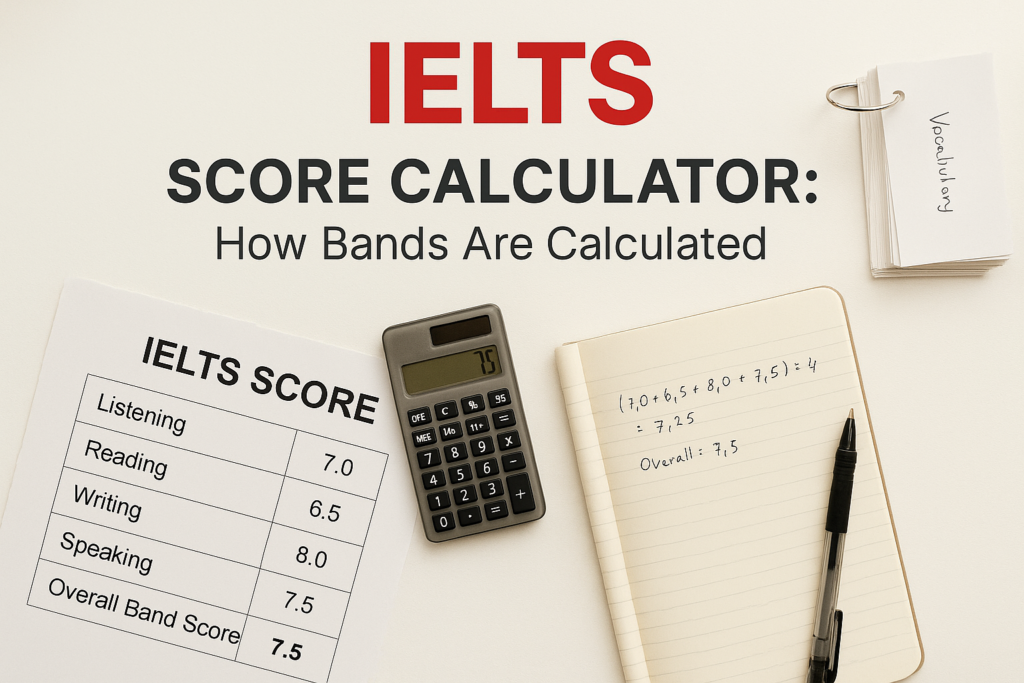
Your overall band is the average of your four section scores:
Overall Band = (Listening + Reading + Writing + Speaking) ÷ 4
The result is then rounded to the nearest whole or half band:
- .25 rounds up to .5
- .75 rounds up to the next whole number
- .125 rounds up to .25 (which then rounds to .5)
Example: If you score Listening 7.0, Reading 6.5, Writing 6.0, Speaking 6.5 — your average is 6.5. Your overall band is 6.5.
Example 2: Listening 7.0, Reading 7.5, Writing 6.0, Speaking 6.5 = 27 ÷ 4 = 6.75, which rounds up to 7.0 overall.
One band point in a single skill can shift your overall score. This is why targeted practice on your weakest skill often delivers the best return — you don’t need to be perfect everywhere, just avoid being dragged down by one section.
Minimum Score Requirements vs Overall Band
Many test takers focus only on the overall band and miss a critical detail: most Australian visa subclasses and universities require minimum scores per skill in addition to the overall band.
For example, the Temporary Skill Shortage (TSS) visa typically requires an overall band of 5.0, with minimums in each skill. But some professional registration bodies — nursing, teaching, engineering — require a 7.0 in each skill, not just overall. A candidate who scores 8.0 Listening but 6.0 Speaking will fail the requirement even if their overall band is 7.0.
Always check the specific requirements for your visa subclass or institution. Our IELTS Band Score Framework guide explains how to manage section minimums alongside your overall target.
Using an IELTS Score Calculator Practically
Online IELTS score calculators let you input raw marks for Listening and Reading to estimate your band. They’re useful for post-practice analysis — but they have real limitations:
- They can’t predict your Writing or Speaking band (human-assessed)
- Conversion tables are estimates — IELTS adjusts for test difficulty between forms
- They don’t account for section minimums in your specific requirement
A better approach: after each full practice test, note your raw scores in Listening and Reading, estimate your Writing and Speaking using the band descriptors, and track your pattern over time. Look for consistency, not just single peaks.
If you want real data on where you stand — not just a practice estimate — access our unlimited IELTS mock tests with score reporting built in. You’ll see your actual performance across all four skills with actionable feedback.
How to Close the Gap to Your Target Band
Once you understand how bands are calculated, you can reverse-engineer your study plan. Here’s how to think about it:
- Listening: You need roughly 5–6 more correct answers to move up one full band. That’s about 12–15% improvement in accuracy — achievable with targeted practice on question types where you consistently lose marks.
- Reading: Similar pattern. Identify whether you’re losing marks in True/False/Not Given or matching headings questions — then focus there.
- Writing: One weak criterion (e.g. Coherence and Cohesion at Band 5.5 while others are at 6.5) pulls the whole score down. Work on that criterion specifically.
- Speaking: Most candidates lose marks in Lexical Resource or Fluency and Coherence. Recording yourself and self-assessing against descriptors is the fastest feedback loop outside of a tutor session.
The pattern is always the same: find the specific gap, drill it, measure it. Generalised “study more” advice doesn’t move scores — targeted gap work does.
Ready to find out your IELTS band score?
Take the IELTS Express Pre-Test for just $4.99 and get your personalised band prediction with a 14-day improvement plan.
Frequently Asked Questions
How is the IELTS overall band score calculated?
Your overall band is the average of your four section scores (Listening, Reading, Writing, Speaking), divided by four and rounded to the nearest 0.5. For example, scores of 7.0, 6.5, 6.0, 6.5 average to 6.5 overall.
How many correct answers do I need for Band 7 in IELTS Listening?
For IELTS Academic Listening, you typically need around 30–31 correct answers out of 40 to achieve Band 7. For General Training, the threshold is similar. These conversions can vary slightly between test forms due to difficulty adjustments.
Can I use an IELTS score calculator to predict my Writing band?
No. Writing and Speaking are assessed by trained human examiners against four marking criteria — not raw marks. Score calculators only work for Listening and Reading. For Writing and Speaking, you need examiner feedback or self-assessment against the official band descriptors.
Does a high overall IELTS band guarantee I meet the requirements for my visa?
Not always. Many Australian visa subclasses and professional registration bodies require minimum scores in each individual skill. A high overall band with a low score in one section (e.g. Speaking 5.5) may still fail the requirement. Always check the specific section minimums for your application.
What is the difference between IELTS Academic and General Training scoring?
Listening scoring is the same for both versions. Reading scoring differs — General Training requires more correct answers to achieve the same band as Academic, because the difficulty level is adjusted. Writing and Speaking criteria are identical across both versions.
How often does IELTS update its scoring conversion tables?
IELTS does not publish a fixed conversion table. The conversion from raw score to band score is calibrated per test form to account for variations in difficulty. The published approximate tables are reliable for practice purposes, but your actual result is calculated against the specific form you sat.